Accidental Hypothermia and Frostbite
EMORBIT-CP-114 · Chapter 10 · Toxicological and Environmental Emergencies
Open in the appFree, works on your phone and offline, with every tool alongside.
Evidence base: WMS 2019; ERC 2021
1Purpose
1.1 Standardize recognition and staging of accidental hypothermia in the Emergency Department (ED), including in patients without an obvious cold-exposure history (elderly indoor collapse, sepsis, intoxication).
1.2 Standardize gentle handling and rewarming by severity, and align cardiac arrest management with EMORBIT-CP-03 exactly.
1.3 Standardize recognition and rewarming of frostbite, and define when thrombolysis and extracorporeal life support (ECLS) are referred rather than delivered in the ED.
1.4 Align ED practice with the WMS 2019 hypothermia and frostbite guidelines, the 2022 international accidental-hypothermia update, and ERC 2021.
2Who this protocol applies to
2.1 Any patient with a measured or suspected core temperature below 35 °C from cold-water immersion, prolonged outdoor or mountain exposure, or an elderly patient found collapsed indoors.
2.2 Any patient with a frostbite injury (cold-water immersion, high-altitude or desert-night exposure, contact with a cold surface or refrigerant/cryogen).
2.3 Cardiac arrest with a history of cold exposure or a measured core temperature below 35 °C.
2.4 A hypothermic patient with a coexisting condition that must be actively sought: trauma (EMORBIT-CP-19), drowning (EMORBIT-CP-115), sepsis, hypoglycaemia, intoxication, or hypothyroidism/myxedema (EMORBIT-CP-104).
3Not covered by this protocol
3.1 Fever and heat-related illness, governed by EMORBIT-CP-23.
3.2 Definitive surgical and plastic-surgery management of established frostbite tissue loss, which is a referral from the ED, not delivered in the ED.
3.3 Selection of an antiarrhythmic, vasopressor, or arrest drug regimen, which follows EMORBIT-CP-03 and EMORBIT-CP-39 exactly and is not restated here.
3.4 Trauma resuscitation itself, governed by EMORBIT-CP-19; this guideline covers the hypothermia component in a trauma patient only.
4Protocol
4.1History and Assessment:
4.1.1Triage and Recognition:
4.1.1.1 Suspect hypothermia in any cold-exposed, immersion, or found-down patient, and in any elderly patient found collapsed indoors in a cold house, even without a history of outdoor exposure.
4.1.1.2 Handle every hypothermic patient gently: minimise movement, keep horizontal, avoid rough transfers or exertion. Rough handling or sudden movement can precipitate ventricular fibrillation in a cold heart.
4.1.1.3 Remove wet clothing, insulate with dry blankets and a vapour barrier, and move the patient to a warm environment at triage.
4.1.1.4 Triage a suspected frostbite to standard acuity unless a life threat coexists; treat any coexisting hypothermia first (section 4.3.1).
4.1.2History:
4.1.2.1 Duration and type of exposure (immersion, ambient cold, altitude), time last seen normal, alcohol or sedative use, and any trauma, drowning, or avalanche mechanism.
4.1.2.2 For frostbite: exposed tissue, duration, any prior thaw-refreeze cycle, and contact with a cold surface or cryogen.
4.1.2.3 Pre-existing endocrine, cardiac, or psychiatric disease; medications that impair thermoregulation; and, in the elderly, home heating, mobility, and cognitive status.
4.1.3Examination:
4.1.3.1 Measure core temperature with a low-reading thermometer (oesophageal, bladder, or rectal); a standard thermometer does not read low enough to confirm or exclude severe hypothermia.
4.1.3.2 Stage clinically by consciousness and shivering (Attachment 2, Table 1); do not wait for a core temperature reading before starting treatment.
4.1.3.3 Cardiac monitoring for bradyarrhythmia and J (Osborn) waves; assess for a pulse and breathing for up to one minute before concluding cardiac arrest (as for any suspected arrest).
4.1.3.4 Examine frostbitten tissue for colour, sensation, and blister character only after rewarming (section 4.3.2); do not grade a frozen or partly frozen part before rewarming.
4.1.4Risk Stratification and Severity:
4.1.4.1Swiss staging (clinical, core temperature is a guide only — Attachment 2, Table 1): HT I conscious and shivering; HT II impaired consciousness, not shivering; HT III unconscious, vital signs present; HT IV no vital signs (apparent death, may be salvageable); HT V death confirmed only after rewarming fails or a lethal cause is evident.
4.1.4.2 Afterdrop — core temperature can continue to fall for a period after removal from cold exposure and after rewarming starts, as cold peripheral blood returns to the core: anticipate it, do not stop monitoring at the point of rescue.
4.1.5Differential Diagnosis:
4.1.5.1 Sepsis, hypoglycaemia, intoxication (alcohol, sedatives), stroke, and hypothyroidism/myxedema coma (EMORBIT-CP-104) can present as, or coexist with, hypothermia; actively exclude them, do not assume cold exposure explains reduced consciousness alone.
4.1.5.2 Trauma and drowning as a cause of, or found alongside, hypothermia (EMORBIT-CP-19, EMORBIT-CP-115).
4.1.6Special Populations:
4.1.6.1 Elderly found collapsed indoors: often no dramatic exposure history; screen for sepsis, hypothyroidism, immobility, medication effect, and a home-safety concern before discharge (section 4.3.7).
4.1.6.2 Children: lose heat faster than adults for the same exposure; stage and rewarm on the same principles, with paediatric input for active internal rewarming and arrest.
4.1.6.3 Trauma and drowning: treat time-critical injury or airway/breathing per EMORBIT-CP-19 and EMORBIT-CP-115 in parallel with rewarming; hypothermia worsens coagulopathy and must not be overlooked in a bleeding trauma patient.
4.2Investigations:
4.2.1 Core temperature by low-reading thermometer, repeated during rewarming; venous or arterial blood gas — interpret at the measured (uncorrected) value, do not temperature-correct.
4.2.2 12-lead ECG (bradyarrhythmia, prolonged intervals, J/Osborn waves); glucose; serum potassium — a markedly elevated level (above 12 mmol/L) in cardiac arrest is one basis for not attempting rewarming (section 4.3.3, matches EMORBIT-CP-03).
4.2.3 Coagulation screen and full blood count (hypothermic coagulopathy can occur despite a normal international normalised ratio, as cold impairs enzyme function that standard assays run at 37 °C do not detect); creatine kinase if prolonged immobility is possible.
4.2.4 Investigate for a precipitating or coexisting cause: septic screen, thyroid function (EMORBIT-CP-104), and imaging directed by trauma or drowning mechanism (EMORBIT-CP-19, EMORBIT-CP-115).
4.2.5 No investigation shall delay removal from cold, insulation, or the start of rewarming.
4.3Plan of Care:
4.3.1Immediate Actions:
4.3.1.1 Remove from the cold environment and remove wet clothing; insulate with dry blankets and a vapour/wind barrier; keep horizontal.
4.3.1.2 Handle gently throughout — avoid rough movement, jostling, or unnecessary exertion by the patient, which can precipitate ventricular fibrillation.
4.3.1.3 Warm humidified oxygen if hypoxaemic; continuous cardiac monitoring; if airway management is needed, proceed without delay (EMORBIT-CP-31) — do not withhold a needed airway intervention for a theoretical arrhythmia risk, but perform it gently.
4.3.2Definitive ED Treatment:
4.3.2.1Rewarming by stage (Attachment 2, Table 1): HT I — passive external rewarming (dry insulation, warm environment, warm sweet oral fluids if fully conscious and able to protect the airway); ambulation permitted only in confirmed HT I. HT II — active external rewarming (forced-air warming blanket, chemical heat packs to the trunk, not the limbs); keep horizontal, avoid mobilisation. HT III — active external plus active internal rewarming (warmed humidified oxygen, warmed IV crystalloid at 38–42 °C); continuous cardiac monitoring; refer for extracorporeal rewarming if unstable or refractory. HT IV — see cardiac arrest below.
4.3.2.2 Use warmed normal saline rather than a lactate-containing crystalloid in significant hypothermia; lactate clearance is impaired.
4.3.2.3 Most bradyarrhythmias correct with rewarming alone: do not give antiarrhythmics or attempt pacing for a non-malignant bradyarrhythmia below approximately 30 °C — treat only a malignant or peri-arrest rhythm before rewarming is complete, per EMORBIT-CP-39.
4.3.2.4Frostbite: rapid rewarming in circulating water at 37–39 °C until the distal tissue is soft and flushed (roughly 15–30 minutes); do not rewarm if there is a risk of refreezing; do not rub or massage the tissue; do not use dry heat (stove, fire, heater). Give opioid analgesia before and during rewarming — the process is painful. Leave clear blisters intact where possible; do not debride a haemorrhagic blister in the ED. Elevate and splint the affected part with loose, non-constrictive dressings; avoid tobacco and other vasoconstrictors.
4.3.2.5 Treat a coexisting hypothermia in a frostbite patient first, unless the frostbite itself is immediately life-threatening (it is not).
4.3.3Escalation and Refractory Features:
4.3.3.1Cardiac arrest with hypothermia — match EMORBIT-CP-03 exactly: withhold adrenaline and other drugs until the core temperature is 30 °C or above; between 30 °C and 35 °C, double the drug intervals; limit defibrillation to three shocks until the core temperature reaches 30 °C. Continue CPR during active rewarming and refer for extracorporeal rewarming; a patient is not declared dead until they are warm (or a decision is made on the basis of a lethal injury, an obviously fatal cause, or a serum potassium above 12 mmol/L).
4.3.3.2 Refer early for extracorporeal life support (ECMO/ECLS) rewarming in cardiac arrest, refractory arrhythmia, or haemodynamic instability at HT III/IV. Where ECMO/ECLS is not available on site, arrange transfer through the hospital's referral pathway.
4.3.3.3 Severe deep frostbite presenting within 24 hours of injury: thrombolysis is a specialist decision, not an ED-initiated treatment, and depends on interventional radiology/vascular capability and perfusion imaging. Access to thrombolysis for frostbite follows the hospital's vascular and interventional radiology pathway.
4.3.4Monitoring and Reassessment:
4.3.4.1 Continuous core temperature during active rewarming; anticipate afterdrop and do not stop monitoring once removal from cold is complete.
4.3.4.2 Continuous cardiac monitoring until the core temperature is normal and the rhythm is stable; recheck glucose, potassium, and coagulation as clinically indicated.
4.3.4.3 Reassess frostbitten tissue after rewarming is complete (not before) to determine depth and plan referral.
4.3.5Disposition:
4.3.5.1 Discharge: confirmed HT I only, fully rewarmed, alert, precipitating cause addressed, no coexisting injury or illness, and a safe environment to return to confirmed (section 4.3.7).
4.3.5.2 Admit: HT II or above, any arrhythmia during rewarming, coexisting injury/illness, or a frostbite requiring elevation, analgesia, or specialist follow-up.
4.3.5.3 Critical Care: HT III/IV, any arrest, haemodynamic instability, or a patient referred for extracorporeal rewarming.
4.3.5.4 Refer: deep frostbite (vascular/plastic surgery or the regional referral centre for possible thrombolysis, per section 4.3.3), and any HT III/IV or arrest for ECMO/ECLS discussion.
4.3.6Discharge and Follow-up:
4.3.6.1 For an elderly patient found collapsed indoors: address the home-safety and heating concern before discharge and involve social/community support; do not discharge back to an unsafe cold environment.
4.3.6.2 Arrange plastic surgery or vascular follow-up for any frostbite beyond the most minor injury; warn that final tissue demarcation can take weeks and that early amputation is avoided outside wet gangrene or sepsis.
4.3.6.3 Safety-net advice: return for increasing pain, spreading discolouration, or fever in a frostbite injury; return for confusion, chest pain, or collapse after a hypothermia episode.
4.3.7Documentation and Reporting:
4.3.7.1 Record: core temperature trend and method, Swiss stage, rewarming method(s), cause identified, and time of any arrest interventions against EMORBIT-CP-03 targets.
4.3.7.2 Record frostbite site, initial and post-rewarming appearance, analgesia given, and referral made.
4.3.7.3 Report any death not meeting the "warm and dead" criteria before pronouncement, and any delay to rewarming, through the local incident reporting system.
5Algorithm
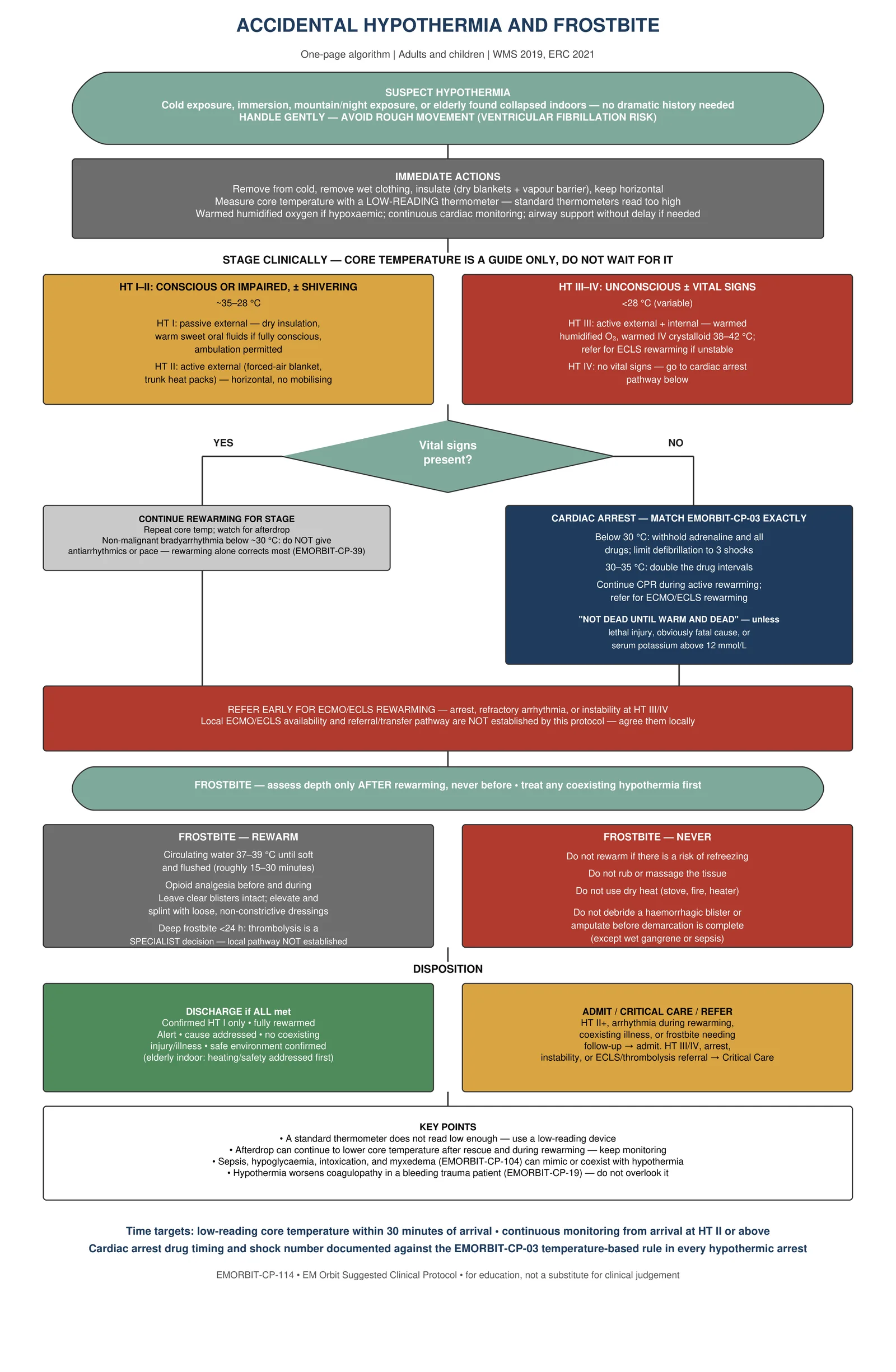
The one-page algorithm is shown at the top of this page.
6Team roles
6.1Triage/ED Nurse:
6.1.1 Recognise the found-down or cold-exposed patient, remove wet clothing, insulate, and handle gently from first contact; measure temperature with a low-reading device.
6.2ED Pharmacist:
6.2.1 Confirm availability of warmed IV fluid and opioid analgesia for frostbite rewarming; advise on drug timing/dosing intervals during active rewarming per EMORBIT-CP-03/39.
6.3Critical Care / Anaesthesia:
6.3.1 Attend for HT III/IV, arrest, or haemodynamic instability; lead the ECMO/ECLS referral discussion; accept ICU admissions meeting section 4.3.5 criteria.
6.4Vascular / Plastic Surgery:
6.4.1 Advise on and, where the pathway is confirmed, deliver thrombolysis for severe deep frostbite; provide follow-up for tissue-loss risk.
6.5Endocrinology:
6.5.1 Review where myxedema coma cannot be excluded as a cause of hypothermia (EMORBIT-CP-104).
6.6Laboratory:
6.6.1 Process gas, electrolytes, coagulation, and creatine kinase urgently and report critical results (especially potassium) to the treating team by telephone.
6.7Social Work / Community Support:
6.7.1 Assess home heating and safety for an elderly patient found hypothermic indoors before discharge.
7The patient's role
7.1 Report the exposure history and any prior frostbite or cold injury.
7.2 Keep the affected limb elevated and undisturbed after frostbite rewarming, and attend arranged follow-up.
7.3 Return for worsening pain, colour change, fever, confusion, or chest pain after discharge.
8Definitions
8.1Accidental Hypothermia: an unintentional fall in core body temperature below 35 °C.
8.2Swiss Staging (HT I–V): a clinical staging system for accidental hypothermia by consciousness and shivering, supported where available by core temperature (Attachment 2, Table 1).
8.3Afterdrop: a continued fall in core temperature after removal from cold exposure or after rewarming starts, from return of cold peripheral blood to the core.
8.4Frostbite: localised tissue freezing from cold exposure; severity is assessed only after rewarming is complete.
8.5Extracorporeal Life Support (ECLS) / ECMO: mechanical circulatory support capable of rewarming blood directly; a referral or transfer decision, not delivered in the ED.
9Attachments
- Attachment 1: One-page algorithm (top of this page)
- Attachment 2: Swiss Staging/Rewarming and Frostbite Quick Reference
11Suggested quality indicators
11.1Core temperature measured with a low-reading device: (Number of suspected hypothermia patients with a low-reading core temperature recorded within 30 minutes of arrival / Total number of such patients) × 100. Target ≥ 90%.
11.2Gentle-handling and monitoring compliance: (Number of HT II or above patients with continuous cardiac monitoring documented from arrival / Total number of such patients) × 100. Target ≥ 95%.
11.3Cardiac arrest management matches EMORBIT-CP-03: (Number of hypothermic cardiac arrests with drug timing and shock number documented against the temperature-based rule / Total number of such arrests) × 100. Target 100%.
11.4Safe frostbite rewarming: (Number of frostbite patients rewarmed in water at the specified temperature range with analgesia documented / Total number of frostbite patients rewarmed in the ED) × 100. Target ≥ 95%.
11.5Outcome indicator (monitored, no fixed ED target): survival to hospital discharge after hypothermic cardiac arrest, and tissue-loss rate after frostbite at surgical follow-up.
13References
- Dow J, Giesbrecht GG, Danzl DF, et al. Wilderness Medical Society Clinical Practice Guidelines for the Out-of-Hospital Evaluation and Treatment of Accidental Hypothermia: 2019 Update. Wilderness Environ Med. 2019;30(4S):S47–S69.
- McIntosh SE, Freer L, Grissom CK, et al. Wilderness Medical Society Clinical Practice Guidelines for the Prevention and Treatment of Frostbite: 2019 Update. Wilderness Environ Med. 2019;30(4S):S19–S32.
- Paal P, Pasquier M, Darocha T, et al. Accidental Hypothermia: 2021 Update. Int J Environ Res Public Health. 2022;19(1):501.
- Lott C, Truhlar A, Alfonzo A, et al. European Resuscitation Council Guidelines 2021: Cardiac arrest in special circumstances. Resuscitation. 2021;161:152–219.
A2Attachment 2: Swiss Staging/Rewarming and Frostbite Quick Reference
| Stage | Clinical features | Core temp (guide) | Rewarming |
|---|---|---|---|
| HT I | Conscious, shivering | ~35–32 °C | Passive external; warm sweet oral fluids if able to protect airway; ambulation permitted |
| HT II | Impaired consciousness, not shivering | ~32–28 °C | Active external (forced-air blanket, trunk heat packs); keep horizontal, no mobilisation |
| HT III | Unconscious, vital signs present | ~28–24 °C | Active external + active internal (warmed O₂, warmed IV crystalloid 38–42 °C); refer for ECLS if unstable |
| HT IV | No vital signs (apparent death) | <24 °C (variable) | CPR per EMORBIT-CP-03 temperature-based rule; refer for ECMO/ECLS rewarming |
Stage clinically; do not wait for a core temperature reading before starting treatment.
| Do this |
|---|
| Rewarm in circulating water at 37–39 °C until soft and flushed (roughly 15–30 minutes) |
| Give opioid analgesia before and during rewarming |
| Leave clear blisters intact; elevate and splint with loose, non-constrictive dressings |
| Do not |
|---|
| Do not rewarm if there is a risk of refreezing |
| Do not rub or massage the tissue |
| Do not use dry heat (stove, fire, heater) |
| Do not grade depth, debride a haemorrhagic blister, or amputate before rewarming and demarcation are complete (outside wet gangrene or sepsis) |