Thyroid Storm and Myxoedema Coma in the Emergency Department
EMORBIT-CP-104 · Chapter 6 · Endocrine and Metabolic Emergencies
Open in the appFree, works on your phone and offline, with every tool alongside.
Evidence base: ATA 2016; JTA
1Purpose
1.1 Standardize the recognition and immediate treatment of both life-threatening extremes of thyroid dysfunction — thyroid storm and myxoedema coma — in the Emergency Department (ED).
1.2 Fix the treatment sequence for each: for thyroid storm, beta-blocker first, then the thionamide, then iodine at least one hour later, with steroid and cooling alongside; for myxoedema coma, hydrocortisone before any thyroid hormone. A step out of sequence can worsen either crisis.
1.3 Match hydrocortisone dosing exactly to EMORBIT-CP-51 (Adrenal Crisis) in both conditions, and align beta-blocker/rate-control doses with EMORBIT-CP-38 (Tachyarrhythmias) where an infusion is used.
1.4 Align practice with the American Thyroid Association (ATA) 2016 and Japan Thyroid Association 2016 guidance on thyroid storm, and with the published approach to myxoedema coma.
2Who this protocol applies to
2.1 Any patient with known or newly suspected hyperthyroidism (Graves' disease, toxic nodular goitre, thyroiditis, or excess thyroid hormone intake) presenting with fever, marked tachycardia or a tachyarrhythmia, agitation, delirium, psychosis, seizure, coma, vomiting, diarrhoea, or unexplained jaundice, particularly with a precipitating infection, surgery, trauma, childbirth, iodinated contrast load, or a stopped or missed antithyroid drug.
2.2 Any patient with known or newly suspected hypothyroidism presenting with hypothermia, bradycardia, hypoventilation, reduced consciousness or coma, hyponatraemia, or hypoglycaemia, particularly an elderly patient with a precipitating illness, cold exposure, sedative or opioid use, or a stopped thyroid replacement.
2.3 Children with a thyroid-disease history, or a neonate of a mother with Graves' disease, presenting with the features above.
3Not covered by this protocol
3.1 Uncomplicated hyperthyroidism or hypothyroidism with none of the crisis features above: refer to routine Endocrinology outpatient titration, not this guideline.
3.2 Fever from a confirmed alternative cause, with a coincidental history of thyroid disease and no cardiovascular or neurological feature of storm: manage under the sepsis pathway (EMORBIT-CP-11), send thyroid function, and inform Endocrinology.
3.3 Altered mental status from a confirmed alternative cause: manage under EMORBIT-CP-46; this guideline supplies its myxoedema coma / thyroid storm differential row and is not a competing pathway.
3.4 Hypothermia from environmental exposure with no thyroid disease: manage under EMORBIT-CP-114 (Accidental Hypothermia).
4Protocol
4.1History and Assessment:
4.1.1Triage and Recognition:
4.1.1.1 Fever with marked tachycardia or agitation, OR hypothermia with reduced consciousness, in a patient with known or suspected thyroid disease, is triaged to the highest acuity category and an ED physician attends within 5 minutes.
4.1.1.2 Diagnosis is clinical: treatment shall never be delayed for a thyroid-function result.
4.1.2History:
4.1.2.1 Known thyroid diagnosis and treatment, adherence, and time of last dose taken.
4.1.2.2 Precipitants sought actively: infection, recent iodinated contrast or amiodarone, surgery, trauma, childbirth, sedative or opioid use, cold exposure, a discontinued thyroid replacement, or a stopped/missed antithyroid drug.
4.1.3Examination:
4.1.3.1 ABCDE with temperature at both extremes; goitre, eye signs, tremor, skin (warm and moist versus dry and cool), reflexes, a thyroidectomy scar, level of consciousness, and a cardiovascular examination for arrhythmia or failure.
4.1.4Risk Stratification – Severity:
4.1.4.1 The Burch-Wartofsky Point Scale (Attachment 3) supports the diagnosis of thyroid storm; it does not gate treatment, which starts on the clinical picture.
4.1.4.2 Myxoedema coma is a clinical diagnosis — hypothermia, reduced consciousness, and a precipitant, in confirmed or strongly suspected hypothyroidism; no validated equivalent scoring system is in routine clinical use.
4.1.5Differential Diagnosis:
4.1.5.1 Altered mental status from another cause (EMORBIT-CP-46, myxoedema coma/thyroid storm differential row — point to it, do not restate it).
4.1.5.2 Sepsis (EMORBIT-CP-11); heat illness (EMORBIT-CP-23) or accidental hypothermia (EMORBIT-CP-114) without thyroid disease; sympathomimetic toxicity or serotonin syndrome (tachycardia, agitation, hyperthermia) managed under the poisoned-patient guideline where suspected; coexisting adrenal crisis (EMORBIT-CP-51).
4.1.6Special Populations:
4.1.6.1 Children: thyroid storm and myxoedema coma are rare; use the weight-based doses in Attachment 2, all confirmed by Clinical Pharmacy before use.
4.1.6.2 Pregnancy: thyroid storm may be precipitated by hyperemesis or labour; treat without delay and involve Obstetrics and Endocrinology together.
4.1.6.3 Elderly patients: myxoedema coma classically presents in an elderly woman in winter and may look atypically mild — a normal-looking heart rate can mask significant illness against a bradycardic baseline.
4.2Investigations:
4.2.1 No investigation shall delay treatment. Send free T4, free T3 and TSH immediately but do not wait for the result before treating the clinical picture.
4.2.2 Capillary and laboratory glucose, urea and electrolytes (including sodium), full blood count, cortisol (before hydrocortisone if it adds no delay), blood cultures and a septic screen where infection is suspected (EMORBIT-CP-11), and a 12-lead electrocardiogram.
4.3Plan of Care:
4.3.1Immediate Actions (first 5–15 minutes):
4.3.1.1 Call for senior help for any patient meeting the crisis criteria in section 2; ABCDE; IV access; continuous ECG, SpO₂ and temperature monitoring; capillary glucose immediately; catheterise for hourly urine output.
4.3.2Definitive ED Treatment — Thyroid Storm: give the drugs in the strict order set out in Table 1, Attachment 2.
Table 1: Thyroid storm — treatment in strict order (adult and child) Step Adult Child 1. Beta-blockade — first Propranolol 60–80 mg PO/NG every 4 hours, or 0.5–1 mg IV slow, repeated to response. Esmolol infusion (loading 500 micrograms/kg IV, then 50–200 micrograms/kg/minute — EMORBIT-CP-38 dose) if bronchospasm risk or reversibility is needed. 0.5–1 mg/kg/day PO divided every 6 hours — check against the product information. 2. Thionamide — next Propylthiouracil 500–1000 mg loading PO/NG, then 250 mg every 4 hours (preferred — also blocks peripheral T4→T3 conversion). Methimazole 20 mg every 4–6 hours only if propylthiouracil is not stocked. Propylthiouracil 5–7 mg/kg/day divided every 6–8 hours, or methimazole 0.4–0.7 mg/kg/day divided — check against the product information. 3. Iodine — at least 1 hour AFTER the thionamide, never before Potassium iodide (SSKI) 5 drops every 6 hours, or Lugol's iodine 8 drops every 6–8 hours — where stocked. Weight-based, endocrinology-directed; where stocked. 4. Hydrocortisone 100 mg IV (IM if no IV access) first dose, then 100 mg IV every 6 hours or infusion 200 mg/24 h (doses match EMORBIT-CP-51 exactly). Child 6–12 years: 50 mg IV/IM. Child under 6 years: 25 mg IV/IM (EMORBIT-CP-51 exactly). 5. Cooling and antipyretic Active cooling (evaporative/ice packs as EMORBIT-CP-23). Paracetamol only — aspirin is never used: it displaces thyroid hormone from binding globulin and worsens the crisis. Same principle; paediatric paracetamol dosed by weight. 6. Treat the precipitant Identify and treat infection, diabetic ketoacidosis, acute coronary syndrome, trauma, surgery, or childbirth in parallel with the above. Same principle. Give the beta-blocker first, the thionamide next, and the iodine preparation at least 1 hour after the first thionamide dose: iodine given first supplies substrate for new hormone synthesis and worsens the storm. The Burch-Wartofsky score (Attachment 3) supports the diagnosis; it does not gate treatment, which starts on the clinical picture. All doses in this table require Clinical Pharmacy verification before use.
4.3.3Definitive ED Treatment — Myxoedema Coma: give the drugs in the strict order set out in Table 2, Attachment 2.
Table 2: Myxoedema coma — treatment in strict order (adult and child) Step Adult Child 1. Hydrocortisone — BEFORE any thyroid hormone 100 mg IV (IM if no IV access) first dose, then 100 mg IV every 6 hours or infusion 200 mg/24 h (doses match EMORBIT-CP-51 exactly). Child 6–12 years: 50 mg IV/IM. Child under 6 years: 25 mg IV/IM (EMORBIT-CP-51 exactly). 2. Thyroid hormone — after hydrocortisone IV levothyroxine loading 200–400 micrograms once, then 50–100 micrograms IV or oral/NG once daily. Use the IV preparation where available. Not established in children — endocrinology-directed. 3. Rewarming Passive external rewarming only (blankets), as for accidental hypothermia (EMORBIT-CP-114). Active or rapid rewarming is never used — it causes peripheral vasodilatation and cardiovascular collapse. Same principle. 4. Glucose and ventilation Correct glucose below 4.0 mmol/L (EMORBIT-CP-49). Consider early ventilatory support or intubation for hypoventilation and carbon dioxide retention. Same principle; weight-based glucose dose per EMORBIT-CP-49. 5. Precipitant and cautions Search for infection (may be present without fever), a discontinued thyroid replacement, sedative or opioid use, and cold exposure. Avoid sedatives and opioids — clearance is delayed. Same principle. Give hydrocortisone before any thyroid hormone in every case: thyroid hormone alone can unmask coexisting adrenal insufficiency and precipitate adrenal crisis (EMORBIT-CP-51). Correct significant hyponatraemia cautiously and involve endocrinology and critical care early. All doses in this table require Clinical Pharmacy verification before use.
4.3.4Escalation – Refractory:
4.3.4.1 No improvement in heart rate, temperature or mental status within 1 hour of storm treatment, or persisting hypotension or bradycardia in myxoedema coma despite treatment: call the senior ED physician and critical care immediately, and reconsider the diagnosis and the precipitant.
4.3.4.2 Therapeutic plasma exchange and emergency thyroidectomy are tertiary-centre rescue options for refractory storm.
4.3.5Monitoring and Reassessment:
4.3.5.1 Continuous ECG, temperature and conscious-level monitoring; vital signs at least hourly until stable; recheck glucose and electrolytes per EMORBIT-CP-49 and local practice.
4.3.6Disposition:
4.3.6.1 ICU/HDU: confirmed thyroid storm (Burch-Wartofsky ≥ 45) or myxoedema coma — mandatory in every case.
4.3.6.2 Monitored ward bed: impending storm (Burch-Wartofsky 25–44), or mild myxoedema features without coma, with treatment started and vital signs stable.
4.3.6.3 Discharge: thyroid dysfunction with no crisis feature in section 2, tolerating oral treatment, with safe Endocrinology follow-up arranged.
4.3.7Discharge and Follow-up (non-crisis only):
4.3.7.1 Confirm oral antithyroid or thyroid-replacement adherence, arrange Endocrinology follow-up, and give safety-net return advice for fever, palpitations, worsening confusion, or reduced level of consciousness.
4.3.8Documentation and Reporting:
4.3.8.1 Document the time of recognition, the time and dose of every drug given — with particular care to record the interval between the first thionamide dose and any iodine, and the interval between hydrocortisone and any thyroid hormone — the Burch-Wartofsky score where calculated, response, and disposition.
4.3.8.2 Capture crisis presentations for departmental audit (section 11).
5Algorithm
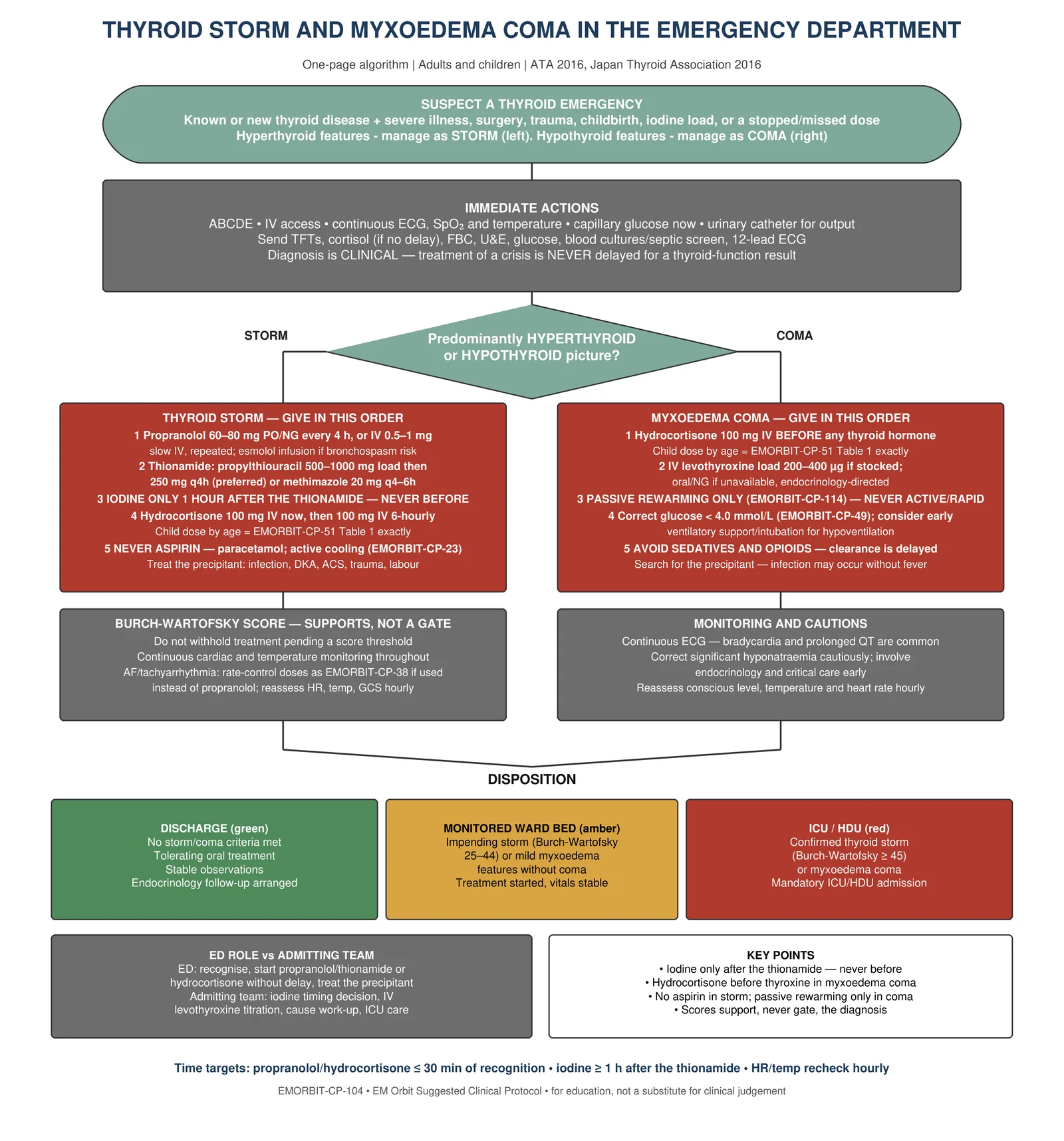
The one-page algorithm is shown at the top of this page.
6Team roles
6.1Triage / ED Nurse:
6.1.1 Recognize a fever with marked tachycardia/agitation or a hypothermia with reduced consciousness in a patient with thyroid disease, escalate to the highest acuity category, and record the time of every drug given.
6.2Pharmacist:
6.2.1 Confirm the local formulary position for propylthiouracil, methimazole, potassium iodide/Lugol's iodine, and IV levothyroxine before use, and verify every dose against Table 1 and Table 2 (Attachment 2).
6.3Endocrinology:
6.3.1 Review every case, direct ongoing thionamide and levothyroxine titration, and arrange the cause work-up and long-term plan.
6.4Laboratory Staff:
6.4.1 Process thyroid function, cortisol and electrolyte samples urgently and flag a critical result to the treating team without delay.
6.5Ambulance / Pre-hospital Providers:
6.5.1 Pre-alert the ED for any patient with suspected thyroid storm or myxoedema coma and hand over the time and dose of any treatment already given.
7The patient's role
7.1 Take thyroid medication as prescribed and never stop it without medical advice.
7.2 Seek urgent care for fever with palpitations, worsening confusion, or reduced level of consciousness.
7.3 Attend the arranged Endocrinology follow-up appointment.
8Definitions
8.1Thyroid Storm: a life-threatening exaggeration of thyrotoxicosis with multi-organ decompensation — fever, tachyarrhythmia, central nervous system and gastrointestinal/hepatic dysfunction — usually with an identifiable precipitant (Burch and Wartofsky, 1993; Ross et al., 2016).
8.2Myxoedema Coma: the decompensated extreme of severe hypothyroidism, with hypothermia, reduced consciousness, and a precipitating illness, usually in an elderly patient with long-standing untreated or undertreated hypothyroidism.
8.3Burch-Wartofsky Point Scale: a weighted clinical scoring system (Table 3, Attachment 3) that supports, but does not gate, the diagnosis of thyroid storm.
8.4Thionamide: an antithyroid drug (propylthiouracil or methimazole) that blocks new thyroid hormone synthesis; propylthiouracil additionally blocks peripheral conversion of T4 to T3.
9Attachments
- Attachment 1: One-page algorithm (top of this page)
- Attachment 2: Thyroid Storm and Myxoedema Coma Drug Quick Reference
- Attachment 3: Burch-Wartofsky Point Scale
11Suggested quality indicators
11.1Time to first beta-blocker or hydrocortisone dose ≤ 30 minutes: (Number of thyroid storm or myxoedema coma patients receiving the first propranolol or hydrocortisone dose within 30 minutes of recognition / Total number of such patients treated in the ED) × 100. Target ≥ 90%.
11.2Correct treatment sequence followed: (Number of thyroid storm patients whose iodine was given ≥ 1 hour after the first thionamide dose, and myxoedema coma patients whose hydrocortisone preceded any thyroid hormone / Total number of such patients) × 100. Target 100%.
11.3Appropriate level-of-care admission: (Number of confirmed thyroid storm or myxoedema coma patients admitted to ICU/HDU / Total number meeting the criteria in section 4.3.5) × 100. Target 100%.
11.4Unplanned return within 72 hours: (Number of thyroid storm, myxoedema coma, or non-crisis thyroid discharges re-attending within 72 hours with recurrent symptoms / Total number discharged) × 100. Monitored as an outcome indicator.
13References
- Ross DS, Burch HB, Cooper DS, et al. 2016 American Thyroid Association Guidelines for Diagnosis and Management of Hyperthyroidism and Other Causes of Thyrotoxicosis. Thyroid. 2016;26(10):1343–1421.
- Satoh T, Isozaki O, Suzuki A, et al. 2016 Guidelines for the Management of Thyroid Storm from The Japan Thyroid Association and Japan Endocrine Society. Endocr J. 2016;63(12):1025–1064.
- Burch HB, Wartofsky L. Life-threatening thyrotoxicosis. Thyroid storm. Endocrinol Metab Clin North Am. 1993;22(2):263–277.
- Klubo-Gwiezdzinska J, Wartofsky L. Thyroid Emergencies. Med Clin North Am. 2012;96(2):385–403.
- Wiersinga WM. Myxedema and Coma (Severe Hypothyroidism). In: Feingold KR, et al., editors. Endotext. South Dartmouth (MA): MDText.com; updated periodically.
- ED Clinical Practice Guidelines EMORBIT-CP-11 (Sepsis Addendum), EMORBIT-CP-23 (Heat Illness), EMORBIT-CP-38 (Tachyarrhythmias), EMORBIT-CP-46 (Altered Mental Status), EMORBIT-CP-49 (Hypoglycaemia), EMORBIT-CP-51 (Adrenal Crisis) and EMORBIT-CP-114 (Accidental Hypothermia).
A2Attachment 2: Thyroid Storm and Myxoedema Coma Drug Quick Reference
| Step | Adult | Child |
|---|---|---|
| 1. Beta-blockade — first | Propranolol 60–80 mg PO/NG every 4 hours, or 0.5–1 mg IV slow, repeated to response. Esmolol infusion (loading 500 micrograms/kg IV, then 50–200 micrograms/kg/minute — EMORBIT-CP-38 dose) if bronchospasm risk or reversibility is needed. | 0.5–1 mg/kg/day PO divided every 6 hours — check against the product information. |
| 2. Thionamide — next | Propylthiouracil 500–1000 mg loading PO/NG, then 250 mg every 4 hours (preferred — also blocks peripheral T4→T3 conversion). Methimazole 20 mg every 4–6 hours only if propylthiouracil is not stocked. | Propylthiouracil 5–7 mg/kg/day divided every 6–8 hours, or methimazole 0.4–0.7 mg/kg/day divided — check against the product information. |
| 3. Iodine — at least 1 hour AFTER the thionamide, never before | Potassium iodide (SSKI) 5 drops every 6 hours, or Lugol's iodine 8 drops every 6–8 hours — where stocked. | Weight-based, endocrinology-directed; where stocked. |
| 4. Hydrocortisone | 100 mg IV (IM if no IV access) first dose, then 100 mg IV every 6 hours or infusion 200 mg/24 h (doses match EMORBIT-CP-51 exactly). | Child 6–12 years: 50 mg IV/IM. Child under 6 years: 25 mg IV/IM (EMORBIT-CP-51 exactly). |
| 5. Cooling and antipyretic | Active cooling (evaporative/ice packs as EMORBIT-CP-23). Paracetamol only — aspirin is never used: it displaces thyroid hormone from binding globulin and worsens the crisis. | Same principle; paediatric paracetamol dosed by weight. |
| 6. Treat the precipitant | Identify and treat infection, diabetic ketoacidosis, acute coronary syndrome, trauma, surgery, or childbirth in parallel with the above. | Same principle. |
Give the beta-blocker first, the thionamide next, and the iodine preparation at least 1 hour after the first thionamide dose: iodine given first supplies substrate for new hormone synthesis and worsens the storm. The Burch-Wartofsky score (Attachment 3) supports the diagnosis; it does not gate treatment, which starts on the clinical picture. All doses in this table require Clinical Pharmacy verification before use.
| Step | Adult | Child |
|---|---|---|
| 1. Hydrocortisone — BEFORE any thyroid hormone | 100 mg IV (IM if no IV access) first dose, then 100 mg IV every 6 hours or infusion 200 mg/24 h (doses match EMORBIT-CP-51 exactly). | Child 6–12 years: 50 mg IV/IM. Child under 6 years: 25 mg IV/IM (EMORBIT-CP-51 exactly). |
| 2. Thyroid hormone — after hydrocortisone | IV levothyroxine loading 200–400 micrograms once, then 50–100 micrograms IV or oral/NG once daily. Use the IV preparation where available. | Not established in children — endocrinology-directed. |
| 3. Rewarming | Passive external rewarming only (blankets), as for accidental hypothermia (EMORBIT-CP-114). Active or rapid rewarming is never used — it causes peripheral vasodilatation and cardiovascular collapse. | Same principle. |
| 4. Glucose and ventilation | Correct glucose below 4.0 mmol/L (EMORBIT-CP-49). Consider early ventilatory support or intubation for hypoventilation and carbon dioxide retention. | Same principle; weight-based glucose dose per EMORBIT-CP-49. |
| 5. Precipitant and cautions | Search for infection (may be present without fever), a discontinued thyroid replacement, sedative or opioid use, and cold exposure. Avoid sedatives and opioids — clearance is delayed. | Same principle. |
Give hydrocortisone before any thyroid hormone in every case: thyroid hormone alone can unmask coexisting adrenal insufficiency and precipitate adrenal crisis (EMORBIT-CP-51). Correct significant hyponatraemia cautiously and involve endocrinology and critical care early. All doses in this table require Clinical Pharmacy verification before use.
A3Attachment 3: Burch-Wartofsky Point Scale
| Domain | Finding | Points |
|---|---|---|
| Temperature | 37.2–37.7 °C | 5 |
| 37.8–38.2 °C | 10 | |
| 38.3–38.8 °C | 15 | |
| 38.9–39.2 °C | 20 | |
| 39.3–39.9 °C | 25 | |
| ≥ 40.0 °C | 30 | |
| Central nervous system effects | Absent | 0 |
| Mild (agitation) | 10 | |
| Moderate (delirium, psychosis, extreme lethargy) | 20 | |
| Severe (seizure, coma) | 30 | |
| Gastrointestinal / hepatic dysfunction | Absent | 0 |
| Moderate (diarrhoea, nausea/vomiting, abdominal pain) | 10 | |
| Severe (unexplained jaundice) | 20 | |
| Heart rate (beats/minute) | 90–109 | 5 |
| 110–119 | 10 | |
| 120–129 | 15 | |
| 130–139 | 20 | |
| ≥ 140 | 25 | |
| Congestive heart failure | Absent | 0 |
| Mild (pedal oedema) | 5 | |
| Moderate (bibasilar crackles) | 10 | |
| Severe (pulmonary oedema) | 15 | |
| Atrial fibrillation | Absent / Present | 0 / 10 |
| Precipitant history | Negative / Positive | 0 / 10 |
Total score ≥ 45 is highly suggestive of thyroid storm; 25–44 is suggestive (impending storm); below 25 makes storm unlikely. Used as clinical support only — never to withhold or delay treatment. No validated equivalent scoring system for myxoedema coma is in routine clinical use; that diagnosis remains clinical (hypothermia plus reduced consciousness plus a precipitant, in confirmed or strongly suspected hypothyroidism). Point values are those of the primary source (Burch and Wartofsky, 1993).