Management of Adrenal Crisis in the Emergency Department
EMORBIT-CP-51 · Chapter 6 · Endocrine and Metabolic Emergencies
Open in the appFree, works on your phone and offline, with every tool alongside.
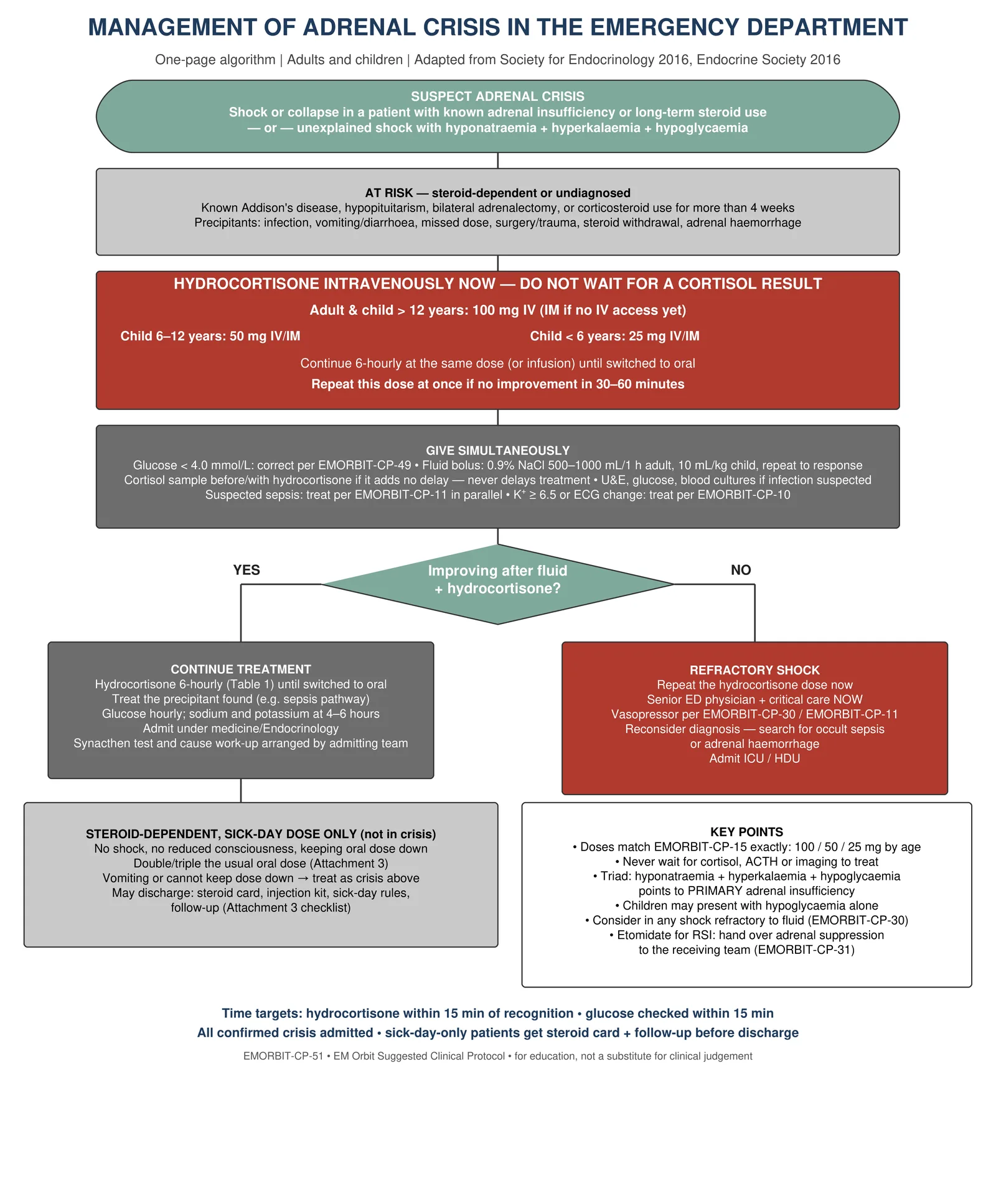
Evidence base: Society for Endocrinology 2016; Endocrine Society 2016
1Purpose
1.1 Standardize the immediate recognition and treatment of adrenal crisis in both the known steroid-dependent patient and the patient presenting undiagnosed, in the Emergency Department (ED).
1.2 Ensure intravenous or intramuscular hydrocortisone is given without delay and is never withheld pending a cortisol result, an ACTH result, or confirmation of the diagnosis.
1.3 Identify and treat the precipitating cause, and ensure every steroid-dependent patient leaves with sick-day rules, a steroid emergency card, and an injection kit where indicated.
1.4 Align practice with the Society for Endocrinology and Endocrine Society standards and with the doses already fixed in EMORBIT-CP-15.
2Who this protocol applies to
2.1 Any patient with known primary adrenal insufficiency (Addison's disease), secondary adrenal insufficiency (hypopituitarism), bilateral adrenalectomy, or long-term corticosteroid therapy (any dose for more than 4 weeks, or repeated short courses) who presents with hypotension, collapse, or an intercurrent illness they cannot manage with oral sick-day dosing.
2.2 Any patient with unexplained shock, collapse, or reduced consciousness not responding to the expected treatment, particularly with hyponatraemia, hyperkalaemia, or hypoglycaemia, in whom adrenal crisis has not previously been diagnosed.
2.3 Children with unexplained hypoglycaemia, shock, or salt-losing crisis in whom congenital adrenal hyperplasia or another cause of adrenal insufficiency is suspected.
3Not covered by this protocol
3.1 A known steroid-dependent patient with a minor illness, tolerating oral intake, who is not hypotensive and responds fully to doubling or tripling the usual oral dose at home (managed by sick-day rules, section 4.3.6, without needing to attend the ED).
3.2 Chronic replacement titration, routine endocrine follow-up, and asymptomatic biochemical adrenal insufficiency without acute illness (referred to the Endocrinology clinic).
3.3 Isolated hyponatraemia or hyperkalaemia with a clear alternative cause and no clinical suspicion of adrenal insufficiency (see EMORBIT-CP-50 and EMORBIT-CP-10).
4Protocol
4.1History and Assessment:
4.1.1Triage and Recognition:
4.1.1.1 Any steroid-dependent patient who looks unwell, or any patient in unexplained or refractory shock, shall be triaged to the highest acuity category and an ED physician shall attend within 5 minutes.
4.1.1.2 Ask every patient in shock or with unexplained collapse: "Do you take steroid tablets, or have you ever been told you have Addison's disease or a pituitary problem?" and look for a steroid alert bracelet or card.
4.1.1.3 Adrenal crisis is a clinical diagnosis in a steroid-dependent patient who is unwell: hydrocortisone shall not be delayed for any blood test.
4.1.2History:
4.1.2.1 Steroid-dependency status and cause (Addison's disease, hypopituitarism, bilateral adrenalectomy, long-term exogenous steroid for another condition), usual daily dose, and time of the last dose taken and kept down.
4.1.2.2 Precipitant sought actively: infection at any site, vomiting or diarrhoea preventing oral absorption, missed or reduced dose, surgery or trauma, recent abrupt withdrawal of long-term steroid, new medication (rifampicin, phenytoin, and other enzyme inducers increase cortisol clearance), and — in the undiagnosed patient — anticoagulation or a coagulopathy (adrenal haemorrhage) or overwhelming sepsis (Waterhouse–Friderichsen).
4.1.2.3 Ask about postural dizziness, salt craving, weight loss, fatigue, abdominal pain, and vomiting, which may have been present for days before the crisis.
4.1.3Examination:
4.1.3.1 ABCDE with vital signs and capillary glucose immediately. Look for hyperpigmentation of the skin creases, scars, and buccal mucosa, and for vitiligo (primary adrenal insufficiency); their absence does not exclude secondary insufficiency.
4.1.3.2 Examine for a source of infection, for a surgical abdomen mimic (adrenal crisis itself causes severe abdominal pain and vomiting — see EMORBIT-CP-15), and for a petechial or purpuric rash suggesting meningococcal sepsis.
4.1.4Risk Stratification – Severity:
4.1.4.1 Shock (systolic blood pressure < 90 mmHg or a fall of more than 20 mmHg from baseline), reduced consciousness, or severe electrolyte or glucose derangement define crisis and mandate immediate parenteral hydrocortisone and resuscitation.
4.1.4.2 Sick-day illness without shock or reduced consciousness in a patient who can take and keep down an increased oral dose does not need parenteral treatment (section 4.3.6).
4.1.5Differential Diagnosis:
4.1.5.1 Septic shock, cardiogenic shock, and other distributive causes (EMORBIT-CP-30); hyperkalaemia from another cause (EMORBIT-CP-10); hyponatraemia from another cause (EMORBIT-CP-50); hypoglycaemia from another cause (EMORBIT-CP-49); acute abdomen (EMORBIT-CP-15).
4.1.5.2 The biochemical triad supporting primary adrenal insufficiency is hyponatraemia with hyperkalaemia (mineralocorticoid deficiency) and hypoglycaemia; hyperkalaemia is typically absent in secondary adrenal insufficiency.
4.1.6Special Populations:
4.1.6.1 Children: hypoglycaemia is often the dominant and sometimes only presenting feature; consider congenital adrenal hyperplasia in a salt-losing crisis in the first weeks of life. Dose by Table 1 (Attachment 2).
4.1.6.2 Pregnancy: adrenal crisis can mimic hyperemesis gravidarum; treat with the adult dose without delay and involve Obstetrics and Endocrinology together.
4.1.6.3 Rapid sequence intubation: where etomidate is used in a patient at risk of adrenal insufficiency, the resulting adrenal suppression shall be handed over to the receiving team exactly as set out in EMORBIT-CP-31; it does not change the immediate hydrocortisone dose here.
4.1.6.4 Steroid-dependent patients on chronic disease-modifying steroid (transplant, rheumatological, respiratory): the same doses apply regardless of the original indication for steroids.
4.2Investigations:
4.2.1 No investigation shall delay hydrocortisone. Where it adds no delay, draw a plain (clotted) sample for random serum cortisol before or with the first dose; a low or inappropriately normal cortisol in an acutely unwell patient supports the diagnosis retrospectively — a normal result does not exclude it and shall not stop treatment.
4.2.2 An ACTH sample, if the admitting team requests one to distinguish primary from secondary insufficiency, needs specific handling (chilled, rapid transport); local laboratory capability for this is not confirmed — flag for local sign-off.
4.2.3 Point-of-care and laboratory glucose; urea and electrolytes (sodium, potassium); calcium (may be mildly elevated); full blood count; venous blood gas; blood cultures and a septic screen where infection is suspected (EMORBIT-CP-11).
4.2.4 A confirmatory short Synacthen (ACTH stimulation) test is arranged by the admitting team once the patient is stable and is not an ED investigation.
4.3Plan of Care:
4.3.1Immediate Actions (first 5 minutes):
4.3.1.1 Call for senior help for any patient in shock; move to a monitored area; obtain IV access (two large-bore cannulae if shocked); attach continuous ECG, SpO₂, and blood pressure monitoring.
4.3.1.2 Check capillary glucose immediately and treat if below 4.0 mmol/L per EMORBIT-CP-49.
4.3.1.3 Draw the cortisol sample (section 4.2) only if it adds no delay, then give hydrocortisone immediately (section 4.3.2).
4.3.2Definitive ED Treatment: Hydrocortisone and initial fluids by age are set out in Table 1, Attachment 2. Give the first dose intravenously, or intramuscularly if IV access is not yet available; do not wait for any result.
Table 1: Hydrocortisone and initial fluid bolus by age (doses match EMORBIT-CP-15 exactly) Age group Hydrocortisone — first dose Continuing hydrocortisone Initial fluid bolus Adult and child > 12 years 100 mg IV (IM if no IV access) 100 mg IV every 6 hours, or infusion 200 mg/24 h, until switched to oral 0.9% sodium chloride 500–1000 mL over 1 hour, reassess Child 6–12 years 50 mg IV/IM 50 mg IV every 6 hours 0.9% sodium chloride 10 mL/kg, repeat to response Child < 6 years 25 mg IV/IM 25 mg IV every 6 hours 0.9% sodium chloride 10 mL/kg, repeat to response Give the first dose immediately; it shall never be delayed for a cortisol result, an ACTH result, imaging, or IV access — give intramuscularly if a vein is not yet available. Correct hypoglycaemia (below 4.0 mmol/L) exactly as per EMORBIT-CP-49 Attachment 2; do not restate its doses here. Fludrocortisone is not an emergency drug: hydrocortisone at this dose has intrinsic mineralocorticoid activity; the admitting team adds fludrocortisone once the dose is reduced below 50 mg/day.
4.3.3Treat the Precipitant:
4.3.3.1 Suspected infection: treat per the ED sepsis pathway (EMORBIT-CP-11); do not let sepsis screening delay hydrocortisone.
4.3.3.2 Hyperkalaemia with ECG changes or potassium ≥ 6.5 mmol/L: treat per EMORBIT-CP-10; hydrocortisone and fluid resuscitation alone correct most cases within hours.
4.3.3.3 Suspected adrenal haemorrhage (anticoagulated, antiphospholipid syndrome, or overwhelming sepsis): treat as above and refer for urgent cross-sectional imaging under the admitting team.
4.3.4Escalation – Refractory Shock:
4.3.4.1 No improvement in blood pressure or perfusion 30 to 60 minutes after the first hydrocortisone dose and an adequate fluid bolus: repeat the hydrocortisone dose, call the senior ED physician and critical care, and start a vasopressor exactly per the distributive-shock pathway in EMORBIT-CP-30 (see also EMORBIT-CP-11).
4.3.4.2 Reconsider the diagnosis and search harder for an unrecognised precipitant (occult sepsis, adrenal haemorrhage, an alternative cause of shock) rather than assuming the crisis alone explains ongoing shock.
4.3.4.3 Admit refractory patients to the Intensive Care Unit (ICU) or High Dependency Unit (HDU).
4.3.5Monitoring and Reassessment:
4.3.5.1 Continuous ECG, SpO₂, and blood pressure until stable, then per ward observation policy. Capillary glucose hourly until stable. Repeat sodium and potassium at 4 to 6 hours.
4.3.5.2 Reassess perfusion, conscious level, and fluid balance after every intervention; catheterise and record hourly urine output in shock.
4.3.6Disposition:
4.3.6.1 Every patient meeting the crisis criteria in section 2 shall be admitted; none is discharged directly from the ED after a treated crisis. Admit to ICU/HDU per the refractory criteria above; otherwise admit under the medical/Endocrinology on-call team.
4.3.6.2 Endocrinology shall review all crisis admissions and arrange the confirmatory Synacthen test, cause work-up (imaging, ACTH), and long-term dose planning; these are not ED tasks.
4.3.6.3 The exception is the sick-day-only patient in section 3 who fully responds to an increased oral dose without shock or reduced consciousness: this patient may be discharged using the Attachment 3 checklist.
4.3.7Discharge and Follow-up (sick-day-only patients, section 3):
4.3.7.1 Confirm and reinforce sick-day dose-escalation rules (Attachment 3) and that the patient can keep the increased oral dose down.
4.3.7.2 Issue or reinforce a steroid emergency card and, where the patient is not already carrying one, a hydrocortisone self-injection kit with hands-on training; a locally branded card template is not yet available — use the generic wording and flag for a local template.
4.3.7.3 Arrange Endocrinology or primary-care follow-up and give explicit return advice: come back immediately if vomiting starts, the oral dose cannot be kept down, or symptoms worsen.
4.3.8Documentation and Reporting:
4.3.8.1 Document: time of recognition, steroid-dependency status, precipitant identified, time and dose of every hydrocortisone administration, time of the cortisol sample relative to the first dose, glucose and electrolyte results, response, and disposition.
4.3.8.2 Capture crisis presentations for departmental audit (section 11).
5Algorithm
The one-page algorithm is shown at the top of this page.
6Team roles
6.1Triage / ED Nurse:
6.1.1 Recognize the steroid-dependent patient (history, alert bracelet, steroid card), escalate to the highest acuity category, and prepare hydrocortisone at the age-appropriate dose without waiting for a physician order where an approved standing order exists.
6.1.2 Record the time of every dose and vital signs; reinforce sick-day rules and provide auto-injection training at discharge.
6.2Pharmacist:
6.2.1 Ensure hydrocortisone for injection is stocked in the resuscitation area; verify the age-appropriate dose; dispense the injection kit and steroid card at discharge.
6.2.2 Review the medication list for enzyme-inducing drugs and recent steroid changes.
6.3Endocrinology:
6.3.1 Review all crisis admissions, arrange the confirmatory Synacthen test and cause work-up, and set the long-term stress-dosing plan.
6.4Laboratory Staff:
6.4.1 Process the cortisol sample and, where taken, the ACTH sample with correct handling and report results to the treating and admitting teams.
6.5Ambulance / Pre-hospital Providers:
6.5.1 Pre-alert the ED for any patient given pre-hospital hydrocortisone; hand over the time and dose given and the response.
7The patient's role
7.1 Carry a steroid emergency card and wear medical alert identification at all times.
7.2 Learn and follow the sick-day rules (Attachment 3): increase the oral dose during illness, and use the injection kit and seek emergency care if vomiting or unable to keep the oral dose down.
7.3 Never stop steroid therapy abruptly, and inform every treating clinician, including dentists and other specialists, of steroid-dependency status.
7.4 Attend Endocrinology follow-up and replace the injection kit before expiry.
8Definitions
8.1Adrenal Crisis: an acute, life-threatening deterioration in a patient with adrenal insufficiency, typically with hypotension, reduced consciousness, and electrolyte disturbance, that improves with parenteral glucocorticoid and fluid (Bornstein et al. 2016; Rushworth et al. 2019).
8.2Primary Adrenal Insufficiency: failure of the adrenal cortex itself (Addison's disease, bilateral adrenalectomy, adrenal haemorrhage, congenital adrenal hyperplasia), causing combined glucocorticoid and mineralocorticoid deficiency.
8.3Secondary Adrenal Insufficiency: failure of pituitary ACTH secretion (hypopituitarism) or hypothalamic–pituitary–adrenal axis suppression by exogenous steroid; mineralocorticoid secretion is usually preserved.
8.4Steroid-Dependent Patient: a patient on any dose of oral, and in some cases high-dose inhaled or topical, corticosteroid for more than 4 weeks, or repeated short courses, sufficient to suppress the hypothalamic–pituitary–adrenal axis.
8.5Sick-Day Rules: pre-agreed instructions for a steroid-dependent patient to increase the oral glucocorticoid dose during illness and to escalate to injection or emergency care if unable to keep the oral dose down (Attachment 3).
8.6Steroid Emergency Card: a card carried by the steroid-dependent patient stating the diagnosis and the emergency treatment required.
9Attachments
- Attachment 1: One-page algorithm (top of this page)
- Attachment 2: Hydrocortisone and Fluid Dosing Quick Reference
- Attachment 3: Sick-Day Rules and Discharge Checklist
11Suggested quality indicators
11.1Time to first hydrocortisone dose ≤ 15 minutes from recognition: (Number of adrenal crisis patients receiving hydrocortisone within 15 minutes of ED recognition / Total number of adrenal crisis patients treated in the ED) × 100. Target ≥ 90%.
11.2Glucose checked within 15 minutes of arrival: (Number of suspected adrenal crisis patients with a capillary glucose recorded within 15 minutes / Total number of suspected adrenal crisis patients) × 100. Target 100%.
11.3Appropriate level-of-care admission: (Number of confirmed adrenal crisis patients admitted to ICU/HDU when meeting the refractory-shock criteria in section 4.3.4 / Total number meeting those criteria) × 100. Target 100%.
11.4Discharge bundle for sick-day-only patients: (Number of discharged sick-day patients with sick-day rules reinforced, steroid card confirmed, and follow-up arranged / Total number of such patients discharged) × 100. Target ≥ 90%.
11.5Unplanned return within 72 hours: (Number of adrenal crisis or sick-day patients re-attending within 72 hours with recurrent symptoms / Total number discharged) × 100. Monitored as an outcome indicator.
13References
- Arlt W; Society for Endocrinology Clinical Committee. SOCIETY FOR ENDOCRINOLOGY ENDOCRINE EMERGENCY GUIDANCE: Emergency management of acute adrenal insufficiency (adrenal crisis) in adult patients. Endocr Connect. 2016;5(5):G1–G3.
- Bornstein SR, Allolio B, Arlt W, et al. Diagnosis and Treatment of Primary Adrenal Insufficiency: An Endocrine Society Clinical Practice Guideline. J Clin Endocrinol Metab. 2016;101(2):364–389.
- Rushworth RL, Torpy DJ, Falhammar H. Adrenal Crisis. N Engl J Med. 2019;381(9):852–861.
- Puar THK, Stikkelbroeck NMML, Smans LCCJ, Zelissen PMJ, Hermus ARMM. Adrenal Crisis: Still a Deadly Event in the 21st Century. Am J Med. 2016;129(3):339.e1–339.e9.
- NHS England and NHS Improvement. Patient Safety Alert: Steroid Emergency Card to support early recognition and treatment of adrenal crisis in adults. 2020.
- British Society for Paediatric Endocrinology and Diabetes (BSPED). Emergency guidance: management of adrenal insufficiency and adrenal crisis in children.
A2Attachment 2: Hydrocortisone and Fluid Dosing Quick Reference
| Age group | Hydrocortisone — first dose | Continuing hydrocortisone | Initial fluid bolus |
|---|---|---|---|
| Adult and child > 12 years | 100 mg IV (IM if no IV access) | 100 mg IV every 6 hours, or infusion 200 mg/24 h, until switched to oral | 0.9% sodium chloride 500–1000 mL over 1 hour, reassess |
| Child 6–12 years | 50 mg IV/IM | 50 mg IV every 6 hours | 0.9% sodium chloride 10 mL/kg, repeat to response |
| Child < 6 years | 25 mg IV/IM | 25 mg IV every 6 hours | 0.9% sodium chloride 10 mL/kg, repeat to response |
Give the first dose immediately; it shall never be delayed for a cortisol result, an ACTH result, imaging, or IV access — give intramuscularly if a vein is not yet available. Correct hypoglycaemia (below 4.0 mmol/L) exactly as per EMORBIT-CP-49 Attachment 2; do not restate its doses here. Fludrocortisone is not an emergency drug: hydrocortisone at this dose has intrinsic mineralocorticoid activity; the admitting team adds fludrocortisone once the dose is reduced below 50 mg/day.
A3Attachment 3: Sick-Day Rules and Discharge Checklist
| Situation | Action |
|---|---|
| Minor illness with fever, unable to keep to the usual routine | Double the usual oral hydrocortisone dose for the duration of the illness and 24 hours after recovery |
| Vomiting once, or diarrhoea, oral dose likely only partly absorbed | Take an extra oral dose immediately; if vomiting recurs, move to the next row |
| Vomiting twice or more, unable to keep any oral dose down, or a severe illness/injury | Give the emergency hydrocortisone injection (100 mg IM, adult) immediately and go to the nearest ED |
| Major stress: surgery, trauma, labour | ED/peri-operative stress-dose hydrocortisone (Attachment 2) arranged with Anaesthesia/Endocrinology |
| ✓ | Item |
|---|---|
| ☐ | No shock, reduced consciousness, or electrolyte/glucose derangement requiring admission. |
| ☐ | Tolerating and keeping down the increased oral dose; sick-day rules (Table 2) explained and understood. |
| ☐ | Steroid emergency card confirmed or issued; injection kit prescribed and training given if not already carrying one. |
| ☐ | Precipitant identified and addressed (e.g., infection treated). |
| ☐ | Endocrinology or primary-care follow-up arranged; return advice given for vomiting or recurrent symptoms. |