Paediatric Seizures and Status Epilepticus
EMORBIT-CP-79 · Chapter 12 · Paediatric Emergencies
Open in the appFree, works on your phone and offline, with every tool alongside.
Evidence base: NICE NG217; APLS
1Purpose
1.1 Provide a time-based framework for the recognition and treatment of convulsive status epilepticus in children under 13 years presenting to Emergency Departments (ED), to terminate seizures as early as possible and prevent airway compromise and neuronal injury.
1.2 Ensure a capillary glucose is checked within 5 minutes of every seizing child and hypoglycaemia corrected per EMORBIT-CP-49.
1.3 Provide a safe pathway for the child whose seizure has already terminated — first afebrile seizure, simple or complex febrile seizure, and breakthrough seizure in known epilepsy.
1.4 Ensure non-accidental injury is considered as a cause of seizure in children under 2 years.
2Who this protocol applies to
2.1 Children aged 28 days to under 13 years with a convulsive seizure ongoing on arrival, lasting 5 minutes or more, or recurring without full recovery of consciousness between seizures (convulsive status epilepticus).
2.2 Children whose convulsive seizure has terminated before or on arrival: first afebrile seizure, simple or complex febrile seizure, and breakthrough seizure in a child with known epilepsy.
2.3 The age boundary follows the departmental standard: 13 years and over is managed as an adult under EMORBIT-CP-02.
3Not covered by this protocol
3.1 Neonates under 28 days with a suspected seizure: aetiology (hypoxic-ischaemic encephalopathy, metabolic, intracranial haemorrhage, infection) and management differ; discuss with the neonatal team on arrival and manage under the local neonatal guideline, not this one.
3.2 Non-epileptic paroxysmal events without a convulsive seizure — reflex anoxic seizure, breath-holding spell, syncope, shuddering attacks, or a psychogenic non-epileptic event — are assessed on their own presentation; this guideline applies if a convulsive seizure develops.
3.3 Adults and children 13 years and over: manage under EMORBIT-CP-02 (Status Epilepticus).
4Protocol
4.1History and Assessment:
4.1.1Triage and Recognition:
4.1.1.1 A child with a seizure ongoing at triage, or reported as ongoing en route, shall be triaged to the highest acuity category and taken directly to a resuscitation/monitored area; the ED physician shall attend immediately.
4.1.1.2 The triage nurse shall not wait for physician review before starting oxygen, monitoring, positioning, and a capillary glucose per approved nursing standing order.
4.1.1.3 Operational definition (ILAE 2015, as EMORBIT-CP-02): a generalized convulsive seizure lasting 5 minutes or more, or two or more seizures without recovery of consciousness between them, is convulsive status epilepticus.
4.1.2History:
4.1.2.1 Exact time of onset, duration, and description of the seizure (generalized versus focal onset); any benzodiazepine already given, by whom, dose, and time — this counts toward the two-dose maximum.
4.1.2.2 Fever or recent illness; known epilepsy, current anti-seizure medication and last dose/compliance; previous febrile or afebrile seizures; developmental history; birth and perinatal history.
4.1.2.3 Head injury, possible ingestion, ventriculoperitoneal shunt, and family history of epilepsy or febrile seizures.
4.1.2.4 For an infant under 2 years with an unwitnessed or unexplained seizure and no fever: obtain a careful, non-leading history of the events preceding the seizure and any injury.
4.1.3Examination:
4.1.3.1 Structured ABCDE with continuous reassessment; temperature, capillary glucose, level of consciousness (AVPU/paediatric Glasgow Coma Scale).
4.1.3.2 Neurological examination once the seizure has stopped: focal deficit, tone, pupils, and time to full return to baseline mental state.
4.1.3.3 Signs of meningism (neck stiffness, photophobia), a bulging fontanelle in an infant, and a non-blanching rash — see EMORBIT-CP-47 for the meningitis/encephalitis pathway if any are present.
4.1.3.4 Examine for signs of trauma or injury inconsistent with the history, particularly in a child under 2 years.
4.1.4Risk Stratification – Severity:
4.1.4.1 Early status: 0–20 minutes from onset (benzodiazepine-responsive phase).
4.1.4.2 Established status: persisting after two adequate benzodiazepine doses, typically 20–40 minutes (requires a second-line agent, Table 2).
4.1.4.3 Refractory status: persisting after a benzodiazepine and at least one second-line agent, or beyond 40–60 minutes (requires general anaesthesia and PICU) — matches the staging used in EMORBIT-CP-02.
4.1.5Differential Diagnosis:
4.1.5.1 Hypoglycaemia (check glucose in every child — EMORBIT-CP-49); electrolyte disturbance; reflex anoxic seizure or breath-holding spell (pallor/cyanosis with a trigger, brief, rapid recovery); syncope; rigors; benign shuddering attacks; psychogenic non-epileptic events.
4.1.5.2 Meningitis or encephalitis — suspect with fever, meningism, a bulging fontanelle, unexplained irritability, or a first complex febrile convulsion in an infant (EMORBIT-CP-47).
4.1.5.3 Ventriculoperitoneal shunt malfunction in a child with a shunt: urgent CT head and neurosurgical referral.
4.1.6Special Populations:
4.1.6.1 Infant under 2 years with an unexplained or unwitnessed seizure and no fever: consider non-accidental injury. Follow EMORBIT-CP-83: escalate through the safeguarding process, document objectively, and do not discharge until the child's safety is assessed.
4.1.6.2 Neonate (28 days to under 3 months): lower threshold for sepsis and meningitis work-up (EMORBIT-CP-25, EMORBIT-CP-47); discuss early with paediatrics.
4.1.6.3 Known epilepsy on treatment: if the child has a prescribed rescue benzodiazepine and it has not yet been given, give it as the first dose; do not exceed the two-dose maximum; a seizure that is longer or different from the child's usual pattern is treated on this algorithm regardless of baseline diagnosis.
4.1.6.4 Ventriculoperitoneal shunt: urgent CT head and neurosurgical referral in addition to seizure treatment.
4.1.6.5 Infant under 18 months with a refractory seizure and no clear cause: consider pyridoxine-dependent epilepsy — pyridoxine 100 mg IV, as in EMORBIT-CP-02.
4.2Investigations:
4.2.1 Capillary blood glucose within 5 minutes of arrival in every seizing child (EMORBIT-CP-49: treatment threshold below 4.0 mmol/L; 2 mL/kg of 10% glucose IV/IO if hypoglycaemic and unable to take oral treatment).
4.2.2 Electrolytes, calcium, magnesium, and venous gas in a prolonged, refractory, or first afebrile seizure, and in any infant.
4.2.3 Anti-seizure medication level where the child is on treatment and a level is available; does not delay treatment.
4.2.4 Blood culture, lactate, and ammonia where sepsis or a metabolic cause is suspected.
4.2.5 Lumbar puncture only where EMORBIT-CP-47 criteria for suspected meningitis/encephalitis are met, and only after the child is stabilized and any contraindication excluded — never as a routine investigation for a seizure.
4.2.6 CT head for a focal neurological deficit not resolving, signs of raised intracranial pressure, head trauma, a ventriculoperitoneal shunt, or failure to return to baseline mental state.
4.2.7 A child who has not returned to baseline consciousness within 30–60 minutes after a convulsive seizure is assumed to be in non-convulsive status epilepticus until an EEG or neurology assessment proves otherwise (as EMORBIT-CP-02). Electroencephalography is not an ED investigation; it is arranged by neurology, urgently for suspected non-convulsive status and non-urgently for a first afebrile seizure or febrile seizure needing follow-up.
4.3Plan of Care:
4.3.1Immediate Actions (first 5 minutes):
4.3.1.1 Position the child safely on their side once convulsing; do not restrain; protect from injury; do not put anything in the mouth.
4.3.1.2 High-flow oxygen; continuous SpO₂, ECG, and non-invasive blood pressure monitoring; IV or IO access.
4.3.1.3 Capillary glucose immediately; treat hypoglycaemia per EMORBIT-CP-49 without delaying benzodiazepine treatment for a seizure still ongoing.
4.3.1.4 Record the exact time of seizure onset and of every drug dose.
4.3.2First-Line Treatment — Benzodiazepine (5 minutes):
Table 1: First-line benzodiazepine (maximum TWO doses in total, including any dose given before arrival) Route (fastest available) Dose Note Lorazepam IV/IO (if access already present) 0.1 mg/kg (maximum 4 mg) Preferred if IV/IO access is already in place — do not delay treatment to obtain access. Midazolam buccal (no IV/IO access) 0.3 mg/kg (maximum 10 mg) A dose given by ambulance or parents/carers before arrival counts as the first dose. Midazolam IM (no IV/IO access, buccal not possible) 0.2 mg/kg (maximum 10 mg) Alternative to buccal route. Give the second dose 5–10 minutes after the first if the seizure continues, by IV/IO route if access has since been obtained. No more than two benzodiazepine doses in total — a third dose adds respiratory depression and hypotension without improving seizure control. These doses match EMORBIT-CP-02 exactly.
4.3.2.1 If the seizure has lasted 5 minutes or is ongoing on arrival, give the first benzodiazepine dose by the fastest available route (Table 1).
4.3.2.2 If the seizure continues 5–10 minutes after the first dose, give the second dose — by IV/IO route if access has since been obtained.
4.3.2.3 No more than two benzodiazepine doses in total, including any dose given before arrival by ambulance or a parent/carer.
4.3.3Second-Line Treatment — Established Status (20 minutes):
Table 2: Second-line anti-seizure medication (established status, 10 minutes after the second benzodiazepine dose) Agent Dose Note Levetiracetam IV (preferred) 60 mg/kg over 10 minutes (maximum 4.5 g) — AES 2016; ESETT Same dose as EMORBIT-CP-02, Table 2, for all ages. Phenytoin IV (if levetiracetam unavailable, contraindicated, or the child already takes levetiracetam) 20 mg/kg over 20 minutes (maximum 2 g), with continuous ECG and blood pressure monitoring Never give in a child already taking phenytoin at a therapeutic dose — give levetiracetam instead. If seizures continue 10 minutes after completion of the first second-line agent, give the second agent from this table while calling anaesthesia/critical care and the paediatric intensive care unit (PICU) — do not repeat benzodiazepines.
4.3.3.1 If the seizure continues 5–10 minutes after the second benzodiazepine dose, give one second-line agent over the stated infusion time (Table 2); call the senior ED physician.
4.3.4Third-Line Treatment / Refractory Status (40–60 minutes):
4.3.4.1 Seizures continuing 40–60 minutes despite a benzodiazepine and a second-line agent constitute refractory status epilepticus and require rapid sequence induction of general anaesthesia by the most experienced operator present, with a difficult-airway plan.
4.3.4.2 Call anaesthesia/critical care and PICU immediately; continue seizure-terminating treatment while preparing.
4.3.4.3 Continuous EEG monitoring after anaesthetic induction is the standard of care and shall be used where available.
4.3.5Monitoring and Reassessment:
4.3.5.1 Continuous SpO₂, ECG, and blood pressure; repeat capillary glucose after each intervention and at least hourly.
4.3.5.2 Reassess level of consciousness every 15 minutes after the seizure stops; a child not back to baseline within 30–60 minutes is treated as non-convulsive status until proven otherwise (section 4.2).
4.3.5.3 Respiratory depression is expected after benzodiazepines: monitor respiratory rate and SpO₂ closely and prepare bag-valve-mask ventilation.
4.3.6Disposition:
4.3.6.1 Seizure terminated by a benzodiazepine alone, child fully back to baseline, no red flag, and a simple febrile seizure or an identified benign cause: manage disposition per EMORBIT-CP-25 (Febrile Child), including its observation and discharge criteria.
4.3.6.2 Complex febrile seizure, a first febrile seizure under 18 months where meningitis is not confidently excluded, or any child who has not returned fully to normal: admit under paediatrics, per EMORBIT-CP-25 and, where meningitis/encephalitis is suspected, EMORBIT-CP-47.
4.3.6.3 First afebrile seizure with a normal examination, full return to baseline, and no red flag: may be discharged after paediatric review, with outpatient neurology referral — routine ED imaging or EEG is not required.
4.3.6.4 Any child requiring a second-line agent, refractory status epilepticus, or rapid sequence induction: admit to PICU.
4.3.6.5 A seizure with a safeguarding concern (Special Populations, section 4.1.5): the child does not go home until safety has been assessed, regardless of the seizure itself having resolved.
4.3.7Discharge and Follow-up:
4.3.7.1 Give written seizure safety-netting advice: what to do if a seizure recurs, when to call an ambulance (a seizure lasting 5 minutes or longer, or a second seizure without recovery), and general seizure first aid.
4.3.7.2 Advise bathing supervision and swimming precautions until reviewed by a specialist; children with known epilepsy follow their individualized care plan.
4.3.7.3 Arrange paediatric or paediatric neurology follow-up for every first seizure (febrile or afebrile) and every breakthrough seizure in known epilepsy.
4.3.7.4 Prescribe and provide hands-on training in a rescue benzodiazepine (buccal midazolam) for a child assessed as being at risk of a further prolonged seizure, per specialist advice.
4.3.8Documentation and Reporting:
4.3.8.1 Document: time of onset, time of triage and physician review, description of the seizure, time and dose of every drug given (including pre-hospital), glucose values, response, time to full recovery of consciousness, differential considered, disposition and its reasoning, and any safeguarding concern raised and to whom.
4.3.8.2 Paediatric status epilepticus presentations are captured for departmental audit (section 11).
5Algorithm
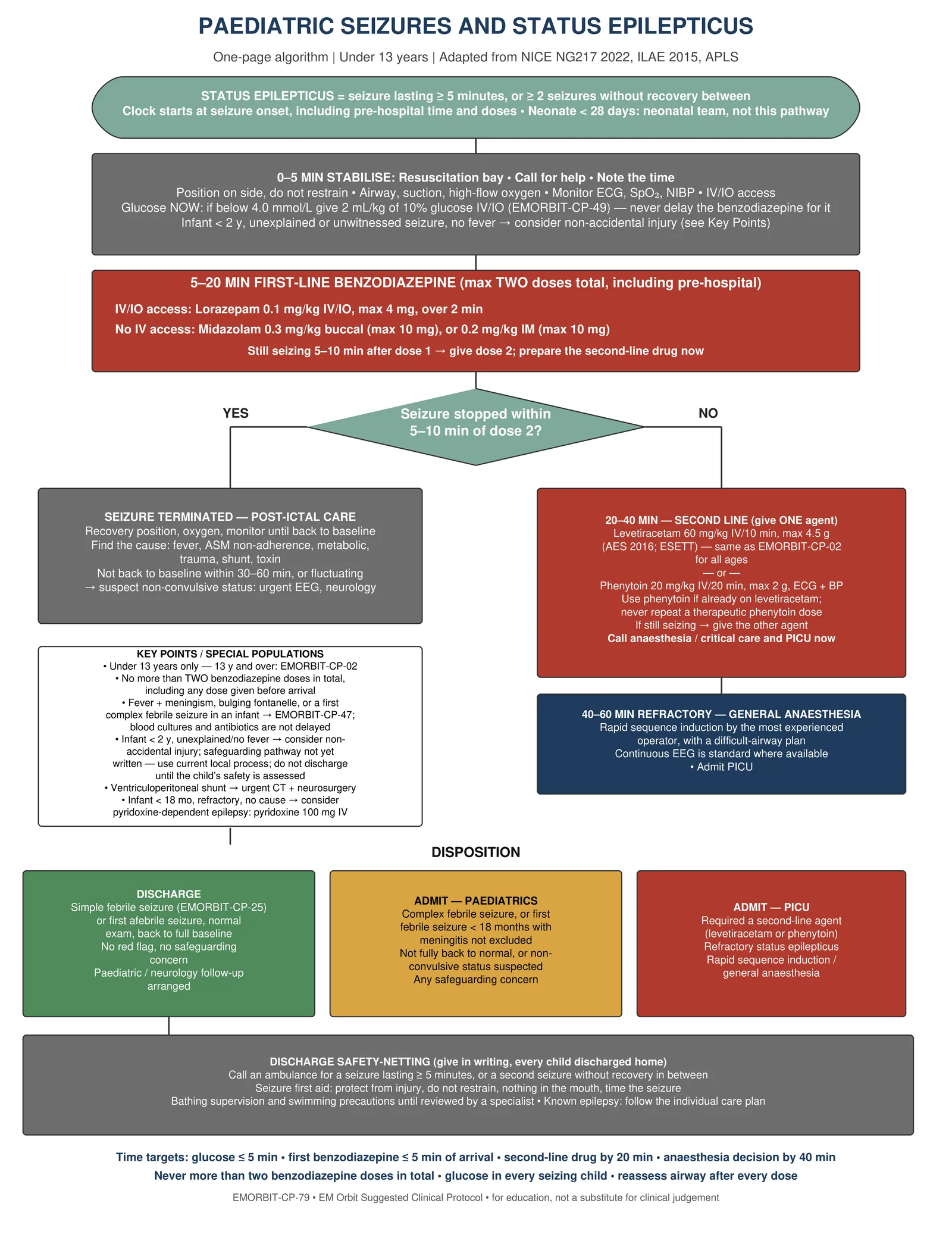
The one-page algorithm is shown at the top of this page.
6Team roles
6.1Triage / ED Nurse:
6.1.1 Recognize a seizure ongoing at triage, assign the highest acuity category, and move the child to a monitored area immediately.
6.1.2 Initiate oxygen, monitoring, positioning, and capillary glucose, and prepare the first benzodiazepine dose ready for immediate administration on physician order or per approved nursing standing order.
6.1.3 Record the time of every drug dose and the time of return to baseline consciousness.
6.2Pharmacist:
6.2.1 Ensure lorazepam, buccal and IM midazolam, levetiracetam, and phenytoin are available in the resuscitation area with weight-based dose charts; verify doses against the local formulary.
6.2.2 Verify the levetiracetam dose (60 mg/kg, maximum 4.5 g, as in EMORBIT-CP-02) at every dispensing.
6.3Paediatrics:
6.3.1 Attend for any child requiring a second-line agent or admission; review every first seizure, complex febrile seizure, and breakthrough seizure before disposition; assess for non-accidental injury where indicated and initiate the safeguarding process.
6.4Laboratory / Radiology:
6.4.1 Process glucose, electrolyte, and anti-seizure medication levels urgently; perform CT head where indicated without delaying stabilization.
6.5Ambulance / Pre-hospital Providers:
6.5.1 Pre-alert for an ongoing seizure; hand over the time of onset and the time, dose, and route of every benzodiazepine already given, so the ED does not exceed the two-dose maximum.
7The patient's role
7.1 Parent/carer reports the exact time the seizure started, its description, and any medication already given, including at home or by ambulance.
7.2 Parent/carer of a child with known epilepsy brings the individualized care plan and any prescribed rescue medication.
7.3 Parent/carer follows the written safety-netting advice and calls an ambulance for a seizure lasting 5 minutes or more, or a second seizure without recovery.
8Definitions
8.1Convulsive Status Epilepticus: a generalized convulsive seizure lasting 5 minutes or more, or two or more seizures without recovery of consciousness between them (ILAE 2015).
8.2Simple Febrile Convulsion: a seizure in a child aged 6 months to 6 years with fever, without central nervous system infection, that is generalized, lasts under 15 minutes, does not recur within 24 hours, and is followed by full recovery — as defined in EMORBIT-CP-25.
8.3Complex Febrile Convulsion: a febrile seizure that is focal, lasts 15 minutes or more, recurs within 24 hours, or is followed by incomplete recovery — as defined in EMORBIT-CP-25.
8.4Refractory Status Epilepticus: status epilepticus persisting despite a benzodiazepine and at least one second-line agent, requiring general anaesthesia.
8.5Non-Convulsive Status Epilepticus: persistent altered consciousness or subtle motor signs after a convulsive seizure without return to baseline, confirmed by EEG.
9Attachments
- Attachment 1: One-page algorithm (top of this page)
- Attachment 2: Benzodiazepine and Second-Line Agent Dosing Quick Reference
- Attachment 3: Disposition and Discharge Safety-Netting Advice
11Suggested quality indicators
11.1Time to first benzodiazepine (time-to-treatment): (Number of children seizing on arrival or at 5 minutes who receive a benzodiazepine within 5 minutes of recognition / Total number of such children) × 100. Target ≥ 90%.
11.2Glucose checked within 5 minutes (process): (Number of seizing children with a capillary glucose documented within 5 minutes of arrival / Total number of seizing children) × 100. Target 100%.
11.3Benzodiazepine dose limit respected (process): (Number of children who received no more than two benzodiazepine doses in total / Total number of children treated for status epilepticus) × 100. Target ≥ 95%.
11.4Safe disposition (safe-disposition): (Number of discharged children with disposition criteria documented and written safety-netting advice given / Total number of children discharged) × 100. Target ≥ 90%.
11.5Unplanned return within 72 hours (outcome): (Number of children re-attending within 72 hours with a further seizure / Total number discharged) × 100. Monitored as an outcome indicator.
13References
- National Institute for Health and Care Excellence. Epilepsies in children, young people and adults. NICE Guideline NG217. London: NICE; 2022.
- Advanced Life Support Group. Advanced Paediatric Life Support: The Practical Approach. 6th ed. Chichester: Wiley-Blackwell.
- Trinka E, Cock H, Hesdorffer D, et al. A definition and classification of status epilepticus — Report of the ILAE Task Force on Classification of Status Epilepticus. Epilepsia. 2015;56(10):1515–1523.
- Lyttle MD, Rainford NEA, Gamble C, et al. Levetiracetam versus phenytoin for second-line treatment of paediatric convulsive status epilepticus (EcLiPSE). Lancet. 2019;393(10186):2125–2134.
- Dalziel SR, Borland ML, Furyk J, et al. Levetiracetam versus phenytoin for second-line treatment of convulsive status epilepticus in children (ConSEPT). Lancet. 2019;393(10186):2135–2145.
- Royal College of Paediatrics and Child Health. Fits, faints and funny turns / febrile seizure guidance. London: RCPCH.
A2Attachment 2: Benzodiazepine and Second-Line Agent Dosing Quick Reference
| Route (fastest available) | Dose | Note |
|---|---|---|
| Lorazepam IV/IO (if access already present) | 0.1 mg/kg (maximum 4 mg) | Preferred if IV/IO access is already in place — do not delay treatment to obtain access. |
| Midazolam buccal (no IV/IO access) | 0.3 mg/kg (maximum 10 mg) | A dose given by ambulance or parents/carers before arrival counts as the first dose. |
| Midazolam IM (no IV/IO access, buccal not possible) | 0.2 mg/kg (maximum 10 mg) | Alternative to buccal route. |
Give the second dose 5–10 minutes after the first if the seizure continues, by IV/IO route if access has since been obtained. No more than two benzodiazepine doses in total — a third dose adds respiratory depression and hypotension without improving seizure control. These doses match EMORBIT-CP-02 exactly.
| Agent | Dose | Note |
|---|---|---|
| Levetiracetam IV (preferred) | 60 mg/kg over 10 minutes (maximum 4.5 g) — AES 2016; ESETT | Same dose as EMORBIT-CP-02, Table 2, for all ages. |
| Phenytoin IV (if levetiracetam unavailable, contraindicated, or the child already takes levetiracetam) | 20 mg/kg over 20 minutes (maximum 2 g), with continuous ECG and blood pressure monitoring | Never give in a child already taking phenytoin at a therapeutic dose — give levetiracetam instead. |
If seizures continue 10 minutes after completion of the first second-line agent, give the second agent from this table while calling anaesthesia/critical care and the paediatric intensive care unit (PICU) — do not repeat benzodiazepines.
A3Attachment 3: Disposition and Discharge Safety-Netting Advice
1Discharge home (all must be met):
- Seizure terminated by a benzodiazepine alone (or resolved before arrival) and the child has returned fully to baseline.
- Simple febrile seizure (EMORBIT-CP-25 criteria), or a first afebrile seizure with a normal examination and no red flag.
- No safeguarding concern identified (section 4.1.5).
- Paediatric or paediatric neurology follow-up arranged.
2Admit under paediatrics:
- Complex febrile seizure, or a first febrile seizure under 18 months where meningitis has not been confidently excluded.
- Any child who has not returned fully to normal, or in whom non-convulsive status is suspected (section 4.2).
- Any safeguarding concern (section 4.1.5) — the child does not go home until this is assessed.
3Admit to PICU:
- Required a second-line agent (Table 2), refractory status epilepticus, or rapid sequence induction.
4Written safety-netting advice (give in every case discharged home):
- Call an ambulance for a seizure lasting 5 minutes or more, or a second seizure without recovery in between.
- Basic seizure first aid: protect from injury, do not restrain, do not put anything in the mouth, time the seizure.
- Bathing supervision and swimming precautions until reviewed by a specialist.