Paediatric Acute Respiratory Distress Syndrome in the Emergency Department
EMORBIT-CP-120 · Chapter 12 · Paediatric Emergencies
Open in the appFree, works on your phone and offline, with every tool alongside.
Evidence base: PALICC-2 2023
1Purpose
1.1 This protocol covers the Emergency Department (ED) front-door phase of care for Paediatric Acute Respiratory Distress Syndrome (PARDS) only. It does not replace, amend, or restate your institution's own guideline. Every severity threshold and ventilator setting below follows PALICC-2 (2023); where your institution's guideline differs, discuss with Paediatric Intensive Care.
1.2 Standardize early recognition of PARDS in the ED, the time-limited trial of oxygen, high-flow, or non-invasive support, and the decision to intubate.
1.3 Set out lung-protective ventilation from the first breath after intubation — tidal volume, plateau pressure, PEEP, oxygenation target, and permissive hypercapnia — so that an injurious pattern is never established while awaiting the ventilator to be "optimised later".
1.4 Define the ED role in fluid management after initial resuscitation, and set out the referral and transfer pathway to Paediatric Intensive Care (PICU), pointing to EMORBIT-CP-91 rather than restating it.
1.5 Align with the Second Pediatric Acute Lung Injury Consensus Conference (PALICC-2, 2023), read alongside your institution's own guideline.
2Who this protocol applies to
2.1 Children under 13 years (the library paediatric boundary) with new or worsening hypoxaemic respiratory failure within 7 days of a known clinical insult (pneumonia, aspiration, sepsis, near-drowning, trauma, transfusion-related, or another acute pulmonary or systemic insult), with new chest imaging consistent with acute parenchymal disease, in whom the hypoxaemia is not fully explained by cardiac failure or fluid overload alone.
2.2 Any child meeting the "at risk" or higher PALICC-2 oxygenation threshold in Table 1, whether or not already intubated on arrival, including a child pre-alerted by ambulance or transferred already ventilated.
3Not covered by this protocol
3.1 Children 13 years and over, or any child over 50 kg: adult acute respiratory distress syndrome and adult lung-protective ventilation apply (EMORBIT-CP-31, EMORBIT-CP-35), stated aloud as in EMORBIT-CP-24.
3.2 Bronchiolitis without PARDS-level hypoxaemia or new parenchymal infiltrate: managed under EMORBIT-CP-76.
3.3 Acute severe asthma without a new parenchymal infiltrate: managed under EMORBIT-CP-78; if PARDS criteria are also met (for example following intubation for status asthmaticus), both guidelines apply together.
3.4 Hypoxaemia fully explained by isolated cardiac failure or fluid overload without a parenchymal insult: managed per the relevant cardiac pathway, not this guideline.
3.5 Definitive PICU ventilator management beyond the first hour, weaning, prone positioning, neuromuscular blockade protocols, high-frequency oscillatory ventilation, and extracorporeal support: governed by your institution's own guideline and PICU, not restated here.
3.6 Cardiac arrest: manage per EMORBIT-CP-24 first; once an airway and ventilation are established and the child remains in respiratory failure meeting Table 1, this guideline applies to the ventilator settings.
4Protocol
4.1History and Assessment:
4.1.1Triage and Recognition:
4.1.1.1 Suspect PARDS in any child with increased work of breathing, hypoxaemia, or a rising oxygen requirement within 7 days of a recognised insult (pneumonia, aspiration, sepsis, trauma, near-drowning), especially with bilateral crackles or a new infiltrate.
4.1.1.2 Grade severity immediately using Table 1 and act on the worst measurement obtained — do not wait for an arterial sample before starting oxygen and calling for senior review.
4.1.1.3 PALICC-2 severity grading and the ED action at each grade.
Table 1: PALICC-2 (2023) severity grading for suspected paediatric ARDS and the ED action at each grade Grade On invasive ventilation (Oxygenation Index) On non-invasive support, full-face mask, PEEP/CPAP ≥ 5 (SpO₂/FiO₂ ratio) ED action At risk Not intubated; new hypoxaemia with a risk factor SpO₂/FiO₂ ≤ 264 (approx. PaO₂/FiO₂ ≤ 300) Oxygen to target (below); trial high-flow or non-invasive support with the strict time limit (section 4.3.2); treat the cause Mild OI 4 to < 8 OSI 5 to < 7.5 As above; low threshold to escalate if not improving within the trial period Moderate OI 8 to < 16 OSI 7.5 to < 12.3 Usually already intubated or trialling non-invasive support at its limit; involve PICU now Severe OI ≥ 16 OSI ≥ 12.3 Intubate on lung-protective settings without delay (section 4.3.2); PICU/retrieval immediately (EMORBIT-CP-91) OI = (FiO₂ × mean airway pressure × 100) / PaO₂. OSI = (FiO₂ × mean airway pressure × 100) / SpO₂, used only while SpO₂ ≤ 97%. Onset within 7 days of a known clinical insult, with new chest imaging consistent with acute parenchymal disease, and oedema not fully explained by cardiac failure or fluid overload alone — the full institutional definition, including the modified criteria for cyanotic heart disease and chronic lung disease, is not restated here. Grade by the worst measurement obtained; do not wait for an arterial sample to start treatment.
4.1.1.4 A child meeting the moderate or severe threshold, or any child already ventilated on transfer, is moved to a monitored area immediately and the senior ED physician and paediatric critical care are notified without delay.
4.1.2History:
4.1.2.1 The precipitating insult and its timing (within 7 days); fever, cough, work of breathing, feeding, and level of activity; aspiration risk (vomiting, reduced consciousness, foreign body); recent transfusion; trauma; near-drowning; chronic lung disease, congenital heart disease, or neuromuscular disease affecting baseline respiratory reserve.
4.1.2.2 Weight (measured, or estimated per EMORBIT-CP-24 Table 2) and, where ventilation is anticipated, height or length for predicted body weight; current medicines and allergies.
4.1.3Examination:
4.1.3.1 Full set of vital signs including SpO₂ and work-of-breathing signs (recession, grunting, nasal flare, tracheal tug); auscultation for asymmetry, crackles, or silent chest; level of consciousness; capillary refill and perfusion; signs of the underlying insult (sepsis, trauma, aspiration).
4.1.3.2 Apnoea may be the presenting feature in the young infant, as in bronchiolitis (EMORBIT-CP-76) — treat it as a red flag regardless of the oxygen saturation at the time.
4.1.4Risk Stratification – Severity:
4.1.4.1 Severe (Table 1): intubate on lung-protective settings without delay (section 4.3.2); involve PICU/retrieval immediately (EMORBIT-CP-91).
4.1.4.2 Moderate: involve PICU now; continue or escalate non-invasive support against the strict time limit in section 4.3.1; a low threshold to intubate if not improving.
4.1.4.3 Mild or at-risk: oxygen to target, trial high-flow or non-invasive support within the time limit, treat the cause, and reassess continuously — this group can deteriorate quickly.
4.1.5Differential Diagnosis:
4.1.5.1 Cardiogenic pulmonary oedema and fluid overload (echocardiography where feasible; not required to start treatment where an insult and risk factor are clear) — manage per the relevant cardiac pathway if this is the sole explanation.
4.1.5.2 Upper airway obstruction (croup, foreign body — EMORBIT-CP-77, EMORBIT-CP-94) and lower airway disease without a parenchymal infiltrate (asthma, bronchiolitis) are excluded by chest imaging and the clinical pattern.
4.1.5.3 Sepsis as the precipitant is managed alongside this guideline, not instead of it, per the sepsis pathway.
4.1.6Special Populations:
4.1.6.1 Cyanotic congenital heart disease and chronic lung disease: your institution's own guideline applies modified oxygenation criteria for these groups; do not apply the Table 1 thresholds unmodified — involve paediatric cardiology/PICU early.
4.1.6.2 Infancy (including apnoea as the presenting feature): lower the threshold for continuous monitoring and senior review; weight-based dosing and equipment throughout, per EMORBIT-CP-24.
4.1.6.3 Neuromuscular disease or a pre-existing tracheostomy: involve the child's usual respiratory/PICU team early; baseline ventilator settings may already differ from Table 2.
4.2Investigations:
4.2.1 No investigation shall delay oxygen, a high-flow or non-invasive trial, or intubation in a child meeting the severe threshold. Clinical recognition and respiratory support take priority over completing the work-up.
4.2.2 Chest imaging to identify a new infiltrate consistent with the diagnosis; capillary or venous blood gas with lactate; septic screen where sepsis is a plausible precipitant (per the sepsis pathway); point-of-care glucose.
4.2.3 Arterial line and blood gas only where already indicated for the level of respiratory support — do not delay treatment to obtain one; use the SpO₂/FiO₂ (OSI) method in Table 1 until an arterial sample is available.
4.3Plan of Care:
4.3.1Immediate Actions — Oxygen, High-Flow, and Non-Invasive Trial:
4.3.1.1 Give oxygen to the target in Table 2 by the simplest effective device; escalate to high-flow humidified oxygen or non-invasive ventilation (full-face mask, PEEP/CPAP ≥ 5) for a child not meeting target or with worsening work of breathing.
4.3.1.2 Set a strict time limit for the high-flow or non-invasive trial (in the order of one to two hours) with the endpoint decided and documented in advance — rising FiO₂ requirement, worsening work of breathing, a falling conscious level, or haemodynamic instability on that trial is treated as failure, not as a reason to extend it.
4.3.1.3 Treat the precipitating cause in parallel (antimicrobials per the sepsis or pneumonia pathway, source control, trauma management) — this guideline does not restate those pathways.
4.3.2Intubation Decision:
4.3.2.1 Intubate without delay for the severe grade (Table 1), for failure of the time-limited non-invasive trial, for recurrent apnoea, exhaustion, a falling conscious level, or haemodynamic instability. Do not wait for the trial's time limit to expire if the child is deteriorating within it.
4.3.2.2 The most experienced operator available performs intubation, per EMORBIT-CP-24/EMORBIT-CP-31 technique (not restated here); use a cuffed tube (Table 2) sized from EMORBIT-CP-24 Table 5.
4.3.3Lung-Protective Ventilation — From the First Breath:
4.3.3.1 Set the ventilator on lung-protective settings from the first breath after intubation — do not use a "standard" paediatric setting and adjust later.
4.3.3.2 Lung-protective ventilation starting settings.
Table 2: Lung-protective ventilation from the first breath (invasive), PALICC-2 2023 Parameter ED starting point Tracheal tube Cuffed tube, sized and lengths from EMORBIT-CP-24 Table 5; measure and record cuff pressure, keep below 20–25 cmH₂O. Tidal volume 5–8 mL/kg predicted body weight, using the weight obtained and announced per EMORBIT-CP-24 (measured weight or length-based tape first, age-based formula only as a fallback); use the lower end of the range where compliance is poor. Plateau pressure Keep below 28 cmH₂O (up to 32 cmH₂O only where chest-wall compliance is reduced); reduce tidal volume first if exceeded. PEEP / FiO₂ Start at PEEP 5 cmH₂O; titrate PEEP and FiO₂ together against oxygenation and plateau pressure — do not raise PEEP without checking its effect on plateau pressure and blood pressure. Oxygenation target SpO₂ 92–97% with PEEP below 10 cmH₂O; SpO₂ 88–92% is acceptable once PEEP reaches 10 cmH₂O or more, to avoid escalating FiO₂ further. Carbon dioxide Permissive hypercapnia accepted, pH ≥ 7.15, provided there is no raised intracranial pressure, pulmonary hypertension, significant right- or left-ventricular dysfunction, or haemodynamic instability — do not chase a normal CO₂ at the cost of the settings above. Sedation Deep sedation to tolerate the above settings, per EMORBIT-CP-35; routine early paralysis is not recommended — reserve for severe dyssynchrony that sedation alone does not control. These figures follow PALICC-2 (2023); where your institution's PARDS guideline or ventilator-setup policy differs, discuss with Paediatric Intensive Care. A child of 13 years or over, or over 50 kg, is ventilated on adult lung-protective settings (EMORBIT-CP-31/EMORBIT-CP-35), stated aloud, as in EMORBIT-CP-24.
4.3.3.3 Reassess plateau pressure and oxygenation after every ventilator change; if plateau pressure exceeds the limit, reduce tidal volume before any other adjustment.
4.3.4Fluids:
4.3.4.1 Restrictive fluid strategy once initial shock has been resuscitated: give the fluid bolus required to treat shock or hypoperfusion (per the sepsis pathway) first, then target euvolaemia rather than a positive balance — avoid routine maintenance-rate fluid running "in addition" once resuscitation is complete.
4.3.4.2 Reassess perfusion and fluid balance at each review; a positive fluid balance in PARDS is associated with worse outcomes and is a documented reason to involve PICU on the fluid plan.
4.3.5Escalation / Refractory:
4.3.5.1 Persistent severe hypoxaemia despite Table 2 settings, a plateau pressure that cannot be kept within limit, or haemodynamic instability on the ventilator: call the senior ED physician and PICU immediately; do not increase sedation or paralysis as a substitute for calling for help.
4.3.5.2 High-frequency oscillatory ventilation, prone positioning, inhaled pulmonary vasodilators, and extracorporeal membrane oxygenation are PICU-directed rescue therapies and are not started in the ED without PICU involvement.
4.3.6Monitoring and Reassessment:
4.3.6.1 Continuous SpO₂, continuous waveform capnography once intubated, and frequent vital signs throughout; reassess the non-invasive trial against its stated time limit and endpoint (section 4.3.1) rather than by impression alone.
4.3.6.2 Recheck a blood gas after any significant ventilator change and at least hourly while unstable; recalculate the OI/OSI (Table 1) as the picture evolves.
4.3.7Disposition:
4.3.7.1 Every child meeting the moderate or severe PARDS threshold, or intubated, is discussed with and referred to PICU — this is not a discharge or general-ward pathway.
4.3.7.2 A child improving on the mild/at-risk trial who no longer meets Table 1 criteria is managed per the underlying diagnosis (for example EMORBIT-CP-76 or the pneumonia pathway) and admitted under paediatrics for observation.
4.3.8Discharge and Follow-up:
4.3.8.1 Not applicable to a child meeting PARDS criteria — this guideline ends in admission or PICU transfer, not ED discharge.
4.3.9Documentation and Reporting:
4.3.9.1 Document: time of recognition, OI/OSI or SpO₂/FiO₂ and the grade at each assessment, the non-invasive trial start time and its stated endpoint, the intubation decision and time, every ventilator setting with its time, fluid balance, and the time PICU was contacted and accepted the referral.
4.3.9.2 Report any delay to intubation once the severe threshold or trial-failure criteria are met, and any departure from Table 2 settings, through the local incident reporting system and for departmental review.
5Algorithm
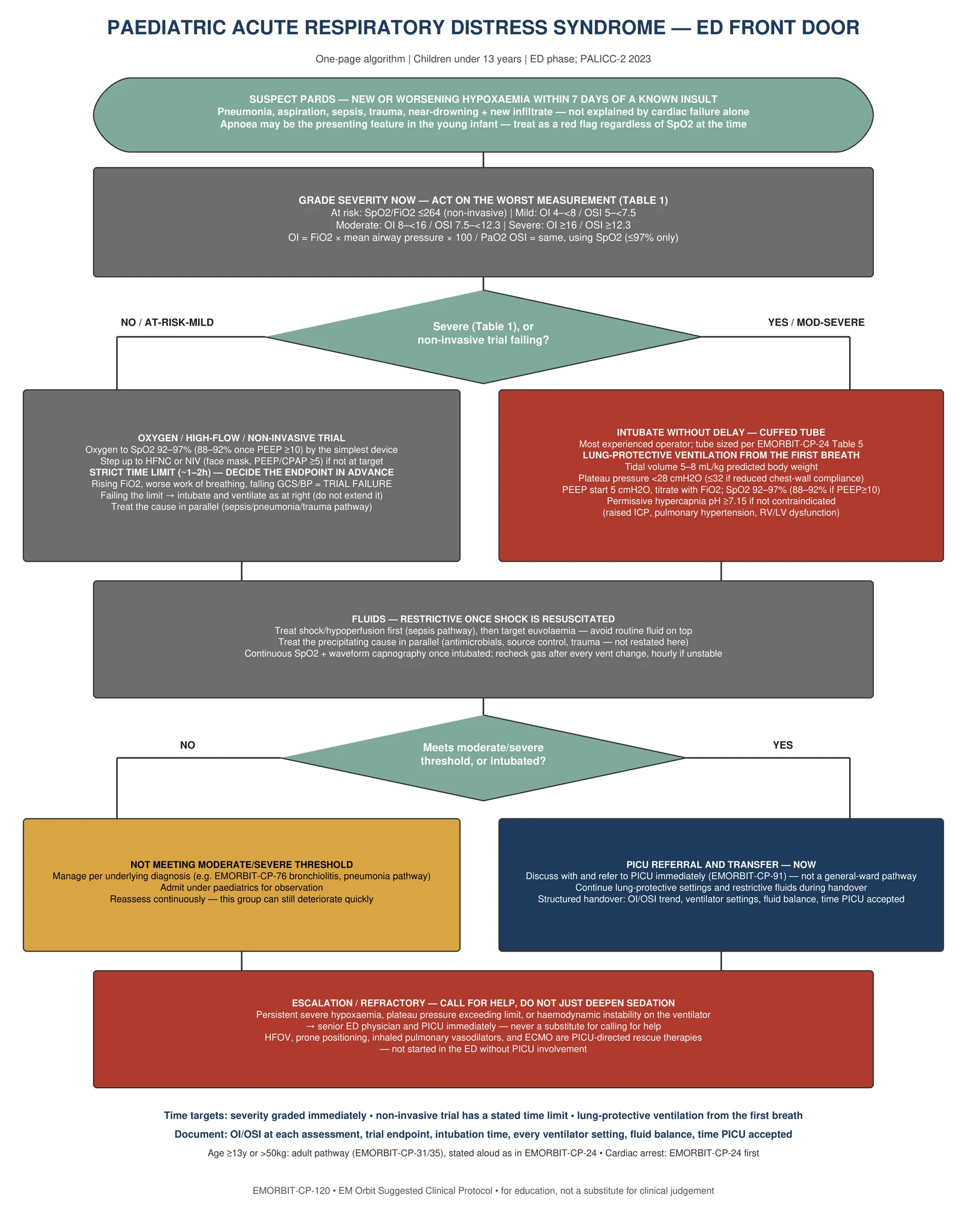
The one-page algorithm is shown at the top of this page.
6Team roles
The roles below are additional to, and consistent with, those defined in your institution's own PARDS guideline.
6.1Triage / ED Nurse: Recognise increased work of breathing or hypoxaemia within 7 days of a known insult; apply oxygen and grade severity at triage; escalate any severe feature immediately; support the non-invasive trial and its time limit.
6.2ED Pharmacist: Verify sedation and any weight-based drug dose per EMORBIT-CP-35; support antimicrobial selection for the underlying cause per the relevant pathway.
6.3Paediatric Intensive Care: Receive the referral at the moderate/severe threshold or on trial failure; advise on ventilator settings and the fluid plan; accept transfer per EMORBIT-CP-91.
6.4Respiratory Therapy / Nursing (High-Flow/Non-Invasive): Set up and monitor high-flow oxygen or non-invasive ventilation once prescribed; alert the treating team to deterioration or to the trial reaching its time limit.
6.5Laboratory / Radiology: Process blood gases and portable chest imaging urgently for a child meeting Table 1 criteria.
6.6Ambulance: Pre-alert the ED for a hypoxaemic or already-ventilated child, so the resuscitation area and PICU contact can be prepared before arrival.
7The patient's role
7.1 Not applicable to the child requiring respiratory support. Parents/carers: give an accurate history of the preceding illness or injury, feeding, and baseline respiratory or cardiac condition, and will be kept informed by a named clinician throughout.
8Definitions
The definitions in your institution's own PARDS guideline apply in full. The following are additional terms used in this protocol.
8.1PARDS: paediatric acute respiratory distress syndrome — new hypoxaemic respiratory failure within 7 days of a known insult, with a new parenchymal infiltrate, not fully explained by cardiac failure or fluid overload alone (PALICC-2, 2023).
8.2Oxygenation Index (OI) / Oxygen Saturation Index (OSI): severity measures combining FiO₂, mean airway pressure, and PaO₂ (OI) or SpO₂ (OSI, used only while SpO₂ ≤ 97%) — see Table 1.
8.3Predicted Body Weight: the weight used to set tidal volume, obtained per EMORBIT-CP-24 (measured weight or length-based tape first); not the same as the actual body weight in an obese child.
8.4Permissive Hypercapnia: accepting a raised carbon dioxide and a lower pH (to 7.15) to avoid an injurious tidal volume or plateau pressure, where not contraindicated (section 4.1.6).
9Attachments
- Attachment 1: One-page algorithm (top of this page)
- Attachment 2: PALICC-2 Severity Grading and Lung-Protective Ventilation Quick Reference
11Suggested quality indicators
11.1Time to lung-protective ventilation: (Number of children intubated for PARDS with tidal volume and plateau pressure within the Table 2 limits within 30 minutes of intubation / Total number of children intubated for PARDS) × 100. Target ≥ 90%.
11.2Severity grade documented (process): (Number of children meeting PARDS inclusion criteria with a documented OI/OSI grade within 30 minutes of recognition / Total number of such children) × 100. Target ≥ 95%.
11.3Non-invasive trial time limit respected (process): (Number of high-flow/non-invasive trials with a documented endpoint and time limit set at the start of the trial / Total number of such trials) × 100. Target ≥ 90%.
11.4Safe PICU handover (safe disposition): (Number of children meeting the moderate/severe threshold with a documented PICU referral and structured handover / Total number of such children) × 100. Target 100%.
11.5Outcome indicator (monitored, no fixed ED target): time from ED recognition to PICU bed arrival, and incidence of a plateau pressure or tidal volume outside the Table 2 limits sustained beyond 1 hour.
13References
- Emeriaud G, López-Fernández YM, Iyer NP, et al. Executive Summary of the Second International Guidelines for the Diagnosis and Management of Pediatric Acute Respiratory Distress Syndrome (PALICC-2). Pediatr Crit Care Med. 2023;24(2):143–168.
- Second Pediatric Acute Lung Injury Consensus Conference (PALICC-2) Group. Pediatric Acute Respiratory Distress Syndrome: Consensus Recommendations from PALICC-2. Pediatr Crit Care Med. 2023;24(2):e1–e33.
A2Attachment 2: PALICC-2 Severity Grading and Lung-Protective Ventilation Quick Reference
| Grade | On invasive ventilation (Oxygenation Index) | On non-invasive support, full-face mask, PEEP/CPAP ≥ 5 (SpO₂/FiO₂ ratio) | ED action |
|---|---|---|---|
| At risk | Not intubated; new hypoxaemia with a risk factor | SpO₂/FiO₂ ≤ 264 (approx. PaO₂/FiO₂ ≤ 300) | Oxygen to target (below); trial high-flow or non-invasive support with the strict time limit (section 4.3.2); treat the cause |
| Mild | OI 4 to < 8 | OSI 5 to < 7.5 | As above; low threshold to escalate if not improving within the trial period |
| Moderate | OI 8 to < 16 | OSI 7.5 to < 12.3 | Usually already intubated or trialling non-invasive support at its limit; involve PICU now |
| Severe | OI ≥ 16 | OSI ≥ 12.3 | Intubate on lung-protective settings without delay (section 4.3.2); PICU/retrieval immediately (EMORBIT-CP-91) |
OI = (FiO₂ × mean airway pressure × 100) / PaO₂. OSI = (FiO₂ × mean airway pressure × 100) / SpO₂, used only while SpO₂ ≤ 97%. Onset within 7 days of a known clinical insult, with new chest imaging consistent with acute parenchymal disease, and oedema not fully explained by cardiac failure or fluid overload alone — the full institutional definition, including the modified criteria for cyanotic heart disease and chronic lung disease, is not restated here. Grade by the worst measurement obtained; do not wait for an arterial sample to start treatment.
| Parameter | ED starting point |
|---|---|
| Tracheal tube | Cuffed tube, sized and lengths from EMORBIT-CP-24 Table 5; measure and record cuff pressure, keep below 20–25 cmH₂O. |
| Tidal volume | 5–8 mL/kg predicted body weight, using the weight obtained and announced per EMORBIT-CP-24 (measured weight or length-based tape first, age-based formula only as a fallback); use the lower end of the range where compliance is poor. |
| Plateau pressure | Keep below 28 cmH₂O (up to 32 cmH₂O only where chest-wall compliance is reduced); reduce tidal volume first if exceeded. |
| PEEP / FiO₂ | Start at PEEP 5 cmH₂O; titrate PEEP and FiO₂ together against oxygenation and plateau pressure — do not raise PEEP without checking its effect on plateau pressure and blood pressure. |
| Oxygenation target | SpO₂ 92–97% with PEEP below 10 cmH₂O; SpO₂ 88–92% is acceptable once PEEP reaches 10 cmH₂O or more, to avoid escalating FiO₂ further. |
| Carbon dioxide | Permissive hypercapnia accepted, pH ≥ 7.15, provided there is no raised intracranial pressure, pulmonary hypertension, significant right- or left-ventricular dysfunction, or haemodynamic instability — do not chase a normal CO₂ at the cost of the settings above. |
| Sedation | Deep sedation to tolerate the above settings, per EMORBIT-CP-35; routine early paralysis is not recommended — reserve for severe dyssynchrony that sedation alone does not control. |
These figures follow PALICC-2 (2023); where your institution's PARDS guideline or ventilator-setup policy differs, discuss with Paediatric Intensive Care. A child of 13 years or over, or over 50 kg, is ventilated on adult lung-protective settings (EMORBIT-CP-31/EMORBIT-CP-35), stated aloud, as in EMORBIT-CP-24.