Acute Asthma in Children
EMORBIT-CP-78 · Chapter 12 · Paediatric Emergencies
Open in the appFree, works on your phone and offline, with every tool alongside.
Evidence base: BTS/SIGN/NICE 2024; GINA; APLS
1Purpose
1.1 Standardize the recognition, severity classification, treatment, escalation, and safe disposition of children under 13 years presenting to the Emergency Department (ED) with an acute exacerbation of asthma, keeping the severity structure and drug classes parallel with EMORBIT-CP-08 (Acute Asthma in Adults) while using age- and weight-banded paediatric doses.
1.2 Ensure oxygen-driven or spacer bronchodilator within 10 minutes and, for children aged 2 years and over, oral corticosteroid within 1 hour of arrival, are delivered to every child.
1.3 Define the escalation pathway (IV magnesium, senior-directed IV bronchodilators) for severe and life-threatening attacks, and ensure that silent chest or exhaustion trigger immediate senior and critical-care involvement.
1.4 Ensure every child discharged receives the full discharge bundle (steroid course where indicated, inhaler/spacer technique, written action plan, follow-up).
2Who this protocol applies to
2.1 All children under 13 years presenting to, or deteriorating within, the ED with an acute exacerbation of asthma or acute wheeze consistent with asthma (acute worsening of breathlessness, cough, wheeze, or chest tightness), whether the diagnosis of asthma is established or made for the first time.
2.2 Children treated with bronchodilators or corticosteroids pre-hospital for an acute attack, including those whose symptoms have improved on arrival.
2.3 Acute asthma presenting as, or progressing to, respiratory or cardiac arrest (section 4.3.3).
3Not covered by this protocol
3.1 Children aged 13 years and over: managed under EMORBIT-CP-08 (Acute Asthma in Adults), the local adult age boundary.
3.2 A first wheezy episode in a child under 2 years with a coryzal prodrome and no personal/strong family history of atopy: manage as bronchiolitis / viral-induced wheeze (EMORBIT-CP-76) rather than asthma, applying section 4.1.5 where the picture overlaps.
3.3 Bronchospasm as a feature of anaphylaxis, treated with IM adrenaline as first-line per EMORBIT-CP-01; inhaled bronchodilators from this guideline are adjuncts only.
3.4 Chronic asthma management, stepping up long-term therapy beyond the discharge bundle, and specialist assessment, which are the responsibility of primary care and Paediatric Respiratory services.
4Protocol
4.1History and Assessment:
4.1.1Triage and Recognition:
4.1.1.1 The triage nurse shall measure and document, for every child with breathlessness or wheeze: respiratory rate, heart rate, SpO₂ on air, ability to talk/feed, and level of consciousness. Severity shall be classified at triage using Table 1 and recorded in the triage note.
4.1.1.2 Any life-threatening feature (Table 1): highest acuity category, direct to the resuscitation area, ED physician attends immediately, senior ED physician and paediatric team informed within 10 minutes.
4.1.1.3 Severe asthma: Category 2 (emergent), monitored area, ED physician at the bedside within 10 minutes.
4.1.1.4 Moderate asthma: the triage nurse shall give the first salbutamol dose (spacer or nebulised) under the approved nursing standing order within 10 minutes, without waiting for physician review.
4.1.2History (obtained in parallel with treatment, never delaying the bronchodilator):
4.1.2.1 Onset, trigger (viral infection, allergen, exercise, smoke, non-adherence), reliever doses already taken, and any oral steroid already started.
4.1.2.2 Baseline control: usual inhalers (inhaled corticosteroid, reliever), spacer use, previous ED attendances, and previous ICU admission or intubation for asthma (a risk factor that lowers the admission threshold at any severity).
4.1.2.3 Comorbidity relevant to dosing and risk: prematurity, chronic lung disease, cardiac disease; food allergy with prior anaphylaxis; and, for adolescents approaching 13 years, pregnancy.
4.1.3Examination:
4.1.3.1 Structured ABCDE assessment; document respiratory rate, heart rate, SpO₂, and conscious level on arrival, 15–20 minutes after each treatment, and hourly thereafter.
4.1.3.2 Work of breathing (recession, tracheal tug, accessory muscle use), ability to complete sentences/feed, and auscultation for wheeze. A silent chest is a life-threatening sign, as is a falling respiratory rate with exhaustion.
4.1.3.3 Examine for the differentials and complications in section 4.1.4: unilateral breath sounds (pneumothorax), focal crepitations (pneumonia), stridor (upper airway obstruction), and urticaria/angioedema (anaphylaxis).
4.1.4Risk Stratification – Severity: Classify as moderate, severe, or life-threatening using Table 1 (Attachment 2), the most severe feature present. Reclassify after every treatment; failure to improve after the first hour is managed as the next severity tier up.
Table 1: Severity classification of acute asthma in children 2–12 years (BTS/SIGN 2019; GINA 2025) Severity Features (the most severe feature present defines the category) Initial setting Moderate SpO₂ ≥ 92% in air; no feature of severe or life-threatening asthma below; able to talk and feed normally. Treatment area; salbutamol via spacer or nebuliser; reassess 15–20 min Severe SpO₂ < 92%; too breathless to talk or feed; use of accessory neck muscles; heart rate > 140/min (2–5 y) or > 125/min (≥ 5 y); respiratory rate > 40/min (2–5 y) or > 30/min (≥ 5 y). High-acuity area; physician within 10 min; back-to-back nebulised salbutamol + ipratropium; usually admit Life-threatening SpO₂ < 92% plus any ONE of: silent chest; poor respiratory effort; agitation or altered consciousness; cyanosis; exhaustion. Resuscitation area; senior ED physician + paediatric team immediately; continuous nebulisation + IV magnesium; admit HDU/PICU Age bands and thresholds apply to children 2–12 years. Under 2 years (viral-induced wheeze): formal heart-rate/respiratory-rate thresholds are not validated; recognise the same silent-chest, exhaustion and cyanosis features and treat as life-threatening if present — see Special Populations (4.1.5) and EMORBIT-CP-76 (Bronchiolitis) for the infant with a coryzal/bronchiolitic pattern.
4.1.5Differential Diagnosis:
4.1.5.1 Life-threatening: tension pneumothorax, anaphylaxis, inhaled foreign body, upper airway obstruction (croup, epiglottitis — EMORBIT-CP-77), and severe pneumonia.
4.1.5.2 Other wheeze: viral-induced wheeze/bronchiolitis under 2 years (EMORBIT-CP-76), aspiration, and cardiac failure (murmur, hepatomegaly).
4.1.6Special Populations:
4.1.6.1 Under 2 years (viral-induced wheeze): the Table 1 heart-rate/respiratory-rate thresholds are not validated below 2 years. Recognise silent chest, exhaustion, poor respiratory effort, or cyanosis as life-threatening regardless of age. A bronchodilator trial (salbutamol) is reasonable; oral corticosteroid is of unproven benefit in this age group (as for bronchiolitis, EMORBIT-CP-76) and shall be given only on senior/paediatric advice.
4.1.6.2 Non-accidental injury / safeguarding: consider where the history is inconsistent or there is a pattern of unexplained presentations; refer per EMORBIT-CP-83.
4.1.6.3 Adolescents approaching 13 years: apply this guideline's paediatric doses up to the 13th birthday; from 13 years use EMORBIT-CP-08 adult doses.
4.2Investigations:
4.2.1 No investigation shall delay oxygen, bronchodilator, or corticosteroid. Acute asthma in children is a clinical diagnosis; peak flow is often unreliable under 5 years and is not mandatory in this age group.
4.2.2 Pulse oximetry: continuous in severe and life-threatening asthma. Capillary or venous blood gas for life-threatening asthma or failure to improve after the first hour; a normal or rising PCO₂ in a breathless child indicates exhaustion, not reassurance.
4.2.3 Chest radiograph: not routine; only for suspected pneumothorax, focal consolidation, life-threatening asthma, or failure to respond to treatment.
4.2.4 Potassium and glucose after repeated β₂-agonist doses (hypokalaemia and hyperglycaemia are expected and shall be corrected); theophylline level in a child already on oral theophylline and 4–6 hours after any aminophylline load.
4.3Plan of Care:
4.3.1Immediate Actions (first 10 minutes):
4.3.1.1 Position the child for comfort; avoid sedation. Give oxygen to SpO₂ 94–98% (Table 2). Attach continuous pulse oximetry and, for severe/life-threatening asthma, continuous ECG and blood pressure monitoring.
4.3.1.2 Give the first salbutamol dose within 10 minutes of arrival (spacer for moderate, oxygen-driven nebuliser for severe/life-threatening) — add ipratropium to the first nebuliser for severe and life-threatening attacks.
4.3.1.3 Call the senior ED physician for any severe attack not improving after the first nebuliser, and immediately, with the paediatric team, for any life-threatening feature.
4.3.1.4 Give oral prednisolone within 1 hour of arrival for all attacks aged 2 years and over (Table 2); this shall not be deferred to the admitting team.
4.3.2Definitive ED Treatment: Full drug, dose, route and cautions are in Table 2 (Attachment 2) and shall not be restated here.
Table 2: Drug therapy for acute asthma in children under 13 years (generic names; ALL doses require Clinical Pharmacy verification and a documented weight before any weight-based dose) Drug Indication / timing Dose Cautions Oxygen SpO₂ < 94%; all severe and life-threatening attacks Titrate to SpO₂ 94–98% via nasal cannula or face mask; drive nebulisers with oxygen Do not withhold oxygen for fear of hypercapnia Salbutamol (pMDI + spacer) Moderate; or severe if a nebuliser is not immediately available 1 puff (100 mcg) every 30–60 s to a maximum of 10 puffs, one at a time through a spacer (with facemask if < 3 y); repeat every 20–30 min for the first hour As effective as nebuliser for moderate attacks Salbutamol (nebulised) First-line bronchodilator; severe and life-threatening: within 10 min of arrival 2.5 mg (< 5 y) or 5 mg (≥ 5 y) oxygen-driven; back-to-back every 20–30 min for the first hour, or continuous, then 4-hourly Tachycardia, tremor, hypokalaemia; check potassium with repeated doses Ipratropium bromide (nebulised) Added to salbutamol for severe and life-threatening attacks 250 micrograms mixed with salbutamol every 20–30 min for the first hour (maximum 3 doses), then 4–6-hourly if continued Dry mouth; avoid mist in the eyes; no benefit from more frequent dosing beyond the first hour Prednisolone (oral) ALL acute attacks aged ≥ 2 years, within 1 hour of arrival 2–5 years: 20 mg; ≥ 5–12 years: 30–40 mg (or 1–2 mg/kg, maximum 40 mg); once daily up to 3 days; repeat the dose if vomited within 30 min Under 2 years: benefit is unproven (as for bronchiolitis, EMORBIT-CP-76) — give only on senior/paediatric advice Hydrocortisone (IV) Oral route not possible (vomiting, life-threatening, reduced consciousness) 4 mg/kg (maximum 100 mg) IV every 6 hours Change to oral prednisolone as soon as tolerated Magnesium sulphate (IV) Severe with poor response to first-line inhaled therapy; ALL life-threatening attacks 40 mg/kg (maximum 2 g) IV over 20 minutes; single dose Monitor blood pressure during infusion; repeat doses are not recommended Salbutamol (IV) — senior/ICU advice only Life-threatening not responding to inhaled therapy and magnesium Bolus 15 micrograms/kg (maximum 250 mcg) IV over 10 min, then infusion 1–5 micrograms/kg/min titrated to response Continuous ECG; potassium and lactate every 2–4 h Aminophylline (IV) — senior/ICU advice only Life-threatening not responding to inhaled therapy, magnesium and IV salbutamol Loading 5 mg/kg (maximum 500 mg) IV over 20 min — OMIT if on oral theophylline, send a level first; infusion 1 mg/kg/hour Narrow therapeutic window: arrhythmia, seizures, vomiting; continuous ECG Adrenaline (IM) ONLY when anaphylaxis is the suspected cause of bronchospasm Age-band dosing per EMORBIT-CP-01 (Anaphylaxis) Not a routine treatment of asthma Not recommended: routine antibiotics (most exacerbations are viral), nebulised magnesium sulphate, heliox, leukotriene receptor antagonists in the acute phase, sedatives outside a secured airway, and chest physiotherapy.
4.3.3Escalation — Severe and Life-threatening Asthma:
4.3.3.1 Failure to improve after the first hour of maximal inhaled therapy, or any life-threatening feature: declare to the senior ED physician and paediatric critical care, give IV magnesium sulphate (Table 2), and continue continuous nebulised salbutamol with ipratropium.
4.3.3.2 No improvement after magnesium: senior/ICU-directed IV salbutamol and, if still refractory, IV aminophylline (Table 2), with continuous ECG throughout.
4.3.3.3Indications for intubation:
- Respiratory or cardiac arrest, or apnoea.
- Severe hypoxaemia despite high-flow oxygen, or rising PCO₂ with acidosis.
- Exhaustion, silent chest, or altered conscious level unresponsive to maximal therapy.
- Ketamine is the induction agent of choice (bronchodilating, preserves blood pressure); intubate with the most experienced operator available, ideally with anaesthesia/ICU present.
4.3.3.4Cardiac or respiratory arrest in asthma: follow EMORBIT-CP-24 (Paediatric Cardiac Arrest) with the asthma-specific modification of a slow ventilation rate and long expiratory time to avoid gas trapping; if ventilation is difficult or the child becomes hypotensive, disconnect and allow chest deflation, and exclude tension pneumothorax.
4.3.3.5 All children with a life-threatening feature, an IV bronchodilator infusion, or intubation shall be admitted to PICU/HDU.
4.3.4Monitoring and Reassessment:
4.3.4.1 Reassess 15–20 minutes after every treatment: respiratory rate, heart rate, SpO₂, work of breathing, ability to talk/feed.
4.3.4.2 Severe/life-threatening: continuous SpO₂ and ECG; check potassium after the first hour of repeated β₂-agonist and 4-hourly during continuous nebulisation.
4.3.4.3 A child not improving, with a falling respiratory rate and rising heart rate, or becoming drowsy or quiet, is deteriorating — escalate without delay (4.3.3).
4.3.5Disposition:
4.3.5.1PICU / HDU referral:
- Any life-threatening feature not resolving with the first hour of maximal therapy including IV magnesium.
- Requirement for IV bronchodilator infusion, or intubation/ventilation.
- Persisting hypoxaemia, rising PCO₂, or falling pH on serial gases.
4.3.5.2Admission to a monitored paediatric bed:
- All severe attacks persisting after the first hour of treatment, or any attack requiring IV magnesium.
- Age under 2 years with a severe feature, previous ICU admission for asthma, or a carer unable to manage or return promptly.
4.3.5.3Discharge (all required):
- Stable on 3–4-hourly (or less frequent) salbutamol for at least 1 hour, SpO₂ ≥ 94% on air, and no severe/life-threatening feature.
- The full discharge bundle (Table 3, Attachment 3) is delivered and documented.
4.3.6Discharge and Follow-up: Deliver the discharge bundle (Table 3): steroid course, inhaler/spacer technique, written personalised asthma action plan, and follow-up within 2 working days (respiratory clinic within 4 weeks if admitted, life-threatening, or ≥ 2 attacks in 12 months).
Table 3: Paediatric asthma discharge bundle (all items completed and filed before discharge) ✓ Item ☐ Stable on 3–4-hourly (or less frequent) salbutamol for at least 1 hour; SpO₂ ≥ 94% on air; no severe or life-threatening feature (Table 1). ☐ Oral prednisolone course completed or dispensed to complete (first dose already given in the ED). ☐ Inhaled corticosteroid started, restarted, or stepped up where the child is already on one; never discharge on a short-acting β₂-agonist alone if the child has an established ICS regimen. ☐ Inhaler and spacer technique observed and corrected with the carer; spacer (with mask if < 3 y) supplied. ☐ Written personalised asthma action plan (PAAP) issued or updated, stating when to give extra salbutamol, when to start/repeat oral steroid, and when to return or call the emergency number. ☐ Trigger(s) discussed (viral infection, allergen, smoke exposure); smoking/vaping in the household addressed. ☐ Follow-up booked: primary care / paediatrician within 2 working days; respiratory (asthma) clinic within 4 weeks if admitted, life-threatening/near-fatal, or ≥ 2 attacks in 12 months. ☐ Discharge letter to primary care physician stating severity, treatment given, and follow-up plan. 4.3.7Documentation and Reporting:
4.3.7.1 Document: triage severity with supporting vital signs, time of first bronchodilator and steroid, every drug and dose given with time, reassessment findings, senior/PICU referral times, disposition, and the discharge bundle.
4.3.7.2 Life-threatening asthma, intubation, cardiac arrest, or any asthma death shall be reported through the local incident reporting system and reviewed at the ED morbidity and mortality meeting.
4.3.7.3 Acute asthma presentations shall be captured for the departmental audit (section 11).
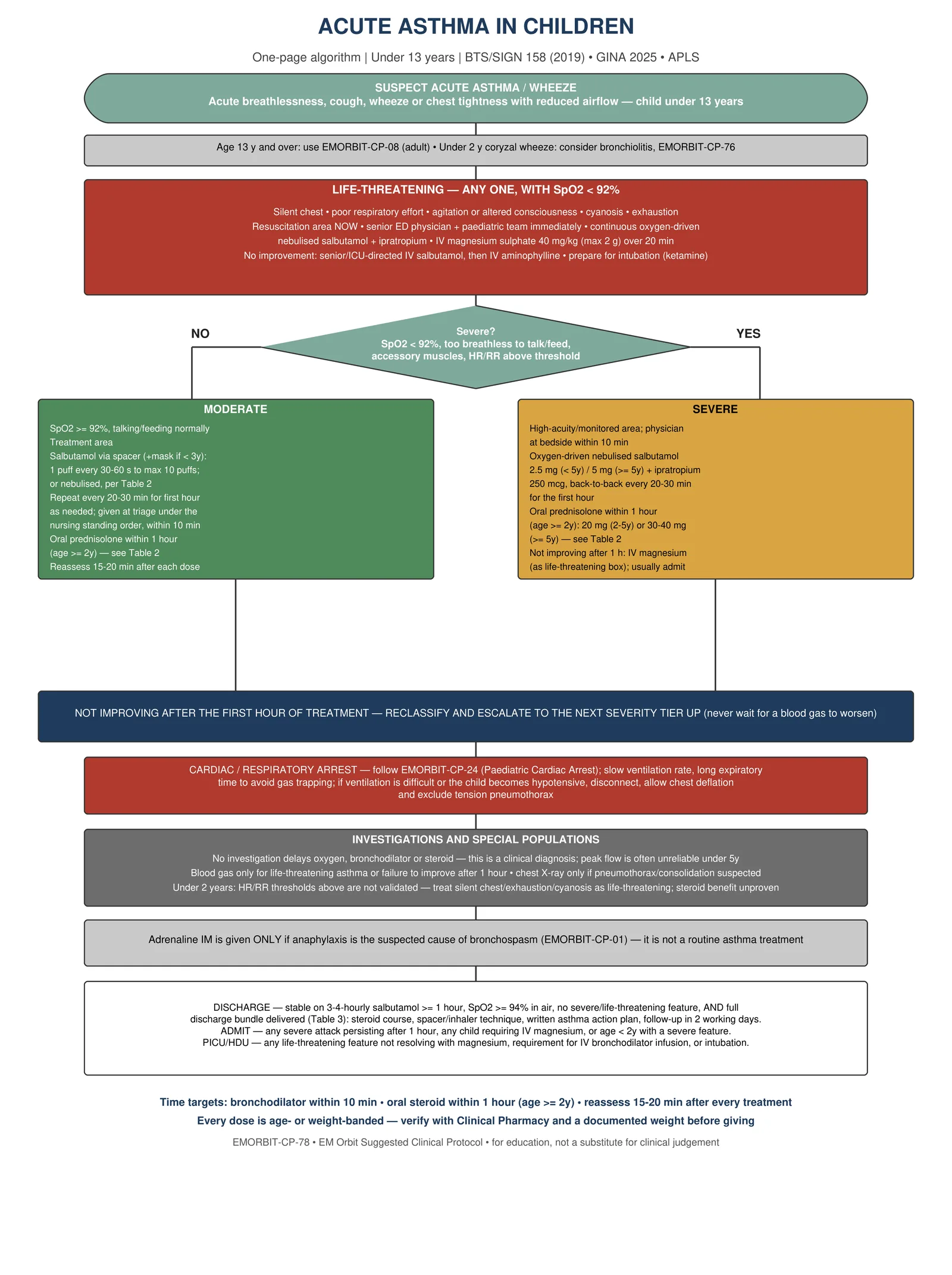
5Algorithm
The one-page algorithm is shown at the top of this page.
6Team roles
6.1Triage / ED Nurse:
6.1.1 Measure respiratory rate, heart rate, SpO₂, and ability to talk/feed at triage; classify severity (Table 1); give the first salbutamol dose under the standing order within 10 minutes for moderate attacks and move any life-threatening presentation to the resuscitation area immediately.
6.1.2 Deliver and document the discharge bundle: inhaler/spacer technique, PAAP education, and follow-up confirmation.
6.2Pharmacist:
6.2.1 Ensure paediatric salbutamol/ipratropium nebules, spacers with paediatric masks, prednisolone (including soluble preparations), hydrocortisone, and magnesium sulphate are stocked and weight-banded.
6.2.2 Verify all weight-based prescriptions, in particular IV magnesium, salbutamol, and aminophylline (including omission of the aminophylline load in a child on oral theophylline).
6.3Paediatrics:
6.3.1 Review every child with a severe or life-threatening attack, any child considered for admission, and any child under 2 years with a severe feature; direct ward or PICU placement.
6.4Critical Care / Anaesthesia (Paediatric):
6.4.1 Attend immediately for a life-threatening feature not responding to first-line therapy; lead intubation and IV bronchodilator therapy; accept patients meeting PICU criteria.
6.5Laboratory and Radiology:
6.5.1 Process blood gases and potassium as urgent samples; perform portable chest radiography in the resuscitation area for life-threatening asthma so the child is not moved.
6.6Ambulance / Pre-hospital Providers:
6.6.1 Pre-alert the ED for a child with severe or life-threatening features; hand over onset time, treatment given, and response using the structured (ATMIST/SBAR) format.
7The patient's role
7.1 The parent/carer informs the team of the current asthma treatment, reliever doses already taken, and any previous ICU admission or intubation for asthma.
7.2 The parent/carer reports worsening breathlessness, inability to talk/feed, or drowsiness immediately during treatment and observation.
7.3 The parent/carer gives the full oral steroid course where prescribed, uses the spacer correctly, and follows the written action plan, returning to the ED or calling the emergency number for the stated warning signs.
7.4 The parent/carer attends the follow-up appointment and the respiratory clinic when referred, and addresses household smoke exposure.
8Definitions
8.1Acute Asthma Exacerbation: a progressive increase in breathlessness, cough, wheeze, or chest tightness with a fall in airflow, sufficient to require a change in treatment (GINA 2025).
8.2Viral-induced Wheeze: episodic wheeze triggered by viral upper respiratory infection, typically under 5 years, without confirmed atopic asthma; managed with the same acute bronchodilator approach.
8.3Silent Chest: absence of audible wheeze because airflow is too low to generate sound — a life-threatening sign, not an improvement.
8.4Personalised Asthma Action Plan (PAAP): a written, individualised plan describing the child's daily treatment, warning signs, and when to seek emergency care.
8.5ICS, PICU, HDU, PCO₂: inhaled corticosteroid; paediatric intensive care unit; high-dependency unit; partial pressure of carbon dioxide.
8.6BTS, SIGN, NICE, GINA, APLS: British Thoracic Society; Scottish Intercollegiate Guidelines Network; National Institute for Health and Care Excellence; Global Initiative for Asthma; Advanced Paediatric Life Support.
9Attachments
- Attachment 1: One-page algorithm (top of this page)
- Attachment 2: Severity Classification and Drug Therapy Quick Reference
- Attachment 3: Paediatric Asthma Discharge Bundle Checklist
11Suggested quality indicators
11.1Severity classified at triage: (Number of children with a documented severity category and supporting vital signs at triage / Total number presenting with acute asthma) × 100. Target ≥ 95%.
11.2Bronchodilator within 10 minutes of arrival: (Number of children with a severe or life-threatening attack receiving the first bronchodilator within 10 minutes / Total number with a severe or life-threatening attack) × 100. Target ≥ 90%.
11.3Oral corticosteroid within 1 hour (age ≥ 2 years): (Number of children aged 2 years and over receiving prednisolone within 1 hour of arrival / Total number aged 2 years and over with acute asthma) × 100. Target ≥ 90%.
11.4Safe discharge bundle: (Number of discharged children with the complete discharge bundle documented / Total number discharged) × 100. Target ≥ 90%.
11.5Unplanned return within 7 days: (Number of children re-attending any ED with asthma within 7 days of discharge / Total number discharged) × 100. Monitored as an outcome indicator; PICU admission is reported alongside.
13References
- British Thoracic Society, Scottish Intercollegiate Guidelines Network. British guideline on the management of asthma. SIGN 158. Edinburgh: SIGN; 2019 (acute asthma in children in hospital chapter, retained as current guidance).
- National Institute for Health and Care Excellence, British Thoracic Society, Scottish Intercollegiate Guidelines Network. Asthma: diagnosis, monitoring and chronic asthma management. NICE guideline NG245. London: NICE; 2024.
- Global Initiative for Asthma. Global Strategy for Asthma Management and Prevention, 2025 update (including the diagnosis and management of asthma in children 5 years and younger). Fontana (WI): GINA; 2025.
- Advanced Life Support Group. Advanced Paediatric Life Support: The Practical Approach. 7th ed. Chichester: Wiley-Blackwell.
A2Attachment 2: Severity Classification and Drug Therapy Quick Reference
| Severity | Features (the most severe feature present defines the category) | Initial setting |
|---|---|---|
| Moderate | SpO₂ ≥ 92% in air; no feature of severe or life-threatening asthma below; able to talk and feed normally. | Treatment area; salbutamol via spacer or nebuliser; reassess 15–20 min |
| Severe | SpO₂ < 92%; too breathless to talk or feed; use of accessory neck muscles; heart rate > 140/min (2–5 y) or > 125/min (≥ 5 y); respiratory rate > 40/min (2–5 y) or > 30/min (≥ 5 y). | High-acuity area; physician within 10 min; back-to-back nebulised salbutamol + ipratropium; usually admit |
| Life-threatening | SpO₂ < 92% plus any ONE of: silent chest; poor respiratory effort; agitation or altered consciousness; cyanosis; exhaustion. | Resuscitation area; senior ED physician + paediatric team immediately; continuous nebulisation + IV magnesium; admit HDU/PICU |
Age bands and thresholds apply to children 2–12 years. Under 2 years (viral-induced wheeze): formal heart-rate/respiratory-rate thresholds are not validated; recognise the same silent-chest, exhaustion and cyanosis features and treat as life-threatening if present — see Special Populations (4.1.5) and EMORBIT-CP-76 (Bronchiolitis) for the infant with a coryzal/bronchiolitic pattern.
| Drug | Indication / timing | Dose | Cautions |
|---|---|---|---|
| Oxygen | SpO₂ < 94%; all severe and life-threatening attacks | Titrate to SpO₂ 94–98% via nasal cannula or face mask; drive nebulisers with oxygen | Do not withhold oxygen for fear of hypercapnia |
| Salbutamol (pMDI + spacer) | Moderate; or severe if a nebuliser is not immediately available | 1 puff (100 mcg) every 30–60 s to a maximum of 10 puffs, one at a time through a spacer (with facemask if < 3 y); repeat every 20–30 min for the first hour | As effective as nebuliser for moderate attacks |
| Salbutamol (nebulised) | First-line bronchodilator; severe and life-threatening: within 10 min of arrival | 2.5 mg (< 5 y) or 5 mg (≥ 5 y) oxygen-driven; back-to-back every 20–30 min for the first hour, or continuous, then 4-hourly | Tachycardia, tremor, hypokalaemia; check potassium with repeated doses |
| Ipratropium bromide (nebulised) | Added to salbutamol for severe and life-threatening attacks | 250 micrograms mixed with salbutamol every 20–30 min for the first hour (maximum 3 doses), then 4–6-hourly if continued | Dry mouth; avoid mist in the eyes; no benefit from more frequent dosing beyond the first hour |
| Prednisolone (oral) | ALL acute attacks aged ≥ 2 years, within 1 hour of arrival | 2–5 years: 20 mg; ≥ 5–12 years: 30–40 mg (or 1–2 mg/kg, maximum 40 mg); once daily up to 3 days; repeat the dose if vomited within 30 min | Under 2 years: benefit is unproven (as for bronchiolitis, EMORBIT-CP-76) — give only on senior/paediatric advice |
| Hydrocortisone (IV) | Oral route not possible (vomiting, life-threatening, reduced consciousness) | 4 mg/kg (maximum 100 mg) IV every 6 hours | Change to oral prednisolone as soon as tolerated |
| Magnesium sulphate (IV) | Severe with poor response to first-line inhaled therapy; ALL life-threatening attacks | 40 mg/kg (maximum 2 g) IV over 20 minutes; single dose | Monitor blood pressure during infusion; repeat doses are not recommended |
| Salbutamol (IV) — senior/ICU advice only | Life-threatening not responding to inhaled therapy and magnesium | Bolus 15 micrograms/kg (maximum 250 mcg) IV over 10 min, then infusion 1–5 micrograms/kg/min titrated to response | Continuous ECG; potassium and lactate every 2–4 h |
| Aminophylline (IV) — senior/ICU advice only | Life-threatening not responding to inhaled therapy, magnesium and IV salbutamol | Loading 5 mg/kg (maximum 500 mg) IV over 20 min — OMIT if on oral theophylline, send a level first; infusion 1 mg/kg/hour | Narrow therapeutic window: arrhythmia, seizures, vomiting; continuous ECG |
| Adrenaline (IM) | ONLY when anaphylaxis is the suspected cause of bronchospasm | Age-band dosing per EMORBIT-CP-01 (Anaphylaxis) | Not a routine treatment of asthma |
Not recommended: routine antibiotics (most exacerbations are viral), nebulised magnesium sulphate, heliox, leukotriene receptor antagonists in the acute phase, sedatives outside a secured airway, and chest physiotherapy.
Children aged 13 years and over: use EMORBIT-CP-08 (Acute Asthma in Adults) adult doses. Under 2 years: see Special Populations (section 4.1.5) — steroid benefit is unproven and formal RR/HR thresholds are not validated.
A3Attachment 3: Paediatric Asthma Discharge Bundle Checklist
| ✓ | Item |
|---|---|
| ☐ | Stable on 3–4-hourly (or less frequent) salbutamol for at least 1 hour; SpO₂ ≥ 94% on air; no severe or life-threatening feature (Table 1). |
| ☐ | Oral prednisolone course completed or dispensed to complete (first dose already given in the ED). |
| ☐ | Inhaled corticosteroid started, restarted, or stepped up where the child is already on one; never discharge on a short-acting β₂-agonist alone if the child has an established ICS regimen. |
| ☐ | Inhaler and spacer technique observed and corrected with the carer; spacer (with mask if < 3 y) supplied. |
| ☐ | Written personalised asthma action plan (PAAP) issued or updated, stating when to give extra salbutamol, when to start/repeat oral steroid, and when to return or call the emergency number. |
| ☐ | Trigger(s) discussed (viral infection, allergen, smoke exposure); smoking/vaping in the household addressed. |
| ☐ | Follow-up booked: primary care / paediatrician within 2 working days; respiratory (asthma) clinic within 4 weeks if admitted, life-threatening/near-fatal, or ≥ 2 attacks in 12 months. |
| ☐ | Discharge letter to primary care physician stating severity, treatment given, and follow-up plan. |
Discharge shall be by, or after discussion with, the ED specialist or consultant. File the completed checklist in the medical record.