Croup (Acute Viral Laryngotracheobronchitis)
EMORBIT-CP-77 · Chapter 12 · Paediatric Emergencies
Open in the appFree, works on your phone and offline, with every tool alongside.
Evidence base: TREKK; Alberta CPG; RCH Melbourne
1Purpose
1.1 Standardize the recognition, severity grading, and treatment of croup in children presenting to Emergency Departments (ED), so that oral dexamethasone is given to every child regardless of severity and nebulised adrenaline is used promptly for severe disease.
1.2 Ensure the child with stridor who does not have simple croup — epiglottitis, bacterial tracheitis, foreign body, or anaphylaxis — is recognised early and is not examined or handled in a way that risks complete airway obstruction.
1.3 Ensure a safe minimum observation period after nebulised adrenaline, to detect rebound of stridor as the drug wears off, before any child is discharged.
2Who this protocol applies to
2.1 Children under 13 years with a barking (“seal-like”) cough, with or without stridor or a hoarse voice, typically following 1–2 days of coryzal symptoms — croup is a clinical diagnosis. Peak incidence is 6 months to 3 years; most cases occur under 6 years.
2.2 Recurrent (spasmodic) croup without a preceding viral prodrome is managed the same way in the ED as typical croup.
3Not covered by this protocol
3.1 Toxic appearance, drooling, tripod positioning, absent cough, or rapid deterioration: manage as suspected epiglottitis (section 4.1.5), not croup.
3.2 Sudden-onset stridor or choking with a preceding well child and no coryzal prodrome: manage as suspected foreign body aspiration.
3.3 Stridor with urticaria, angioedema, or a known allergen exposure: manage per EMORBIT-CP-01 (Anaphylaxis).
3.4 Age under 3 months, or a known structural airway abnormality (e.g. subglottic stenosis, vascular ring, laryngomalacia, prior intubation): croup is uncommon and atypical at this age — keep a low threshold for an alternative diagnosis and ENT involvement (section 4.1.6).
4Protocol
4.1History and Assessment:
4.1.1Triage and Recognition:
4.1.1.1 Assess from a distance before touching the child: work of breathing, stridor at rest, colour, and level of alertness, on the carer’s lap.
4.1.1.2 Do NOT examine the throat, use a tongue depressor, or attempt to lie the child flat at triage. Keep the child and carer together and minimise handling (Table 2).
4.1.1.3 Any severe feature or impending-failure feature (Table 1) is triaged to the highest acuity category; the ED physician shall attend immediately.
4.1.2History:
4.1.2.1 Onset and duration of barking cough, stridor, and preceding coryzal symptoms; any fever.
4.1.2.2 Any choking episode, sudden onset without a preceding cold, or exposure to a small object or food (foreign body).
4.1.2.3 Any known allergen exposure, urticaria, or facial/lip swelling (anaphylaxis).
4.1.2.4 Previous episodes of croup, prior intubation, known airway abnormality, immunisation status (including Haemophilus influenzae type b), and vaccination status against diphtheria where relevant.
4.1.3Examination:
4.1.3.1 Observe first, at a distance, on the carer’s lap: respiratory rate, recession, stridor at rest versus only on crying/agitation, colour, and level of alertness.
4.1.3.2 Auscultation and oximetry are performed with minimal disturbance; do not force the child to lie down or separate from the carer.
4.1.3.3 Do not examine the oropharynx or attempt to visualise the airway if epiglottitis or bacterial tracheitis is possible (Table 2).
4.1.4Risk Stratification – Severity: Grade using Table 1 (Westley-based clinical grading, as used by Alberta CPG and TREKK); severity may change quickly and shall be reassessed after every intervention.
Table 1: Clinical severity and initial ED action (Westley-based; Alberta CPG / TREKK grading) Severity Features Initial ED action Mild Occasional barking cough; no stridor at rest; no or mild suprasternal/intercostal recession; child comfortable, happy, feeding. Oral dexamethasone (Table 2). Reassess in 30–60 minutes. No adrenaline needed. Moderate Frequent barking cough; stridor audible at rest; suprasternal and sternal recession at rest; little or no agitation. Oral dexamethasone (Table 2). Minimal handling. Reassess; give nebulised adrenaline if not settling or any severe feature develops. Severe Frequent barking cough; prominent inspiratory (± expiratory) stridor at rest; marked recession; significant distress, agitation, or tachycardia. Nebulised adrenaline AND oral dexamethasone immediately; call senior ED physician; continuous monitoring; keep with carer. Impending respiratory failure Stridor may become quiet; decreased or absent air entry; cyanosis or pallor; lethargy or decreased level of consciousness; tachycardia progressing to bradycardia (late, pre-arrest). Call senior ED physician, anaesthesia/ENT, and paediatric critical care immediately. Nebulised adrenaline. Prepare for advanced airway management (EMORBIT-CP-31). Minimal handling. 4.1.5Differential Diagnosis:
4.1.5.1 Epiglottitis: toxic appearance, drooling, tripod position, absent or minimal cough, rapid deterioration — do NOT examine the throat; call anaesthesia/ENT and the senior ED physician immediately and keep the child calm with the carer.
4.1.5.2 Bacterial tracheitis: toxic appearance, high fever, thick secretions, and poor response to nebulised adrenaline — consider intensive care and ENT/anaesthesia review.
4.1.5.3 Foreign body aspiration: sudden onset, a choking history, no preceding coryza, or asymmetrical chest signs.
4.1.5.4 Anaphylaxis: stridor with urticaria, angioedema, or a known allergen exposure — manage per EMORBIT-CP-01.
4.1.5.5 Retropharyngeal or peritonsillar abscess: neck stiffness or torticollis, drooling, trismus, or a muffled voice.
4.1.6Special Populations:
4.1.6.1 Age under 3 months, or known airway anomaly (subglottic stenosis, vascular ring, laryngomalacia, prior intubation, Down syndrome): croup is uncommon and may be atypical or more severe; keep a lower threshold to admit and involve ENT/paediatrics early.
4.1.6.2 Recurrent (spasmodic) croup: manage the acute episode identically; refer to paediatrics/ENT if frequent or severe episodes recur.
4.2Investigations:
4.2.1 Croup is a clinical diagnosis. No blood tests, viral swab, or imaging is routinely required and none shall delay treatment.
4.2.2 Do not request a lateral neck or chest X-ray as routine (Table 2); consider only if the diagnosis is uncertain in a stable child, and only after senior discussion, because moving the child for imaging can precipitate distress and worsen obstruction.
4.2.3 Continuous or intermittent pulse oximetry is used to monitor a child receiving adrenaline or with severe/impending-failure features, but a normal reading does not exclude significant obstruction (Table 2); base severity on clinical assessment.
4.3Plan of Care:
4.3.1Immediate Actions:
4.3.1.1 Keep the child calm and with the carer at all times; avoid any handling, examination, or procedure that is not essential (Table 2).
4.3.1.2 Any severe or impending-failure feature (Table 1): move to a monitored area, call the senior ED physician immediately, and give nebulised adrenaline without waiting for further assessment.
4.3.1.3 Give supplemental oxygen only if hypoxic or in impending failure, delivered in a way tolerated by the child (blow-by if a mask distresses them).
4.3.2Definitive ED Treatment:
4.3.2.1Oral dexamethasone (all severities): a single oral dose is given to every child with croup, regardless of severity, as soon as possible after recognition (Table 3).
4.3.2.2Dexamethasone dose: the evidence base for this guideline (Alberta CPG, TREKK) uses 0.6 mg/kg (maximum 10 mg) for all severities. Some sources (e.g. Royal Children’s Hospital Melbourne) use a lower dose of 0.15 mg/kg (maximum 10 mg) for mild-to-moderate croup, shown to be clinically equivalent to 0.6 mg/kg (Bjornson et al., Cochrane review). The two doses are equally effective (Cochrane), so this guideline allows 0.15–0.6 mg/kg (maximum 10 mg).
4.3.2.3Nebulised adrenaline (severe, impending failure, or moderate not settling): give immediately, at the dose in Table 3, in addition to dexamethasone; do not delay for dexamethasone to take effect. May repeat after 15–20 minutes if severe features persist.
4.3.3Escalation – Refractory / Impending Failure:
4.3.3.1 More than two doses of nebulised adrenaline, an ongoing requirement, or any impending-failure feature (Table 1): call the senior ED physician, anaesthesia/ENT, and paediatric critical care immediately.
4.3.3.2 Prepare for advanced airway management per EMORBIT-CP-31 (Airway/RSI); the most experienced operator shall manage the airway, with a surgical airway plan in place, because croup can make intubation difficult.
4.3.3.3 Cardiorespiratory arrest during croup: manage per EMORBIT-CP-24 (Paediatric Cardiac Arrest).
4.3.4Monitoring and Reassessment:
4.3.4.1 Reassess severity (Table 1) after every intervention and at fixed intervals proportionate to severity; a rising severity grade at any point mandates immediate escalation.
4.3.4.2 Any child given nebulised adrenaline shall be observed for a minimum of 3 to 4 hours from the time of the dose, watching specifically for rebound of stridor and recession as the drug wears off, before any discharge decision is made.
4.3.5Disposition:
4.3.5.1 Discharge: no stridor at rest, comfortable, adequate oral intake, a reliable carer able to return, and — if adrenaline was given — the minimum 3–4 hour observation period completed with no recurrence of severe features.
4.3.5.2 Admit: severe croup or impending respiratory failure; more than two doses of adrenaline or an ongoing requirement; persistent stridor at rest after the observation period; hypoxia; age under 3 months or a known airway anomaly; or social factors (carer unable to manage or return, distance from emergency care).
4.3.6Discharge and Follow-up:
4.3.6.1 Give written safety-netting advice (Attachment 2): keep the child calm and upright, cool humidified air is not proven but is not harmful, and symptoms are usually worst on the second or third night.
4.3.6.2 Advise the carer to return immediately, or call the emergency number, for stridor at rest, increasing work of breathing, drowsiness, pale or blue colour, drooling, or difficulty swallowing.
4.3.6.3 No routine follow-up is required after an uncomplicated single episode; refer to paediatrics/ENT for recurrent or severe episodes.
4.3.7Documentation and Reporting:
4.3.7.1 Document: severity grade at each assessment, time and dose of dexamethasone, time and dose of each adrenaline treatment, response, the observation period completed, and the disposition and its reasoning.
5Algorithm
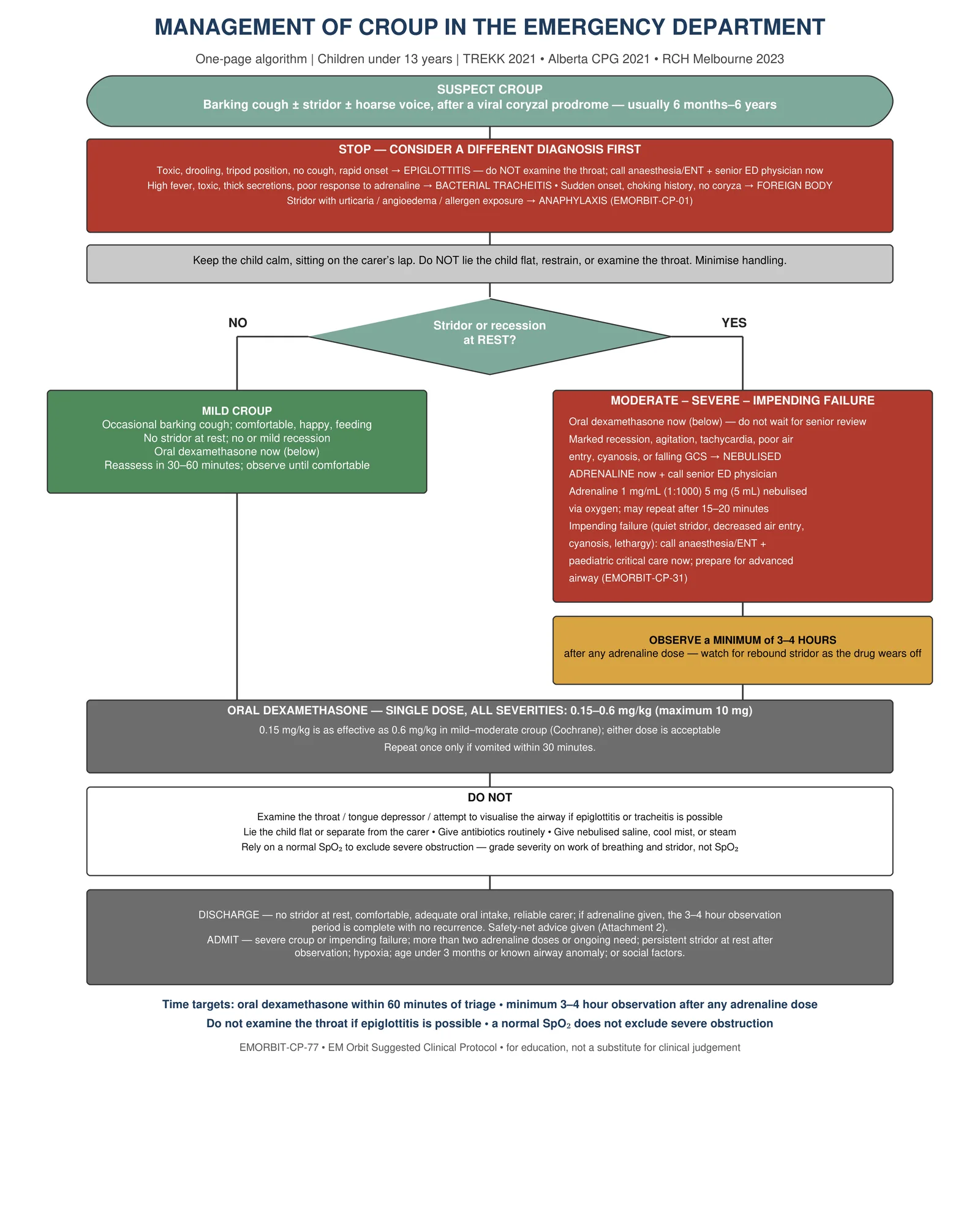
The one-page algorithm is shown at the top of this page.
6Team roles
6.1Triage / ED Nurse:
6.1.1 Assess from a distance before touching the child; recognise a severe or impending-failure feature and move the child to a monitored area without delay, keeping the child with the carer.
6.1.2 Do not attempt a throat examination or lie the child flat.
6.2Pharmacist:
6.2.1 Verify the dexamethasone dose and maximum, and the adrenaline concentration and dose, against the current department standard; confirm which adrenaline preparation is stocked for nebulisation.
6.3Paediatrics:
6.3.1 Review any child admitted, and any child under 3 months or with a known airway anomaly.
6.4Anaesthesia / ENT:
6.4.1 Attend immediately when called for suspected epiglottitis, bacterial tracheitis, or impending respiratory failure; lead advanced/surgical airway management where required.
7The patient's role
7.1 The carer keeps the child calm and upright, avoids distressing the child, and reports any choking history or allergen exposure.
7.2 The carer follows the written safety-netting advice and returns immediately, or calls the emergency number, for any of the return-immediately features.
8Definitions
8.1Croup: acute viral laryngotracheobronchitis causing a barking cough, stridor, and hoarse voice, most often in children aged 6 months to 6 years.
8.2Stridor: a harsh, high-pitched inspiratory sound caused by upper airway narrowing; stridor at rest indicates at least moderate severity (Table 1).
8.3Rebound Stridor: recurrence of stridor and recession as nebulised adrenaline wears off, typically within 2–4 hours — the reason for the mandatory observation period.
8.4Impending Respiratory Failure: quiet stridor, decreased air entry, cyanosis or pallor, and a falling level of consciousness — a pre-arrest state requiring immediate senior and anaesthesia/ENT involvement.
9Attachments
- Attachment 1: One-page algorithm (top of this page)
- Attachment 2: Severity Grading, What-Not-To-Do List, Drug Doses, and Discharge Safety-Netting Advice
11Suggested quality indicators
11.1Time to oral dexamethasone ≤ 60 minutes of triage (time-to-treatment): (Number of children with croup given dexamethasone within 60 minutes of triage / Total number of children treated for croup) × 100. Target ≥ 90%.
11.2Severity grade documented at first assessment (process): (Number of croup presentations with a Table 1 severity grade recorded / Total number of croup presentations) × 100. Target ≥ 95%.
11.3Minimum observation period met after adrenaline (safe disposition): (Number of children given nebulised adrenaline observed for at least 3 hours before discharge / Total number of children given adrenaline and discharged) × 100. Target ≥ 95%.
11.4Safe discharge bundle (safe disposition): (Number of discharged children with dexamethasone given and written safety-netting advice documented / Total number of children discharged) × 100. Target ≥ 90%.
11.5Unplanned return within 72 hours (outcome): (Number of children re-attending within 72 hours with worsening croup / Total number discharged) × 100. Monitored as an outcome indicator.
13References
- Translating Emergency Knowledge for Kids (TREKK). Croup: Emergency Department Bottom Line Recommendations. Edmonton: TREKK; 2021.
- Alberta Health Services. Paediatric Croup Clinical Practice Guideline. Edmonton: Alberta Health Services; 2021.
- Royal Children’s Hospital Melbourne. Clinical Practice Guidelines: Croup (laryngotracheobronchitis). Melbourne: RCH; 2023.
- Bjornson CL, Klassen TP, Williamson J, et al. A randomized trial of a single dose of oral dexamethasone for mild croup. N Engl J Med. 2004;351(13):1306–1313.
- Bjornson C, Russell K, Vandermeer B, Klassen TP, Johnson DW. Nebulized epinephrine for croup in children. Cochrane Database Syst Rev. 2011;(2):CD006619.
A2Attachment 2: Severity Grading, What-Not-To-Do List, Drug Doses, and Discharge Safety-Netting Advice
| Severity | Features | Initial ED action |
|---|---|---|
| Mild | Occasional barking cough; no stridor at rest; no or mild suprasternal/intercostal recession; child comfortable, happy, feeding. | Oral dexamethasone (Table 2). Reassess in 30–60 minutes. No adrenaline needed. |
| Moderate | Frequent barking cough; stridor audible at rest; suprasternal and sternal recession at rest; little or no agitation. | Oral dexamethasone (Table 2). Minimal handling. Reassess; give nebulised adrenaline if not settling or any severe feature develops. |
| Severe | Frequent barking cough; prominent inspiratory (± expiratory) stridor at rest; marked recession; significant distress, agitation, or tachycardia. | Nebulised adrenaline AND oral dexamethasone immediately; call senior ED physician; continuous monitoring; keep with carer. |
| Impending respiratory failure | Stridor may become quiet; decreased or absent air entry; cyanosis or pallor; lethargy or decreased level of consciousness; tachycardia progressing to bradycardia (late, pre-arrest). | Call senior ED physician, anaesthesia/ENT, and paediatric critical care immediately. Nebulised adrenaline. Prepare for advanced airway management (EMORBIT-CP-31). Minimal handling. |
| Do not | Why |
|---|---|
| Examine the throat, use a tongue depressor, or attempt to visualise the airway in a distressed child with stridor | May precipitate complete airway obstruction, particularly if epiglottitis or bacterial tracheitis is possible. |
| Lie the child flat, restrain, or separate from the carer | Increases distress and work of breathing. Keep the child sitting up on the carer’s lap; minimise painful procedures (venepuncture, cannulation) unless essential. |
| Give antibiotics routinely | Croup is viral. Reserve antibiotics for a specific suspected bacterial cause (bacterial tracheitis) under senior direction. |
| Give nebulised saline (hypertonic or normal), cool mist, or steam | No proven benefit. |
| Rely on a normal oxygen saturation to exclude significant obstruction | SpO₂ is often preserved until late, sudden decompensation. Grade severity on work of breathing and stridor (Table 1), not SpO₂ alone. |
| Request a lateral neck X-ray as a routine test | Not needed for typical croup and delays treatment. Consider only if the diagnosis is uncertain in a stable child, and only after senior discussion. |
| Drug | Dose | Notes |
|---|---|---|
| Dexamethasone, oral, single dose — ALL severities | 0.15–0.6 mg/kg (maximum 10 mg) | See dosing note below. May repeat once if vomited within 30 minutes. Use the oral solution; if unavailable, the IV preparation may be given orally. |
| Adrenaline, nebulised — severe / impending failure, or moderate not settling | 1 mg/mL (1:1000) 5 mg (5 mL) undiluted, via oxygen-driven nebuliser | May repeat after 15–20 minutes if severe features persist. More than two doses, or ongoing need, mandates senior ED physician and paediatric critical care review (section 4.3.3). |
All doses in this table require verification by Clinical Pharmacy before use.
1Discharge Safety-Netting Advice (give in writing):
- Keep the child calm and upright; symptoms are usually worst on the second or third night of the illness.
- Return immediately, or call the emergency number, for: stridor at rest, increasing work of breathing, drowsiness, pale or blue colour, drooling, or difficulty swallowing.