Foreign Body Airway Obstruction and Aspiration
EMORBIT-CP-94 · Chapter 3 · Respiratory Emergencies
Open in the appFree, works on your phone and offline, with every tool alongside.
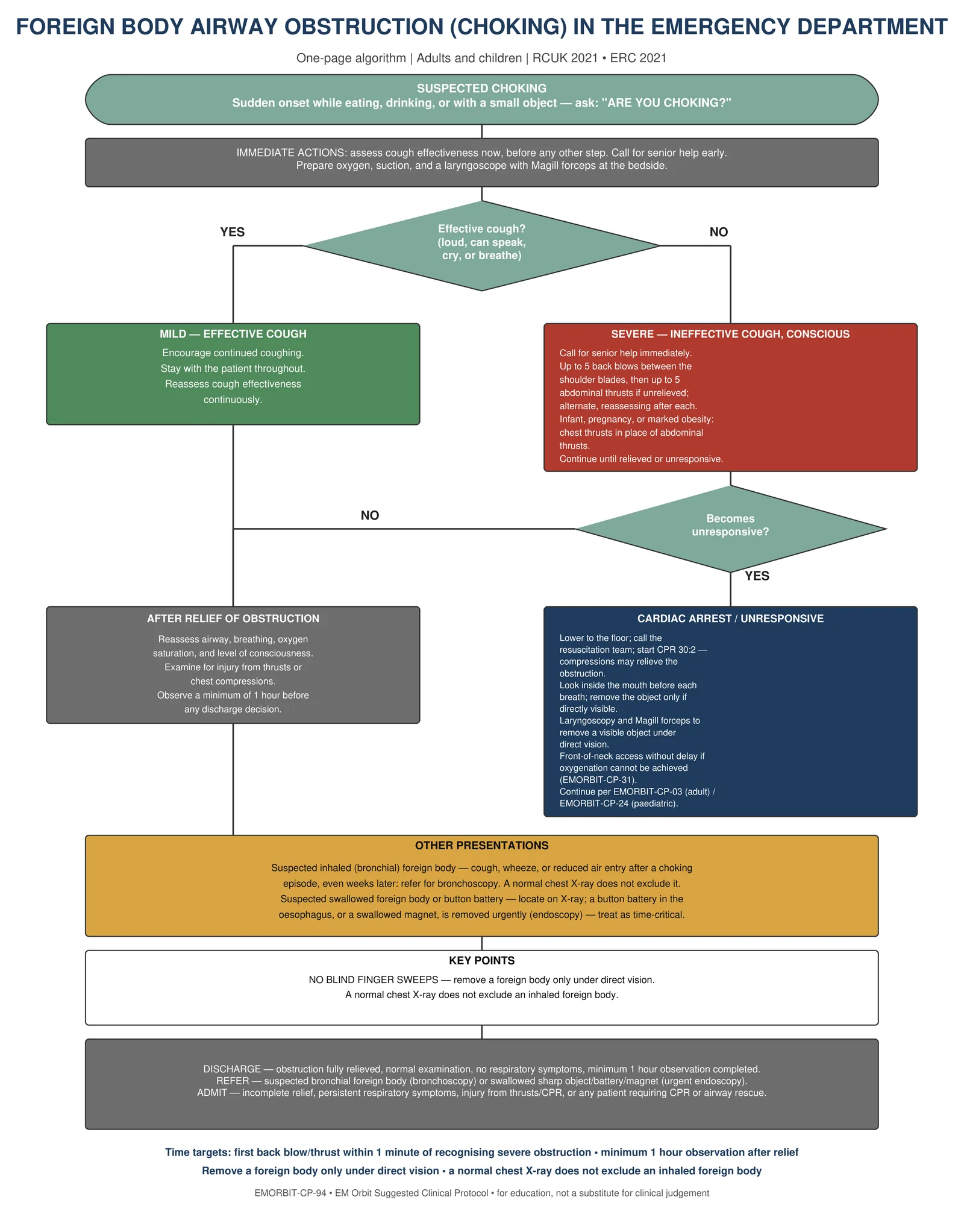
Evidence base: RCUK 2021; ERC 2021
1Purpose
1.1 Standardize the immediate recognition and management of foreign body airway obstruction (choking) in adults and children presenting to Emergency Departments (ED), so that back blows, abdominal or chest thrusts, and — for the unresponsive patient — CPR and airway rescue are started without delay.
1.2 Ensure that no blind finger sweep is ever performed — a foreign body is removed only when directly visible, under direct vision, and that front-of-neck access is available without delay if oxygenation cannot otherwise be achieved.
1.3 Ensure the child or adult with a suspected inhaled (bronchial) foreign body is referred for bronchoscopy on clinical suspicion, because a normal chest X-ray does not exclude it.
2Who this protocol applies to
2.1 Any adult or child with witnessed or suspected acute foreign body airway obstruction (choking) — sudden onset while eating, drinking, or playing with a small object; coughing, gagging, stridor, or inability to speak or breathe.
2.2 A child or adult with symptoms consistent with a lower-airway (bronchial) foreign body following a choking or witnessed-inhalation episode — persistent cough, unilateral wheeze, or reduced air entry, including presentation days to weeks after the event.
2.3 A swallowed (oesophageal) foreign body, including a button battery, presenting with drooling, dysphagia, chest or throat discomfort, or a witnessed ingestion.
3Not covered by this protocol
3.1 Gradual-onset stridor with a coryzal prodrome and no choking history: manage as croup per EMORBIT-CP-77.
3.2 Toxic appearance, drooling, and rapid deterioration with no choking history: manage as suspected epiglottitis per EMORBIT-CP-77 section 4.1.5 — a throat examination is avoided.
3.3 Stridor with urticaria, angioedema, or a known allergen exposure: manage per EMORBIT-CP-01 (Anaphylaxis).
3.4 A foreign body confined to the ear or nose, with no airway or aspiration risk: managed by ENT on its own merits, outside this guideline.
4Protocol
4.1History and Assessment:
4.1.1Triage and Recognition:
4.1.1.1 Ask a distressed patient "are you choking?" — a universal sign for airway obstruction is the patient clutching the throat.
4.1.1.2 Assess cough effectiveness at once, before any other step (Table 1); any severe or unresponsive presentation is triaged to the highest acuity category and the ED physician attends immediately.
4.1.2History:
4.1.2.1 Onset while eating, drinking, or with a small object or button battery; whether the episode was witnessed; any bystander first aid already given and its effect.
4.1.2.2 For a possible lower-airway aspiration: a choking or coughing episode in the preceding days to weeks, followed by persistent cough, wheeze, or a chest infection that does not resolve.
4.1.2.3 For a suspected swallowed object: what was swallowed (a button battery and a magnet are treated as time-critical), when, and any drooling or inability to swallow saliva.
4.1.3Examination:
4.1.3.1 Cough effectiveness, ability to speak, stridor, cyanosis, and level of consciousness (Table 1).
4.1.3.2 Chest auscultation for asymmetrical air entry or unilateral wheeze, which supports a bronchial foreign body.
4.1.3.3 A visible object at the back of the throat is noted for removal under direct vision (section 4.3.2); the airway is not otherwise instrumented in an awake, breathing patient.
4.1.4Risk Stratification – Severity: Grade using Table 1; severity can change within seconds and shall be reassessed continuously and after every intervention.
Table 1: Severity assessment and immediate ED action Severity Features Immediate action Mild (effective cough) Loud cough; able to speak, cry, or breathe between coughs; fully responsive. Encourage continued coughing. Stay with the patient. Reassess cough effectiveness continuously. Severe (ineffective cough), conscious Cannot speak, cry, or breathe; cough is silent or weakening; increasing distress; may become cyanosed. Call for senior help immediately. Back blows and abdominal (or chest) thrusts (Table 2). Unresponsive Loses consciousness; no effective breathing. Lower to the floor, call the resuscitation team, and start CPR at 30:2 (section 4.3.3). 4.1.5Differential Diagnosis:
4.1.5.1 Croup: gradual onset, coryzal prodrome, barking cough — manage per EMORBIT-CP-77.
4.1.5.2 Epiglottitis / bacterial tracheitis: toxic appearance, drooling, rapid deterioration, no choking history — per EMORBIT-CP-77 section 4.1.5; a throat examination is avoided.
4.1.5.3 Anaphylaxis: stridor with urticaria, angioedema, or an allergen exposure — manage per EMORBIT-CP-01.
4.1.5.4 Asthma / bronchospasm: wheeze with a known history and no choking event.
4.1.6Special Populations:
4.1.6.1 Infant under 1 year: back blows and chest thrusts, not abdominal thrusts (Table 2).
4.1.6.2 Pregnancy or marked obesity: chest thrusts in place of abdominal thrusts (Table 2).
4.1.6.3 Suspected inhaled foreign body in a child with a normal chest X-ray: the X-ray does not exclude the diagnosis; refer for bronchoscopy on clinical suspicion (section 4.3.5).
4.2Investigations:
4.2.1 Choking is a clinical diagnosis; imaging never delays back blows, thrusts, or CPR.
4.2.2 For a stable patient with suspected lower-airway aspiration: chest X-ray may show hyperinflation, atelectasis, or mediastinal shift, but most inhaled organic and plastic objects are radiolucent and are not seen — a normal film does not exclude the diagnosis and does not defer a bronchoscopy referral made on clinical grounds.
4.2.3 For a suspected swallowed object or button battery: a soft-tissue neck, chest, and abdominal X-ray localises a radio-opaque object; a button battery shows a characteristic double-ring ("halo") shadow, distinguishing it from a coin.
4.3Plan of Care:
4.3.1Immediate Actions:
4.3.1.1 Determine cough effectiveness (Table 1) before any other assessment. Call for senior help early for any severe or deteriorating presentation.
4.3.1.2 Prepare oxygen, suction, and a laryngoscope and Magill forceps at the bedside whenever severity is more than mild.
4.3.2Definitive ED Treatment:
4.3.2.1Severe obstruction, conscious: back blows and abdominal or chest thrusts by population (Table 2), alternating and reassessing after each, continuing until relieved or the patient becomes unresponsive.
4.3.2.2Unresponsive patient: lower to the floor, call the resuscitation team, and start CPR at 30:2 — chest compressions may themselves relieve the obstruction. Open the airway and look inside the mouth before each rescue breath; remove the object only if it is directly visible (a blind finger sweep risks pushing the object further in). Use laryngoscopy and Magill forceps to remove a visible object under direct vision.
4.3.2.3Cannot-intubate-cannot-oxygenate: proceed to front-of-neck access without delay per EMORBIT-CP-31 if oxygenation cannot be achieved by any other means.
4.3.3Escalation – Refractory / Cardiac Arrest:
4.3.3.1 A patient who arrests from choking is managed per EMORBIT-CP-03 (adult) or EMORBIT-CP-24 (paediatric); continue attempts at direct-vision removal between compression cycles.
4.3.3.2 Persistent complete obstruction despite laryngoscopy and Magill forceps: front-of-neck access per EMORBIT-CP-31, led by the most experienced operator available.
4.3.4Monitoring and Reassessment:
4.3.4.1 Reassess airway, breathing, oxygen saturation, and level of consciousness continuously during any manoeuvre and immediately after relief.
4.3.4.2 Examine for injury from abdominal or chest thrusts, or from chest compressions, before disposition.
4.3.4.3 Observe for a minimum of 1 hour after relief of a severe obstruction, watching for respiratory symptoms, before any discharge decision.
4.3.5Disposition:
4.3.5.1 Discharge: obstruction fully relieved, normal examination, no respiratory symptoms, and the minimum observation period completed.
4.3.5.2 Refer for bronchoscopy: cough, wheeze, or reduced air entry after a choking episode, whether or not the chest X-ray is normal.
4.3.5.3 Refer for urgent endoscopy: a swallowed sharp object, a button battery, or a magnet — treated as time-critical because of the risk of perforation or bowel-wall injury.
4.3.5.4 Admit: incomplete relief, persistent respiratory symptoms, injury from thrusts or compressions requiring further assessment, or any patient who required CPR or airway rescue.
4.3.6Discharge and Follow-up:
4.3.6.1 Give written safety-netting advice (Attachment 2): return immediately, or call the emergency number, for stridor, increasing breathlessness, drooling, or chest pain.
4.3.6.2 No routine follow-up is required after a fully relieved mild or moderate episode with a normal examination.
4.3.7Documentation and Reporting:
4.3.7.1 Document: severity grade, manoeuvres performed and number of attempts, whether an object was recovered or accounted for, complications, the observation period, and the disposition and its reasoning.
5Algorithm
The one-page algorithm is shown at the top of this page.
6Team roles
6.1Triage / ED Nurse:
6.1.1 Recognise the choking sign and any severe or unresponsive feature and escalate immediately; begin back blows or thrusts if trained and no clinician is immediately available.
6.2Pharmacist:
6.2.1 Advise on sedation or analgesia where required for a co-operative removal procedure or for endoscopy.
6.3ENT / Anaesthesia:
6.3.1 Attend immediately for laryngoscopy and Magill forceps removal, front-of-neck access, or a difficult airway; perform bronchoscopy for a suspected inhaled foreign body.
6.4Laboratory / Radiology:
6.4.1 Perform chest or soft-tissue X-ray promptly when indicated, without delaying back blows, thrusts, or CPR; prioritise imaging for a suspected button battery.
6.5Ambulance / Paramedic:
6.5.1 Pre-alert the ED for an ongoing choking episode or arrest en route and hand over the manoeuvres already performed.
7The patient's role
7.1 The patient or carer co-operates with back blows and thrusts while conscious and reports if the sensation of obstruction persists.
7.2 The carer follows the written safety-netting advice and returns immediately, or calls the emergency number, for any return-immediately feature.
8Definitions
8.1Effective Cough: a loud cough with the ability to speak, cry, or breathe between coughs — a sign of partial, not complete, obstruction.
8.2Ineffective (Silent) Cough: a weak or absent cough with inability to speak, cry, or breathe — severe obstruction requiring immediate back blows and thrusts.
8.3Front-of-Neck Access: an emergency surgical airway (cricothyroidotomy) performed when oxygenation cannot be achieved by any other means — see EMORBIT-CP-31.
8.4Inhaled (Bronchial) Foreign Body: an object lodged below the larynx, which may present acutely or, after an unwitnessed or forgotten episode, with a persistent unilateral respiratory sign and a normal chest X-ray.
9Attachments
- Attachment 1: One-page algorithm (top of this page)
- Attachment 2: Severity Table, Technique by Population, and Discharge Safety-Netting Advice
11Suggested quality indicators
11.1Time to first back blow or thrust in severe obstruction (time-to-treatment): (Number of patients with severe obstruction receiving the first manoeuvre within 1 minute of recognition / Total number with severe obstruction) × 100. Target ≥ 90%.
11.2Severity grade documented at first assessment (process): (Number of choking presentations with a Table 1 severity grade recorded / Total number of choking presentations) × 100. Target ≥ 95%.
11.3Bronchoscopy referral for suspected inhaled foreign body despite a normal chest X-ray (process): (Number of such patients referred for bronchoscopy / Total number with a choking history and a persistent respiratory sign) × 100. Target ≥ 90%.
11.4Minimum observation period met after a severe episode (safe disposition): (Number of patients observed for at least 1 hour after relief before discharge / Total number discharged after a severe episode) × 100. Target ≥ 95%.
11.5Unplanned return within 72 hours (outcome): (Number of patients re-attending within 72 hours with a respiratory complaint / Total number discharged) × 100. Monitored as an outcome indicator.
13References
- Resuscitation Council UK. Adult Basic Life Support Guidelines. London: RCUK; 2021.
- Resuscitation Council UK. Paediatric Basic Life Support Guidelines. London: RCUK; 2021.
- Olasveengen TM, Semeraro F, Ristagno G, et al. European Resuscitation Council Guidelines 2021: Basic Life Support. Resuscitation. 2021;161:98–114.
- Van de Voorde P, Turner NM, Djakow J, et al. European Resuscitation Council Guidelines 2021: Paediatric Life Support. Resuscitation. 2021;161:327–387.
- Kramer RE, Lerner DG, Lin T, et al. Management of ingested foreign bodies in children: a clinical report of the NASPGHAN Endoscopy Committee. J Pediatr Gastroenterol Nutr. 2015;60(4):562–574.
- Birk M, Bauerfeind P, Deprez PH, et al. Removal of foreign bodies in the upper gastrointestinal tract in adults: European Society of Gastrointestinal Endoscopy (ESGE) Clinical Guideline. Endoscopy. 2016;48(5):489–496.
A2Attachment 2: Severity Table, Technique by Population, and Discharge Safety-Netting Advice
| Severity | Features | Immediate action |
|---|---|---|
| Mild (effective cough) | Loud cough; able to speak, cry, or breathe between coughs; fully responsive. | Encourage continued coughing. Stay with the patient. Reassess cough effectiveness continuously. |
| Severe (ineffective cough), conscious | Cannot speak, cry, or breathe; cough is silent or weakening; increasing distress; may become cyanosed. | Call for senior help immediately. Back blows and abdominal (or chest) thrusts (Table 2). |
| Unresponsive | Loses consciousness; no effective breathing. | Lower to the floor, call the resuscitation team, and start CPR at 30:2 (section 4.3.3). |
| Population | Technique | Notes |
|---|---|---|
| Adult and child over 1 year | Up to 5 back blows between the shoulder blades, then up to 5 abdominal thrusts (Heimlich manoeuvre) if unrelieved. Alternate 5 and 5, reassessing after each. | Stand or kneel behind the patient for both manoeuvres in a child; support an infant/small child prone along the forearm for back blows. |
| Infant under 1 year | Up to 5 back blows with the infant prone, head down, supported on the rescuer’s forearm, then up to 5 chest thrusts (same landmark as CPR compressions) if unrelieved. | Chest thrusts in place of abdominal thrusts at this age — the abdominal organs are proportionately larger and at risk of injury. |
| Pregnancy or marked obesity | Back blows as above, then chest thrusts in place of abdominal thrusts if unrelieved. | Chest thrusts avoid pressure on the gravid uterus or an abdomen that cannot be encircled effectively. |
Reassess cough effectiveness and level of consciousness after every attempt. Continue until the obstruction is relieved or the patient becomes unresponsive.
1Discharge Safety-Netting Advice (give in writing):
- Return immediately, or call the emergency number, for: stridor, increasing breathlessness, drooling, chest pain, or a persistent cough after a choking episode.
- A cough, wheeze, or reduced air entry that persists after a choking episode needs review even with a normal chest X-ray.