Electrical and Lightning Injury
EMORBIT-CP-116 · Chapter 10 · Toxicological and Environmental Emergencies
Open in the appFree, works on your phone and offline, with every tool alongside.
Evidence base: AHA; ERC 2021
1Purpose
1.1 Standardize recognition and first-hour Emergency Department (ED) management of electrical contact injury (low and high voltage, AC and DC) and lightning injury, in patients of all ages.
1.2 Define which patients require cardiac monitoring and for how long, which can be discharged after a normal ECG, and how to recognise that a low-voltage surface burn can conceal severe deep and high-voltage injury.
1.3 Standardize recognition of rhabdomyolysis, compartment syndrome, and trauma from a fall or a thrown patient, and of the distinct physiology and reverse-triage rule for a lightning mass-casualty incident.
1.4 Align ED practice with the American Heart Association (AHA) 2020 special-circumstances guidance and the European Resuscitation Council (ERC) 2021 guidelines on cardiac arrest in special circumstances.
2Who this protocol applies to
2.1 Any patient of any age with contact electrical injury from a domestic, industrial, or high-voltage power source, or an arc-flash injury, regardless of the visible surface injury.
2.2 Any patient struck by lightning — direct strike, side-flash, contact, or ground current (step voltage).
2.3 Cardiac arrest at the scene attributed to electrocution or lightning.
2.4 Any pregnant woman, or child, with a suspected electrical injury, including a child who has bitten or sucked a live electrical cord or socket.
3Not covered by this protocol
3.1 Definitive burn wound care, TBSA-based fluid resuscitation, and Plastics/Burns admission decisions once the electrical mechanism is recognised, governed by EMORBIT-CP-67; this guideline covers the electrical/cardiac component and hands off to it.
3.2 The compartment-pressure and fasciotomy decision, governed by EMORBIT-CP-66.
3.3 Definitive orthopaedic or trauma management of an injury sustained in a fall or from being thrown by a tetanic contraction, governed by EMORBIT-CP-19.
3.4 A low-energy device with no tissue contact or current pathway through the body (for example a domestic remote-control battery in a child's mouth without a completed circuit): assess and treat the presenting complaint on its own merits.
4Protocol
4.1History and Assessment:
4.1.1Triage and Recognition:
4.1.1.1 Confirm the scene is safe before any patient contact. Never touch a patient still in contact with a live high-voltage source; wait for the power authority or a trained rescuer to isolate the supply — high voltage can arc across a gap.
4.1.1.2 Triage to a high acuity category for: any loss of consciousness (even transient), chest pain or palpitations, a high-voltage or lightning mechanism, a fall or having been thrown, pregnancy, or a child with an oral electrical burn.
4.1.1.3 Start continuous cardiac monitoring and a 12-lead ECG at triage under the approved nursing standing order without waiting for physician review.
4.1.2History:
4.1.2.1 Voltage if known — low voltage is below 1000 V (most domestic supply); high voltage is 1000 V or above (industrial, powerline, arc flash) — current type (AC or DC), duration of contact, and the pathway through the body (hand-to-hand or hand-to-foot across the thorax carries the highest cardiac risk).
4.1.2.2 Whether the patient fell, was thrown, or lost consciousness at any point; a wet environment; a seizure.
4.1.2.3 For lightning: direct strike, side-flash from a nearby object, contact with a struck object, or ground current; clothing or shoes blown off; ear pain (tympanic membrane rupture is common).
4.1.2.4 Pregnancy in any woman who has started menarche, regardless of age; time of last menstrual period.
4.1.2.5 For a child: whether an electrical cord or socket was bitten or sucked (oral commissure burn, section 4.1.5).
4.1.3Examination:
4.1.3.1 Primary survey (ABCDE); apply cervical spine precautions where the mechanism includes a fall from height or being thrown (EMORBIT-CP-19).
4.1.3.2 Skin: entry and exit points, arc burns, and their extent — the surface burn underestimates the deep injury, especially in high-voltage contact. Lightning may leave feathering (Lichtenberg figures), which are pathognomonic of a lightning strike, are not a burn, need no treatment, and fade over days.
4.1.3.3 Cardiovascular: rate, rhythm, and distal pulses in every affected limb.
4.1.3.4 Neurological: full examination including peripheral limb findings. After lightning, a cold, mottled, pulseless limb (keraunoparalysis) reflects transient autonomic spasm, usually resolves within hours, and shall not be mistaken for arterial occlusion requiring urgent vascular intervention.
4.1.3.5 Fixed and dilated pupils after a lightning strike are due to autonomic disturbance, are NOT a sign of death or a marker of poor prognosis, and must never be used to withhold or stop resuscitation.
4.1.3.6 Otoscopy for tympanic membrane rupture (common after lightning); examine for other blast/blunt trauma from the associated shockwave or fall.
4.1.4Risk Stratification and Severity:
4.1.4.1 Low voltage, low risk: domestic (<1000 V) contact, brief duration, asymptomatic throughout, no loss of consciousness, chest pain, palpitations, or arrhythmia at any point, normal ECG, no burn beyond a small entry/exit mark.
4.1.4.2 High risk — any of: high voltage (≥1000 V) or lightning mechanism; any loss of consciousness (even transient) or cardiac arrest; chest pain, palpitations, or an arrhythmia at any point; an abnormal ECG; a current pathway through the thorax; a visible deep or high-voltage burn; a fall or having been thrown; pregnancy with a significant exposure.
4.1.4.3 AC tends to cause tetanic muscle contraction ("can't let go") and is more likely to precipitate ventricular fibrillation at relatively low voltage; DC (including lightning) tends to produce a single large muscle contraction that throws the victim — assess for fall-related trauma even with a brief contact.
4.1.4.4 Lightning is a massive, near-instantaneous DC-like countershock: it commonly causes immediate cardiac asystole, which often reverts spontaneously, together with a longer respiratory arrest from brainstem paralysis — untreated, the prolonged apnoea causes a secondary, hypoxic cardiac arrest.
4.1.5Differential Diagnosis:
4.1.5.1 Syncope or a primary seizure with an incidental burn or fall; other causes of a fall from height (EMORBIT-CP-19); other mechanisms of thermal or chemical burn (EMORBIT-CP-67).
4.1.6Special Populations:
4.1.6.1 Pregnancy: current can cross the uterus and cause fetal arrhythmia, oligohydramnios, or intrauterine death even after an apparently minor domestic shock; obtain obstetric review and cardiotocography for any viable gestation regardless of the voltage (as per EMORBIT-CP-119 principles), and observe for longer where any high-risk feature is present.
4.1.6.2 Children: an oral commissure burn from biting or sucking a live cord or socket looks minor at presentation but the eschar can separate at 7 to 21 days and cause sudden, delayed labial artery bleeding — arrange Plastic Surgery/ENT follow-up and give explicit written and verbal warning before discharge (section 4.3.6); a child sharing a household exposure is assessed on the same criteria as an adult.
4.1.6.3 Lightning mass-casualty incident (multiple victims struck together, e.g. a group in the open): apply reverse triage — treat the apparently dead first. Unlike standard mass-casualty triage, patients in cardiac or respiratory arrest are the ones most likely to be saved by prompt resuscitation, while patients with signs of life are, by definition, less immediately time-critical.
4.2Investigations:
4.2.1 12-lead ECG in every patient with a suspected electrical or lightning injury, whatever the presumed voltage.
4.2.2 Creatine kinase and urinalysis for myoglobinuria in every high-voltage or lightning injury, and in any patient with a visible deep burn or dark urine; troponin where the ECG is abnormal or there is chest pain.
4.2.3 Renal function; pregnancy test in any woman who has started menarche, regardless of age, with cardiotocography for a viable gestation.
4.2.4 Imaging follows the mechanism: the major trauma pathway (EMORBIT-CP-19) for a fall or thrown patient; no dedicated electrical-injury imaging otherwise.
4.2.5 No investigation shall delay resuscitation, cardiac monitoring, or a time-critical referral.
4.3Plan of Care:
4.3.1Immediate Actions:
4.3.1.1 Confirm scene safety (section 4.1.1) before any contact; ABCDE, high-flow oxygen, continuous cardiac monitoring, 12-lead ECG, and IV access in every patient.
4.3.1.2 Cardiac arrest: start advanced life support immediately (EMORBIT-CP-03). Electrical and lightning arrest is frequently VF (electrical) or asystole (lightning) — do not delay compressions or defibrillation for scene details.
4.3.1.3 In a lightning mass-casualty incident, apply reverse triage: treat the apparently dead first, because respiratory-arrest survivors can be saved by prompt ventilation while trauma patients with signs of life are comparatively less time-critical.
4.3.2Definitive ED Treatment:
4.3.2.1 Analgesia per EMORBIT-CP-28; wound assessment, closure, and tetanus status per EMORBIT-CP-111; entry/exit points and any burn assessed and managed per EMORBIT-CP-67, including its fluid-resuscitation formula where a burn qualifies for it.
4.3.2.2 High-voltage electrical injury with myoglobinuria: urine output target 75–100 mL/hour until the urine clears, exactly as EMORBIT-CP-67 (Burns) Attachment 2 — do not restate a different figure here. Give IV crystalloid to reach this target even where the visible surface burn is small, because the deep muscle injury is what drives the myoglobinuria.
4.3.2.3 A struck or thrown patient with a fall mechanism is managed on the major trauma pathway from the outset (EMORBIT-CP-19), in parallel with the electrical assessment above.
4.3.2.4 Resuscitation shall not be prematurely abandoned after a lightning-associated arrest: transient myocardial stunning can recover with sustained, high-quality CPR, even when the initial rhythm is asystole.
4.3.3Escalation and Refractory Features:
4.3.3.1 Compartment syndrome is a recognised complication of a high-voltage limb injury. Pallor and pulselessness are LATE signs; a palpable pulse does NOT exclude it. Reassess serially and refer urgently to Orthopaedics/Surgery per EMORBIT-CP-66 for any of the five Ps.
4.3.3.2 Refractory arrhythmia, cardiogenic shock, or a refractory arrest: involve the senior ED physician, Cardiology, and Critical Care immediately.
4.3.3.3 A major or high-voltage burn, an unstable airway from an oral/facial burn, or extensive TBSA: escalate per EMORBIT-CP-67.
4.3.4Monitoring and Reassessment:
4.3.4.1 Continuous ECG for the duration set out in section 4.3.5 in every high-risk patient; repeat 12-lead ECG before disposition in anyone with an initial abnormality.
4.3.4.2 Hourly urine output while fluid resuscitation is running for myoglobinuria; serial neurovascular checks of any affected limb; serial CK to confirm the trend is falling before stepping down monitoring.
4.3.5Disposition:
4.3.5.1 Discharge after a period of ECG monitoring, with no admission required for cardiac reasons alone: low-voltage exposure, asymptomatic throughout, normal ECG, no loss of consciousness, chest pain, palpitations or arrhythmia at any point, no significant burn, and (where relevant) pregnancy assessed and reassured.
4.3.5.2 Admit for continuous ECG monitoring: any high-risk feature in section 4.1.4 (high voltage or lightning, loss of consciousness, chest pain/palpitations/arrhythmia, abnormal ECG, thoracic current pathway, or pregnancy with significant exposure). The monitoring duration is commonly quoted as 24 hours in the resuscitation literature.
4.3.5.3 Admit under the relevant specialty: cardiac arrest survivor (Critical Care/Cardiology), a burn meeting EMORBIT-CP-67 admission criteria, suspected compartment syndrome or a limb injury meeting EMORBIT-CP-66 criteria, or major trauma meeting EMORBIT-CP-19 criteria.
4.3.6Discharge and Follow-up:
4.3.6.1 Warn every discharged patient to return for new chest pain, palpitations, weakness, or a limb that becomes painful, tense, or swollen.
4.3.6.2 For a child with an oral commissure burn: give explicit written and verbal warning of possible sudden labial artery bleeding 7 to 21 days after the injury, with direct-pressure first aid instructions and an immediate return advisory, and arrange Plastic Surgery/ENT follow-up before discharge — do not discharge without this counselling.
4.3.6.3 Do not allow the patient to return to the electrical source or appliance until it has been declared safe by a qualified electrician or Civil Defence.
4.3.7Documentation and Reporting:
4.3.7.1 Record: mechanism, voltage and current type if known, time of injury, loss of consciousness, ECG findings and times, CK and urine output trend, cardiac monitoring duration, follow-up arranged, and disposition.
4.3.7.2 Report any workplace electrocution through the local incident reporting system and to Occupational Health; a suspected faulty domestic installation is flagged to the household as above.
5Algorithm
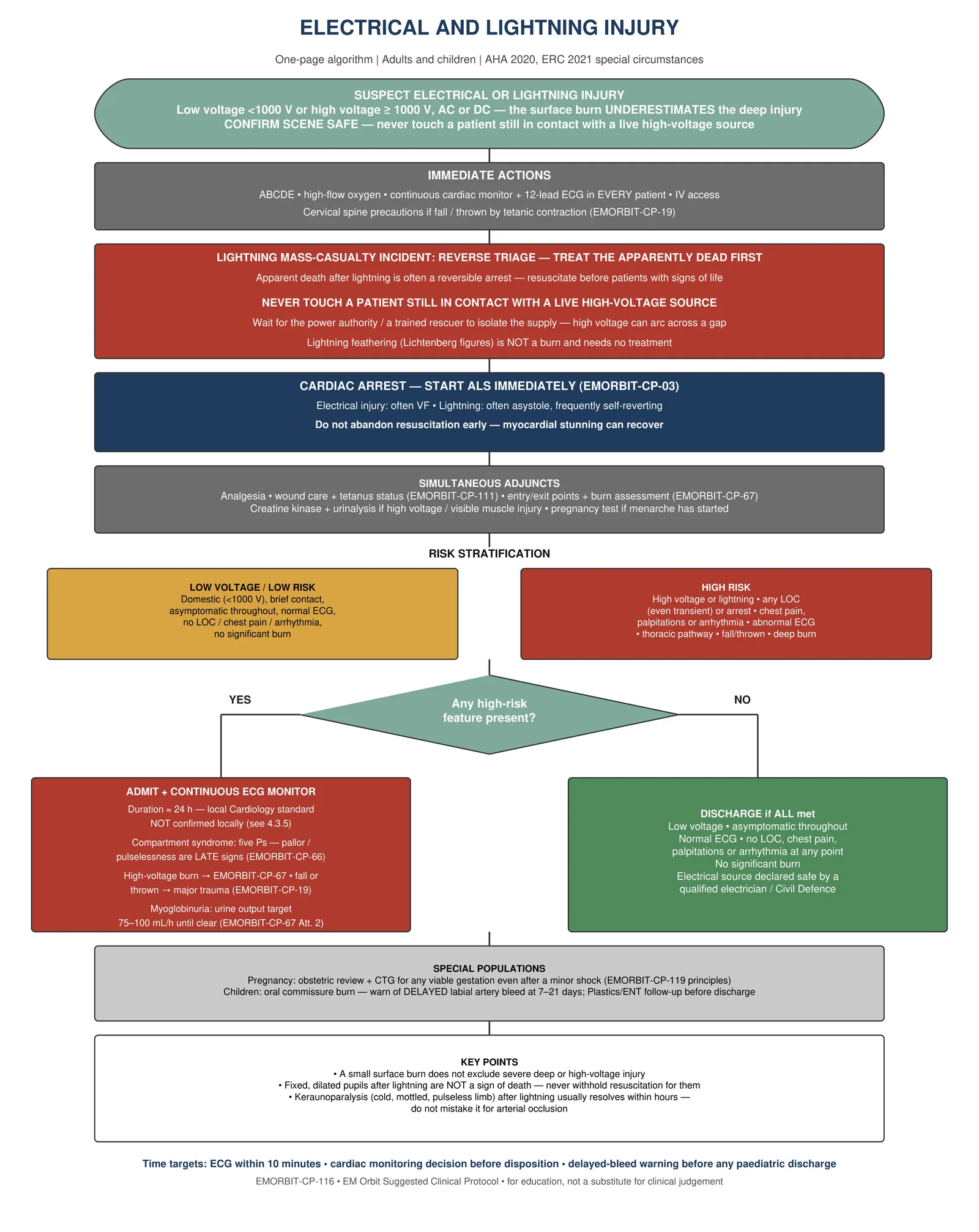
The one-page algorithm is shown at the top of this page.
6Team roles
6.1Triage/ED Nurse:
6.1.1 Recognize the mechanism, ask about voltage, current type, and loss of consciousness, and start cardiac monitoring and ECG under the approved standing order without waiting for physician review.
6.2ED Pharmacist:
6.2.1 Advise on analgesia and IV fluid prescribing for myoglobinuria; confirm tetanus status and product per EMORBIT-CP-111.
6.3Cardiology:
6.3.1 Advise on, and where needed accept, admission for continuous ECG monitoring per section 4.3.5.
6.4Plastic Surgery – Burns / Orthopaedics-Surgery:
6.4.1 Accept referrals and admissions per EMORBIT-CP-67 (burns) and EMORBIT-CP-66 (compartment syndrome); arrange follow-up for a child's oral commissure burn.
6.5Obstetrics:
6.5.1 Review any pregnant patient with a suspected electrical exposure and arrange cardiotocography for a viable gestation.
6.6Laboratory:
6.6.1 Process creatine kinase, troponin, and renal function urgently and report critical results to the treating team by telephone.
6.7Ambulance/Pre-hospital:
6.7.1 Confirm the scene and power source are safe before approaching the patient; apply reverse triage at a lightning mass-casualty incident; pre-alert the ED with mechanism, voltage if known, and loss of consciousness.
7The patient's role
7.1 Report the voltage and current source if known, and any loss of consciousness, chest pain, or palpitations at any point since the injury.
7.2 Do not return to the electrical source or appliance until it has been declared safe.
7.3 For a parent/carer of a child with an oral burn: watch for and act immediately on any bleeding from the mouth in the weeks after injury, and attend the arranged follow-up.
8Definitions
8.1Low Voltage: below 1000 V — most domestic electrical supply.
8.2High Voltage: 1000 V or above — industrial supply, powerlines, and arc-flash sources.
8.3Keraunoparalysis: transient cold, mottled, pulseless limb after a lightning strike from autonomic vasospasm; usually resolves within hours without vascular intervention.
8.4Lichtenberg Figures ("Feathering"): fern-like skin marks pathognomonic of a lightning strike; not a burn, need no treatment, and fade over days.
8.5Reverse Triage (lightning mass-casualty incident): treating patients with no signs of life before those with signs of life, because prompt resuscitation can save the former while the latter are comparatively less time-critical — the opposite of standard mass-casualty triage.
9Attachments
- Attachment 1: One-page algorithm (top of this page)
- Attachment 2: Voltage Classification, Cardiac Monitoring, and Lightning Quick Reference
11Suggested quality indicators
11.1Time to first ECG: (Number of patients with suspected electrical/lightning injury who had a 12-lead ECG within 10 minutes of arrival / Total number of such patients) × 100. Target ≥ 90%.
11.2CK and urinalysis performed: (Number of high-voltage/lightning-injury patients with creatine kinase and urinalysis performed / Total number of such patients) × 100. Target ≥ 95%.
11.3Safe disposition: (Number of patients meeting a high-risk criterion (section 4.1.4) with a cardiac monitoring or admission decision documented before disposition / Total number of such patients) × 100. Target 100%.
11.4Delayed-bleed counselling given (paediatric oral burn): (Number of children with an oral commissure electrical burn given documented written and verbal delayed-bleed warning and follow-up before discharge / Total number of such children) × 100. Target 100%.
11.5Outcome indicator (monitored, no fixed ED target): unplanned re-attendance within 30 days with a new arrhythmia, a missed compartment syndrome, or delayed labial artery bleeding following an electrical injury.
13References
- American Heart Association. 2020 American Heart Association Guidelines for Cardiopulmonary Resuscitation and Emergency Cardiovascular Care — Special Circumstances of Resuscitation: Electric Shock and Lightning Strikes. Circulation. 2020.
- European Resuscitation Council. ERC Guidelines 2021 — Cardiac Arrest in Special Circumstances: Electrocution and Lightning Injury. Resuscitation. 2021.
- Davis C, Engeln A, Johnson EL, et al. Wilderness Medical Society practice guidelines for the prevention and management of lightning injuries. Wilderness Environ Med. 2014;25(4 Suppl):S86–S95.
- American College of Surgeons Committee on Trauma. Advanced Trauma Life Support (ATLS) Student Course Manual. 10th ed. Chicago: American College of Surgeons; 2018. (Electrical and burn injury sections.)
A2Attachment 2: Voltage Classification, Cardiac Monitoring, and Lightning Quick Reference
| Category | Definition and key risk |
|---|---|
| Low voltage | Below 1000 V — most domestic supply; usually brief contact and small entry/exit points; myocardial injury uncommon unless prolonged contact or a wet environment |
| High voltage | 1000 V or above — industrial, powerline, or arc-flash; deep muscle destruction possible under a deceptively minor-looking surface burn; high risk of rhabdomyolysis, compartment syndrome, and arrest at contact |
| AC vs DC | AC causes tetanic contraction ("can't let go") and more readily causes VF at low voltage; DC (including lightning) tends to cause a single large contraction that throws the victim — assess for fall trauma |
| Lightning | A massive, brief DC-like countershock — immediate asystole (often self-reverting) with a longer respiratory arrest; ventilate promptly to prevent a secondary hypoxic cardiac arrest |
| Discharge after ECG — no cardiac admission needed | Admit for continuous ECG monitoring |
|---|---|
| Low-voltage exposure, asymptomatic throughout, normal ECG, no LOC/chest pain/palpitations/arrhythmia at any point, no significant burn | High voltage or lightning; any LOC or cardiac arrest; chest pain, palpitations, or any arrhythmia; abnormal ECG; thoracic current pathway; visible deep/high-voltage burn; pregnancy with significant exposure |
Monitoring duration is commonly quoted as 24 hours in the resuscitation literature; the duration is individualised with cardiology advice.
| Item | Action |
|---|---|
| Myoglobinuria (high-voltage/lightning) | Urine output target 75–100 mL/hour until urine clears, exactly as EMORBIT-CP-67 (Burns) Attachment 2 — do not use a different figure |
| Compartment syndrome | Five Ps — pallor and pulselessness are LATE signs; a palpable pulse does not exclude it; urgent referral per EMORBIT-CP-66 |
| Lichtenberg figures / feathering | Pathognomonic of lightning, not a burn, need no treatment, fade over days |
| Keraunoparalysis | Cold, mottled, pulseless limb from autonomic spasm after lightning; usually resolves within hours — do not mistake for arterial occlusion |
| Pupils after lightning | Fixed and dilated pupils are NOT a sign of death or poor prognosis — never use to withhold resuscitation |
| Paediatric oral commissure burn | Warn of DELAYED labial artery bleeding at 7–21 days; arrange Plastic Surgery/ENT follow-up before discharge |