Fever in the Returning Traveller and High-Consequence Infectious Disease Screening
EMORBIT-CP-106 · Chapter 7 · Infectious Disease Emergencies
Open in the appFree, works on your phone and offline, with every tool alongside.
Evidence base: WHO; UKHSA
1Purpose
1.1 Ensure a travel and exposure history is taken at triage in every patient with a measured or reported fever, so that malaria, dengue, typhoid, and a high-consequence infectious disease (HCID) exposure are actively considered rather than assumed absent.
1.2 Identify and isolate first: ensure any patient whose travel or exposure history is compatible with viral haemorrhagic fever (VHF) or Middle East respiratory syndrome coronavirus (MERS-CoV) is isolated and placed in appropriate personal protective equipment (PPE) before further assessment.
1.3 Ensure malaria is treated as the default diagnosis in a febrile returning traveller from an endemic area, with urgent microscopy or a rapid diagnostic test and immediate treatment of severe falciparum malaria.
1.4 Provide a structured, non-duplicative approach to dengue and typhoid, and point to the guidelines that already govern sepsis, shock and the febrile child rather than restating them.
1.5 Define the explicit isolation and PPE trigger for MERS-CoV, which is regionally relevant, and follow the national notification and HCID isolation routes (section 4.3.9).
1.6 Align with WHO, UKHSA, the CDC Yellow Book and RCEM, and with national health authority guidance where confirmed.
2Who this protocol applies to
2.1 Any patient aged 13 years and over presenting with a measured temperature of 38 °C or above, or a history of fever, in whom the triage travel and exposure screen (Table 1) is positive for travel abroad, or contact with a returning traveller, in the preceding 12 months.
2.2 Any patient with a possible VHF or MERS-CoV exposure (Table 1), whether or not fever is yet present.
2.3 Patients presenting for review of an ongoing malaria, dengue or typhoid illness, or with an incomplete malaria exclusion (Table 2).
2.4 Occupational exposure in returning healthcare or aid workers, assessed under the same VHF/MERS-CoV screen.
3Not covered by this protocol
3.1 Patients under 13 years: manage under EMORBIT-CP-25 (the febrile child), which applies this guideline's screening questions (Table 1) by cross-reference.
3.2 An asymptomatic, afebrile patient seeking pre-travel or post-travel screening: refer to a travel health/primary care clinic, not an ED presentation.
3.3 Definitive inpatient management of confirmed malaria, dengue, typhoid, VHF or MERS-CoV beyond the ED front-door phase, which is an Infectious Diseases and Public Health activity.
3.4 A febrile patient with an obvious alternative local source (for example a clear urinary tract infection) is still asked the Table 1 screen before that source is accepted as the explanation.
4Protocol
4.1History and Assessment:
4.1.1Triage and Recognition:
4.1.1.1 Ask every patient with a measured or reported fever the travel and exposure screen (Table 1) at triage, regardless of how well the patient looks: early malaria and early VHF can present with normal observations.
4.1.1.2 Act on a positive answer for VHF or MERS-CoV before taking the rest of the history.
Table 1: Travel and exposure screen — asked of every patient with a measured or reported fever, at triage Screening question, positive if: Diseases suspected Action Travelled abroad, or resided in, a malaria-endemic area (sub-Saharan Africa, South or Southeast Asia, Oceania, parts of Central/South America) in the preceding 12 months Malaria (highest risk if within the last 3 months) Malaria until proven otherwise (Table 2). Continue standard precautions; no isolation required for malaria alone Travelled to, or resided in, a country with a current viral haemorrhagic fever (VHF) outbreak within 21 days; OR contact with a probable/confirmed VHF case, their body fluids, or a corpse in an affected area; OR (Crimean-Congo haemorrhagic fever) a tick bite or contact with the blood or tissue of livestock in an endemic area (relevant regionally) Viral haemorrhagic fever STOP. Isolate immediately, before any further history, examination or blood draw. Enhanced PPE per Infection Prevention and Control (IPC) risk assessment; notify the senior ED physician and IPC now; minimum staff; do not send samples by routine transport Fever AND (severe acute respiratory illness OR pneumonia) AND: residence/travel to the Arabian Peninsula within 14 days with camel contact or consumption of raw camel milk or urine; OR contact with a healthcare facility with known MERS-CoV transmission; OR close contact with a confirmed/probable MERS-CoV case within 14 days Middle East respiratory syndrome coronavirus (MERS-CoV) Isolate now: airborne + contact precautions, single room (negative-pressure where available), FFP3/N95 respirator, eye protection, gown, gloves — before any aerosol-generating procedure. Notify IPC Travelled to South Asia (particularly India, Pakistan, Bangladesh) or another endemic area with a gradual-onset fever, relative bradycardia, abdominal pain and altered bowel habit Typhoid (enteric fever) Blood cultures before any antibiotic (Table 3); standard precautions Travelled to a dengue-endemic area (South/Southeast Asia, the Indian subcontinent, Latin America, and increasingly widespread) within 14 days Dengue Assess for warning signs (Table 3); standard precautions Identify and isolate first. A positive answer to the VHF or MERS-CoV question is acted on before the rest of the travel history is taken. This is the same standing-order isolation required by EMORBIT-CP-29 Table 2 ("suspected airborne or high-consequence infection — mask, isolate or separate at the front door; notify infection control — isolation before entering the main waiting area") and raises the triage category by at least one level (EMORBIT-CP-29 section 4.3.2). The question is asked of every febrile patient, including one who looks well: early malaria and early VHF can present with normal observations.
4.1.1.3 Triage category is assigned per EMORBIT-CP-29; a positive HCID screen, or any severe-malaria feature, raises the category by at least one level (EMORBIT-CP-29 section 4.3.2) and triggers the front-door isolation standing order (EMORBIT-CP-29 Table 2).
4.1.1.4 Where any sepsis red flag is present (EMORBIT-CP-11), the sepsis pathway runs simultaneously with the travel/isolation screen, not after it.
4.1.2History:
4.1.2.1 Full itinerary and dates: countries and specific regions visited, date of return, and the interval since return.
4.1.2.2 Pre-travel preparation: malaria chemoprophylaxis taken and adherence, and vaccination history.
4.1.2.3 Exposures during travel: insect and tick bites, animal contact, fresh water contact, sexual contacts, food and water source, sick contacts, and any healthcare facility attendance abroad.
4.1.2.4 Symptom pattern: fever pattern, rash (and its character), bleeding, diarrhoea, respiratory symptoms, jaundice.
4.1.2.5 Last menstrual period in any woman who has started menarche, regardless of age (library definition) — relevant to malaria treatment choice (Table 2) and pregnancy risk.
4.1.2.6 For a possible occupational exposure: whether the patient was working in a healthcare or aid role in an outbreak area, and whether appropriate PPE was worn at the time.
4.1.3Examination:
4.1.3.1 General examination for jaundice, rash (petechial/purpuric versus maculopapular), lymphadenopathy, hepatosplenomegaly, hydration status and any bleeding.
4.1.3.2 A patient screened positive for VHF or MERS-CoV is examined only to the extent needed for immediate safety, wearing the PPE specified in Table 1, until IPC has completed its risk assessment.
4.1.3.3 Assess hydration and mental state closely in suspected dengue and severe malaria; deterioration can be rapid.
4.1.4Risk Stratification – Severity:
4.1.4.1 Severe falciparum malaria criteria and the immediate treatment they trigger are set out in Table 2.
4.1.4.2 Dengue warning signs, which mandate admission, are set out in Table 3.
4.1.4.3 A patient meeting any severe-malaria criterion, any dengue warning sign, or the VHF/MERS-CoV screen (Table 1) is triaged no lower than Category 2 (EMORBIT-CP-29).
4.1.5Differential Diagnosis:
4.1.5.1 Malaria, dengue and typhoid frequently present with an identical early fever and can coexist; a positive test for one does not exclude another.
4.1.5.2 Other travel-related causes to keep in mind, without a universal test panel: rickettsial infection, leptospirosis, viral hepatitis A, chikungunya, and non-travel-related sepsis (EMORBIT-CP-11) or a common local infection.
4.1.5.3 A returning healthcare worker or aid worker with fever after an outbreak deployment is treated as a possible VHF exposure until the screen (Table 1) is answered, not assumed to have a benign viral illness.
4.1.6Special Populations:
4.1.6.1 Pregnancy (any woman who has started menarche): malaria is severe malaria until proven otherwise; IV artesunate is the treatment of choice in every trimester (Table 2); obtain the pregnancy test without delaying treatment; involve Obstetrics.
4.1.6.2 Children under 13 years: manage under EMORBIT-CP-25, applying Table 1 by cross-reference; the child does not wait behind adult presentations for isolation or for the first antimalarial dose.
4.1.6.3 Immunosuppressed, asplenic, HIV-positive or transplant travellers: higher risk of severe or atypical malaria presentation; treat any fever in this group as high risk regardless of the film result pending repeat testing.
4.1.6.4 Returning healthcare or aid workers: an explicit occupational VHF/MERS-CoV screen (Table 1) is asked even in the absence of fever; involve Occupational Health.
4.2Investigations:
4.2.1 No investigation delays isolation or PPE application where Table 1 indicates VHF or MERS-CoV.
4.2.2 Send thick and thin blood films (or films plus RDT) urgently in every patient meeting the malaria screen; diagnostic detail and repeat testing are in Table 2.
Table 2: Malaria — diagnosis and first-line treatment Feature Detail Action Diagnosis Thick and thin blood films (microscopy), or films plus a rapid diagnostic test (RDT/antigen test). Result required within 1 hour If the first film is negative and suspicion remains, repeat at 12–24-hour intervals for up to three sets over 48–72 hours before excluding malaria. Document species and parasitaemia % Severe/complicated falciparum malaria — any ONE of Impaired consciousness or coma; prostration; multiple convulsions; acidosis (bicarbonate < 15 mmol/L or lactate > 5 mmol/L); hypoglycaemia (< 4.0 mmol/L — library threshold); severe anaemia (Hb < 7 g/dL, adult); creatinine > 265 µmol/L; jaundice with another organ dysfunction; pulmonary oedema/ARDS; significant spontaneous bleeding; shock; parasitaemia > 10% IV artesunate 2.4 mg/kg at 0, 12 and 24 hours, then once daily, minimum 24 hours IV before switching to a full course of oral ACT. Start as soon as severe disease is suspected in a compatible traveller — do not wait for species confirmation IV artesunate not available Availability varies by region; check with Pharmacy Alternative: IV quinine, with continuous cardiac monitoring for QT prolongation Uncomplicated falciparum malaria No severe feature present Oral artemisinin-based combination therapy (ACT) per the local formulary/Infectious Diseases advice Non-falciparum species (P. vivax, P. ovale, P. malariae, P. knowlesi) Chloroquine resistance is widespread; an ACT is commonly used Radical cure with primaquine or tafenoquine (for P. vivax/ovale hypnozoites) is an Infectious Diseases decision, after a glucose-6-phosphate dehydrogenase (G6PD) result — never started in the ED because of haemolysis risk in a G6PD-deficient patient Pregnancy (any woman who has started menarche, regardless of age) Malaria in pregnancy is severe malaria until proven otherwise IV artesunate is the treatment of choice in every trimester (WHO 2023). Obtain the pregnancy test without delaying treatment. Never give primaquine or tafenoquine in pregnancy Monitor capillary glucose regularly in every patient with suspected or confirmed malaria: hypoglycaemia (below 4.0 mmol/L) occurs from the disease itself and is worsened by quinine.
4.2.3 Baseline bloods in the unwell traveller: full blood count, urea and electrolytes/creatinine, liver function tests, glucose, lactate, coagulation profile, blood cultures, and G6PD (before any radical-cure antimalarial). Pregnancy test in any woman who has started menarche, obtained by the treating team without delay — the triage nurse does not perform it (library decision).
4.2.4 Dengue and typhoid testing is set out in Table 3.
Table 3: Dengue and typhoid — quick reference Disease Recognition ED action Dengue Warning signs (WHO 2009) mandating admission: abdominal pain/tenderness; persistent vomiting; clinical fluid accumulation; mucosal bleeding; lethargy or restlessness; liver enlargement > 2 cm; rising haematocrit with a rapid fall in platelets FBC (platelets, haematocrit trend) and NS1 antigen (first 5 days) or dengue serology. Paracetamol only — no NSAID or aspirin (bleeding risk). IV fluid titrated to warning signs, not given routinely Typhoid (enteric fever) Gradual-onset fever, relative bradycardia, abdominal pain, constipation or diarrhoea; may have rose spots Blood cultures before any antibiotic (the key diagnostic test); stool/urine culture as an adjunct. Antibiotic agent per EMORBIT-CP-57 and the local antibiogram — fluoroquinolone resistance is now widespread; do not invent a regimen here 4.2.5 Suspected VHF or MERS-CoV: do not send samples by routine transport (including the pneumatic tube). Discuss with the laboratory and IPC first; minimum sample volume; hand-carried per the hospital's HCID sample protocol. Chest X-ray if respiratory symptoms are present, once PPE is in place.
4.3Plan of Care:
4.3.1Immediate Actions:
4.3.1.1 Isolate, mask, and apply the PPE specified in Table 1 before further assessment for any positive VHF or MERS-CoV screen; notify the senior ED physician and IPC immediately.
4.3.1.2 Where a sepsis red flag (EMORBIT-CP-11) is also present, start resuscitation in parallel — the sepsis pathway is never delayed for, or by, the travel/isolation pathway.
4.3.1.3 Check capillary glucose in any unwell traveller (threshold below 4.0 mmol/L, library decision); severe malaria and quinine both cause hypoglycaemia.
4.3.2Definitive ED Treatment:
4.3.2.1Malaria: diagnose and treat per Table 2. Start IV artesunate for any severe feature in a compatible traveller without waiting for species confirmation.
4.3.2.2Dengue and typhoid: manage per Table 3.
4.3.2.3VHF or MERS-CoV: supportive care within isolation; no disease-specific antiviral is given routinely in the ED. The time-critical action here is the isolation and notification themselves, exactly as an antibiotic dose is the time-critical action in sepsis or meningitis (EMORBIT-CP-11, EMORBIT-CP-47) — do not treat isolation as optional pending confirmation.
4.3.3Escalation / Refractory:
4.3.3.1 Refer to Infectious Diseases for every confirmed or strongly suspected malaria, dengue, typhoid, VHF or MERS-CoV case; Infectious Diseases leads VHF and MERS-CoV management once isolation is established.
4.3.3.2 Intensive care referral for septic or dengue shock, severe malaria with organ dysfunction, or MERS-CoV respiratory failure.
4.3.3.3 Notify the national public health authority for malaria, dengue, typhoid and any HCID. Use the national notification route and form (section 4.3.9).
4.3.4Monitoring / Reassessment:
4.3.4.1 Repeat capillary glucose and vital signs at least hourly while unwell; repeat malaria films at 12–24-hour intervals per Table 2 until a set is clearly negative or parasitaemia is falling on treatment.
4.3.4.2 Repeat haematocrit and platelet count every 6–12 hours in dengue with any warning sign.
4.3.5Disposition:
4.3.5.1 Confirmed or suspected malaria: admit. Given the risk of rapid progression to severe disease, no patient with a positive film or a strong clinical suspicion is discharged directly from the ED; discharge is an Infectious Diseases decision, not an ED one, mirroring the ED/admitting-team split used throughout this library.
4.3.5.2 Dengue without any warning sign, tolerating oral fluids, with reliable follow-up: discharge with safety-netting and daily review until afebrile for 48 hours.
4.3.5.3 Suspected or confirmed VHF or MERS-CoV: never discharged from the ED. Isolation continues until transfer per the HCID pathway (section 4.3.9).
4.3.5.4 Suspected typhoid: admission is generally advised pending blood culture and clinical response; a well-appearing patient without red flags may be considered for outpatient follow-up only after Infectious Diseases review.
4.3.6Discharge and Follow-up:
4.3.6.1 Written safety-netting advice: return immediately for worsening fever, bleeding, reduced urine output, breathlessness, or new confusion.
4.3.6.2 Book a follow-up review at 24–48 hours and an Infectious Diseases/travel clinic appointment before the patient leaves, for any traveller discharged under this pathway.
4.3.6.3 Where malaria exclusion is incomplete (Table 2), give the patient the date and time of the next film and instruct them to return for it.
4.3.7Documentation and Reporting:
4.3.7.1 Document: the Table 1 screening answers, the time isolation and PPE were applied, all notifications made (IPC, Infectious Diseases, the national public health authority), malaria films sent and their results, and the disposition decision and who made it.
4.3.7.2 Presentations under this pathway are captured for departmental audit (section 11).
5Algorithm
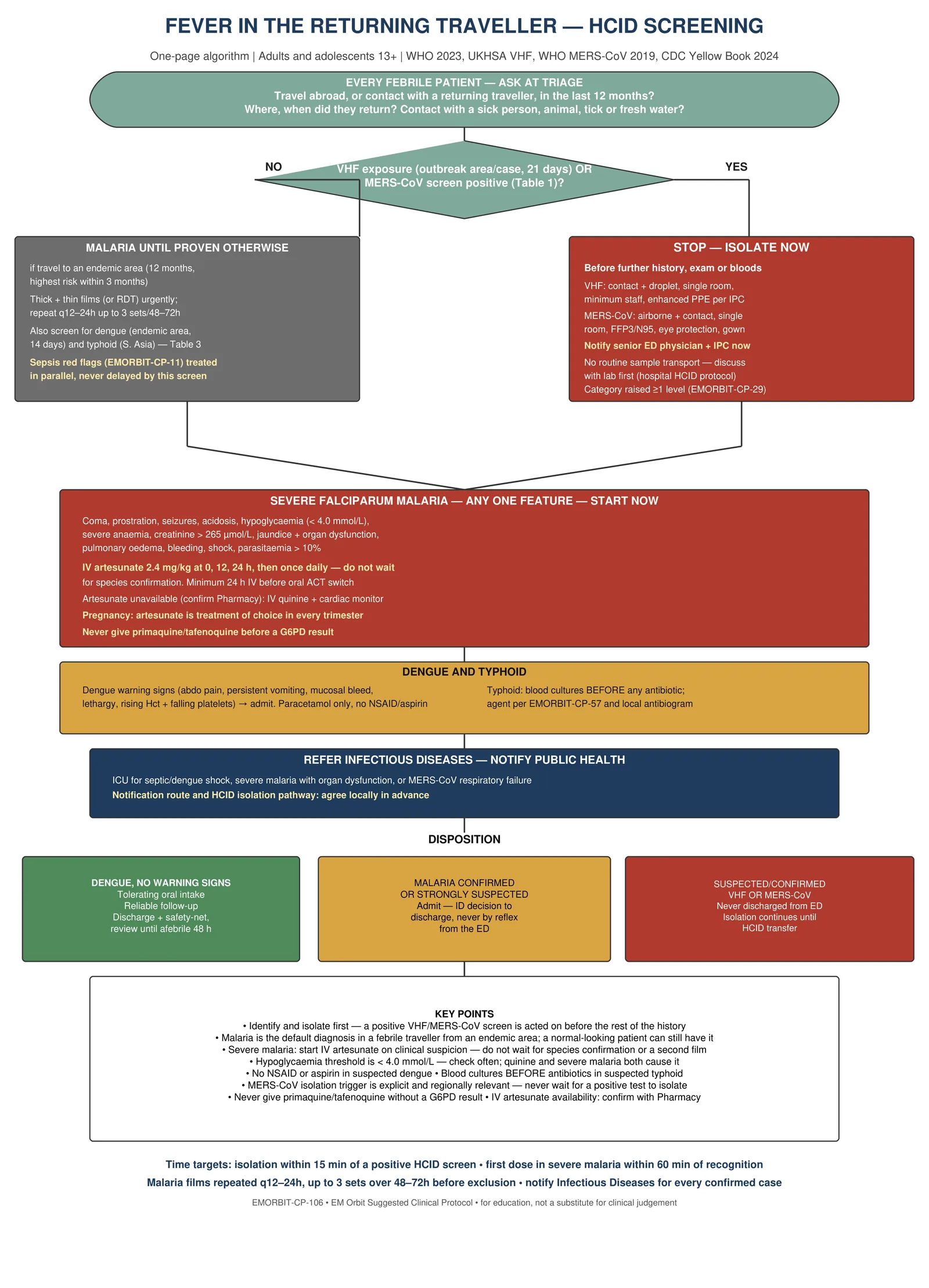
The one-page algorithm is shown at the top of this page.
6Team roles
6.1Triage and ED Nurses Role:
6.1.1 Ask the travel and exposure screen (Table 1) of every febrile patient; on a positive VHF or MERS-CoV answer, mask and isolate immediately under standing order (EMORBIT-CP-29 Table 2), before further assessment, and notify IPC.
6.2Pharmacist:
6.2.1 Confirm IV artesunate (or the quinine alternative) availability and dosing, verify the G6PD result before any radical-cure antimalarial is considered, and check drug interactions.
6.3Infectious Diseases:
6.3.1 Advise on species/regimen for malaria, review before discharge of any confirmed or suspected malaria, dengue or typhoid case, and lead the management of any VHF or MERS-CoV case.
6.4Laboratory:
6.4.1 Process malaria films/RDT urgently and report species and parasitaemia; handle any suspected HCID sample per the hospital's high-consequence sample protocol, not by routine transport.
6.5Infection Prevention and Control / Public Health:
6.5.1 Confirm the isolation category and PPE, receive immediate notification of any suspected VHF or MERS-CoV, and lead the national notification route for malaria, dengue, typhoid and HCID.
6.6Ambulance / Pre-hospital:
6.6.1 Pass on any known travel history at pre-alert so isolation and PPE are ready before the patient arrives.
7The patient's role
7.1 Disclose the full travel and exposure history accurately, including recent travel by household or close contacts.
7.2 Bring or recall pre-travel vaccination and malaria chemoprophylaxis history.
7.3 Attend arranged follow-up review and repeat blood films where a malaria exclusion is incomplete.
7.4 Return earlier for worsening fever, bleeding, reduced urine output, breathlessness or new confusion.
8Definitions
8.1HCID: high-consequence infectious disease — an infection with a high case-fatality rate, no or limited treatment, and a risk of onward transmission requiring enhanced infection control (for example VHF).
8.2VHF: viral haemorrhagic fever — a group of viral illnesses, including Ebola, Marburg, Lassa and Crimean-Congo haemorrhagic fever, that can cause severe bleeding and are transmissible person-to-person.
8.3MERS-CoV: Middle East respiratory syndrome coronavirus, a regionally endemic respiratory virus with a defined case-definition and travel/contact history (Table 1).
8.4ACT: artemisinin-based combination therapy, the standard oral treatment for uncomplicated malaria.
8.5RDT: rapid diagnostic test — an antigen-based point-of-care test for malaria, used alongside, not instead of, microscopy.
8.6G6PD: glucose-6-phosphate dehydrogenase — an enzyme deficiency that causes haemolysis with primaquine or tafenoquine and must be excluded before either drug is given.
8.7Warning signs (dengue): the WHO 2009 clinical and laboratory features that mandate admission in a patient with dengue (Table 3).
8.8Woman who has started menarche: the library definition of a woman of child-bearing age for this guideline library, applied regardless of age.
9Attachments
- Attachment 1: One-page algorithm (top of this page)
- Attachment 2: Quick Reference — Travel/HCID Screen and Isolation, Malaria Diagnosis and Treatment, Dengue and Typhoid
11Suggested quality indicators
11.1Travel history documented at triage: (Number of febrile ED presentations with the Table 1 screen answered and recorded / Total febrile ED presentations) × 100. Target ≥ 95%.
11.2Time to isolation after a positive HCID screen: (Number of patients isolated and in PPE within 15 minutes of a positive VHF/MERS-CoV screen / Total number of positive HCID screens) × 100. Target ≥ 90%.
11.3Time to first dose in severe malaria: (Number of patients with severe falciparum malaria receiving the first dose of IV artesunate (or the quinine alternative) within 60 minutes of recognition / Total number of severe malaria presentations) × 100. Target ≥ 80%.
11.4No suspected HCID discharged without review: (Number of suspected VHF/MERS-CoV presentations discharged from the ED without Infectious Diseases/IPC review / Total suspected HCID presentations) × 100. Target 0%; any occurrence reviewed as an incident.
11.5Malaria diagnosis missed at first presentation: (Number of confirmed malaria diagnoses made only on a re-attendance within 7 days of a first ED visit for fever / Total confirmed malaria diagnoses) × 100. Monitored as an outcome indicator; target as low as achievable.
13References
- World Health Organization. WHO Guidelines for malaria. Geneva: WHO; 2023 update.
- Lalloo DG, Shingadia D, Bell DJ, Beeching NJ, Whitty CJM, Chiodini PL; PHE Advisory Committee on Malaria Prevention. UK malaria treatment guidelines 2016. J Infect. 2016;72(6):635-649.
- World Health Organization. Dengue: Guidelines for Diagnosis, Treatment, Prevention and Control. New edition. Geneva: WHO; 2009.
- World Health Organization. Background document: The diagnosis, treatment and prevention of typhoid fever. Geneva: WHO; 2003.
- UK Health Security Agency (UKHSA), formerly Public Health England / Advisory Committee on Dangerous Pathogens. Viral haemorrhagic fever (VHF): algorithm and guidance on the management of patients. UKHSA; 2023 update.
- World Health Organization. Middle East respiratory syndrome coronavirus (MERS-CoV) — case definition for reporting to WHO. Geneva: WHO; 2019 update.
- Centers for Disease Control and Prevention. CDC Yellow Book 2024: Health Information for International Travel. New York: Oxford University Press; 2023.
- the national health authority. National notifiable disease and high-consequence infectious disease isolation guidance.
A2Attachment 2: Quick Reference — Travel/HCID Screen and Isolation, Malaria Diagnosis and Treatment, Dengue and Typhoid
| Screening question, positive if: | Diseases suspected | Action |
|---|---|---|
| Travelled abroad, or resided in, a malaria-endemic area (sub-Saharan Africa, South or Southeast Asia, Oceania, parts of Central/South America) in the preceding 12 months | Malaria (highest risk if within the last 3 months) | Malaria until proven otherwise (Table 2). Continue standard precautions; no isolation required for malaria alone |
| Travelled to, or resided in, a country with a current viral haemorrhagic fever (VHF) outbreak within 21 days; OR contact with a probable/confirmed VHF case, their body fluids, or a corpse in an affected area; OR (Crimean-Congo haemorrhagic fever) a tick bite or contact with the blood or tissue of livestock in an endemic area (relevant regionally) | Viral haemorrhagic fever | STOP. Isolate immediately, before any further history, examination or blood draw. Enhanced PPE per Infection Prevention and Control (IPC) risk assessment; notify the senior ED physician and IPC now; minimum staff; do not send samples by routine transport |
| Fever AND (severe acute respiratory illness OR pneumonia) AND: residence/travel to the Arabian Peninsula within 14 days with camel contact or consumption of raw camel milk or urine; OR contact with a healthcare facility with known MERS-CoV transmission; OR close contact with a confirmed/probable MERS-CoV case within 14 days | Middle East respiratory syndrome coronavirus (MERS-CoV) | Isolate now: airborne + contact precautions, single room (negative-pressure where available), FFP3/N95 respirator, eye protection, gown, gloves — before any aerosol-generating procedure. Notify IPC |
| Travelled to South Asia (particularly India, Pakistan, Bangladesh) or another endemic area with a gradual-onset fever, relative bradycardia, abdominal pain and altered bowel habit | Typhoid (enteric fever) | Blood cultures before any antibiotic (Table 3); standard precautions |
| Travelled to a dengue-endemic area (South/Southeast Asia, the Indian subcontinent, Latin America, and increasingly widespread) within 14 days | Dengue | Assess for warning signs (Table 3); standard precautions |
Identify and isolate first. A positive answer to the VHF or MERS-CoV question is acted on before the rest of the travel history is taken. This is the same standing-order isolation required by EMORBIT-CP-29 Table 2 ("suspected airborne or high-consequence infection — mask, isolate or separate at the front door; notify infection control — isolation before entering the main waiting area") and raises the triage category by at least one level (EMORBIT-CP-29 section 4.3.2). The question is asked of every febrile patient, including one who looks well: early malaria and early VHF can present with normal observations.
| Feature | Detail | Action |
|---|---|---|
| Diagnosis | Thick and thin blood films (microscopy), or films plus a rapid diagnostic test (RDT/antigen test). Result required within 1 hour | If the first film is negative and suspicion remains, repeat at 12–24-hour intervals for up to three sets over 48–72 hours before excluding malaria. Document species and parasitaemia % |
| Severe/complicated falciparum malaria — any ONE of | Impaired consciousness or coma; prostration; multiple convulsions; acidosis (bicarbonate < 15 mmol/L or lactate > 5 mmol/L); hypoglycaemia (< 4.0 mmol/L — library threshold); severe anaemia (Hb < 7 g/dL, adult); creatinine > 265 µmol/L; jaundice with another organ dysfunction; pulmonary oedema/ARDS; significant spontaneous bleeding; shock; parasitaemia > 10% | IV artesunate 2.4 mg/kg at 0, 12 and 24 hours, then once daily, minimum 24 hours IV before switching to a full course of oral ACT. Start as soon as severe disease is suspected in a compatible traveller — do not wait for species confirmation |
| IV artesunate not available | Availability varies by region; check with Pharmacy | Alternative: IV quinine, with continuous cardiac monitoring for QT prolongation |
| Uncomplicated falciparum malaria | No severe feature present | Oral artemisinin-based combination therapy (ACT) per the local formulary/Infectious Diseases advice |
| Non-falciparum species (P. vivax, P. ovale, P. malariae, P. knowlesi) | Chloroquine resistance is widespread; an ACT is commonly used | Radical cure with primaquine or tafenoquine (for P. vivax/ovale hypnozoites) is an Infectious Diseases decision, after a glucose-6-phosphate dehydrogenase (G6PD) result — never started in the ED because of haemolysis risk in a G6PD-deficient patient |
| Pregnancy (any woman who has started menarche, regardless of age) | Malaria in pregnancy is severe malaria until proven otherwise | IV artesunate is the treatment of choice in every trimester (WHO 2023). Obtain the pregnancy test without delaying treatment. Never give primaquine or tafenoquine in pregnancy |
Monitor capillary glucose regularly in every patient with suspected or confirmed malaria: hypoglycaemia (below 4.0 mmol/L) occurs from the disease itself and is worsened by quinine.
| Disease | Recognition | ED action |
|---|---|---|
| Dengue | Warning signs (WHO 2009) mandating admission: abdominal pain/tenderness; persistent vomiting; clinical fluid accumulation; mucosal bleeding; lethargy or restlessness; liver enlargement > 2 cm; rising haematocrit with a rapid fall in platelets | FBC (platelets, haematocrit trend) and NS1 antigen (first 5 days) or dengue serology. Paracetamol only — no NSAID or aspirin (bleeding risk). IV fluid titrated to warning signs, not given routinely |
| Typhoid (enteric fever) | Gradual-onset fever, relative bradycardia, abdominal pain, constipation or diarrhoea; may have rose spots | Blood cultures before any antibiotic (the key diagnostic test); stool/urine culture as an adjunct. Antibiotic agent per EMORBIT-CP-57 and the local antibiogram — fluoroquinolone resistance is now widespread; do not invent a regimen here |