Atrial fibrillation with rapid ventricular response — 71, palpitations since morning, blood pressure 132/78
EMOD · The Trace 2 of 30
Open in the appFree, works on your phone and offline, with every tool alongside.
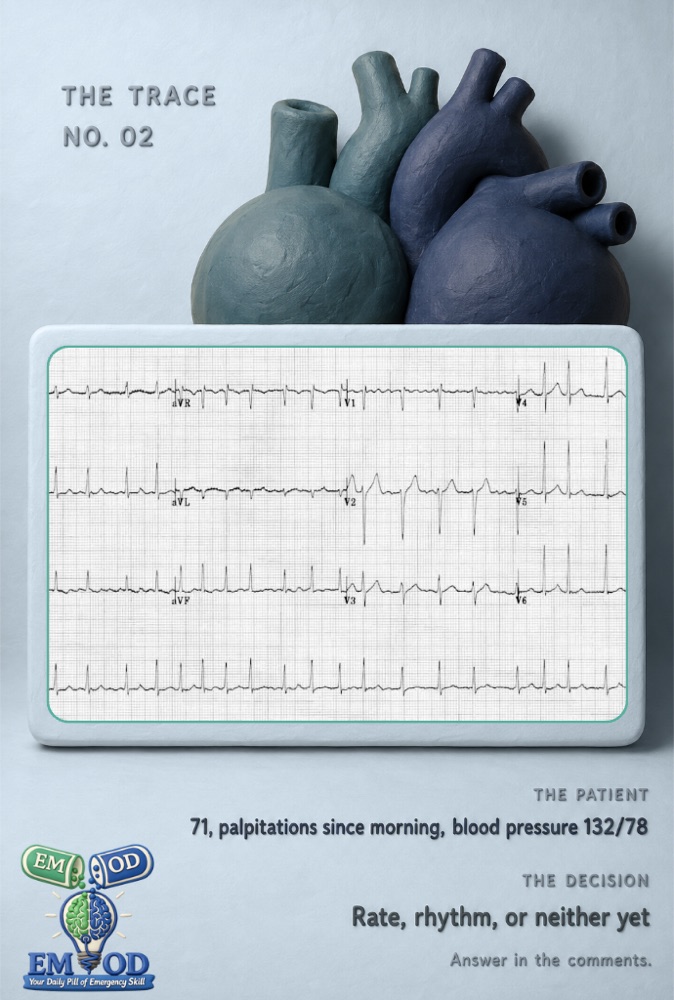
THE PATIENT: 71, palpitations since morning, blood pressure 132/78 · THE DECISION: Rate, rhythm, or neither yet
The case
A 71-year-old noticed palpitations at breakfast and came in by mid-afternoon. They are talking in full sentences, blood pressure 132/78, no chest pain, no failure. The monitor shows an irregular rhythm in the 150s. The diagnosis takes four seconds. The decision — what to do about it, and in what order — is where the next hour is actually spent.
What to look for on the trace
Atrial fibrillation is defined on the ECG by three features, and all three should be confirmed rather than assumed:
- Irregularly irregular R-R intervals with no repeating pattern. March the complexes out with calipers or a strip of paper; group beating or a hidden regularity suggests something else.
- Absent P waves. No organised atrial activity precedes the QRS. The baseline instead shows fibrillatory (f) waves — chaotic undulation, best seen in V1 and the inferior leads, ranging from coarse to almost flat.
- Narrow QRS, unless there is pre-existing bundle branch block, rate-related aberrancy, or pre-excitation.
At very fast rates the irregularity becomes harder to appreciate — the R-R intervals shorten and pseudo-regularise. This is exactly when the mimics matter:
- Atrial flutter with variable block produces an irregular rhythm, but the baseline shows organised sawtooth waves in II, III and aVF rather than chaos, and the R-R intervals cluster at multiples of the flutter cycle.
- Multifocal atrial tachycardia is irregularly irregular with visible P waves of at least three morphologies — a different disease, usually a marker of pulmonary pathology, and cardioversion has no role.
- Pre-excited AF is the mimic that kills: irregular, broad, bizarre, and very fast, with beat-to-beat variation in QRS width. If the irregular rhythm is broad and the rate approaches or exceeds 200, stop — that trace has its own page (case 25) and its own forbidden drug list.
- AF with a regular ventricular response should also make you pause: a regularised, slow rhythm in a patient on digoxin suggests complete AV block with a junctional escape — digoxin toxicity until excluded.

The decision
The fork is rate, rhythm, or neither yet — and the honest answer for this patient on arrival is neither yet, because two pieces of information outrank the drug chart.
First: duration. Onset can be timed here — palpitations since morning, clearly under 48 hours. That opens the cardioversion conversation for a stable patient: electrical or pharmacological rhythm control without a preceding period of anticoagulation becomes defensible, subject to local pathway and the patient's stroke risk. Beyond 48 hours, or when onset cannot be timed — and patients are far less precise than they sound — the thromboembolic question comes first: rate control, anticoagulation decision using a validated score (CHA₂DS₂-VASc is the one named in the European guidance), and elective rhythm control later if indicated, with transoesophageal echo pathways as a local option.
Second: is the AF the disease or the response? New rapid AF is a common final pathway of another illness. In sepsis, pulmonary embolism, thyrotoxicosis, haemorrhage or decompensated heart failure, the fibrillating atrium is a symptom, and the rapid rate may be the only compensation the patient has. Rate-control it hard and the cardiac output falls with it. Before any AV-nodal blocker: temperature, lactate, haemoglobin, oxygen saturation, a directed history, and a deliberate question — why today? A 71-year-old whose AF started this morning has a reason.
And the overriding rule: if the patient is genuinely unstable because of the rhythm — shock, syncope, ischaemic chest pain, acute pulmonary oedema attributable to the rate — the answer is synchronised electrical cardioversion, not a drug chart. Instability short-circuits the entire duration argument.
The traps
- Trusting the reported onset. "Since this morning" sometimes means "I noticed it this morning". Ask what last night was like, whether there were earlier runs, whether the smartwatch has a story. Cardioverting AF of unknown true duration without anticoagulation is how embolic strokes are manufactured.
- Rate-controlling the compensation. The septic or bleeding patient in fast AF who receives aggressive AV-nodal blockade and promptly hypotends. The rate was the treatment the body had chosen.
- Missing pre-excitation. Giving an AV-nodal blocker to what was actually pre-excited AF. If it is broad, bizarre and pushing 200 or more, it is not this page.
- The asymmetry of instability. Hesitating over electricity in a genuinely unstable patient while drawing up a third drug. When the rhythm is the cause of the collapse, cardioversion is the safe option, not the aggressive one.
- Fixing the rhythm and forgetting the stroke. The anticoagulation decision is the part of this encounter most likely to change the patient's life, and the part most often left to somebody else. Score it, document it, and hand it over explicitly.
References
- ESC Guidelines for the diagnosis and management of atrial fibrillation (Hindricks G et al.) — the 48-hour convention, CHA₂DS₂-VASc, and rate-versus-rhythm strategy.
- Resuscitation Council UK, Adult tachycardia (with pulse) algorithm — adverse features mandating synchronised cardioversion.
- NICE guideline: Atrial fibrillation — diagnosis and management.
- LITFL ECG Library — atrial fibrillation; pre-excited AF (the mimic that changes the drug list).
3 questions to test yourself on this dose are in the app.