94% —
EMOD · The Number 2 of 30
Open in the appFree, works on your phone and offline, with every tool alongside.
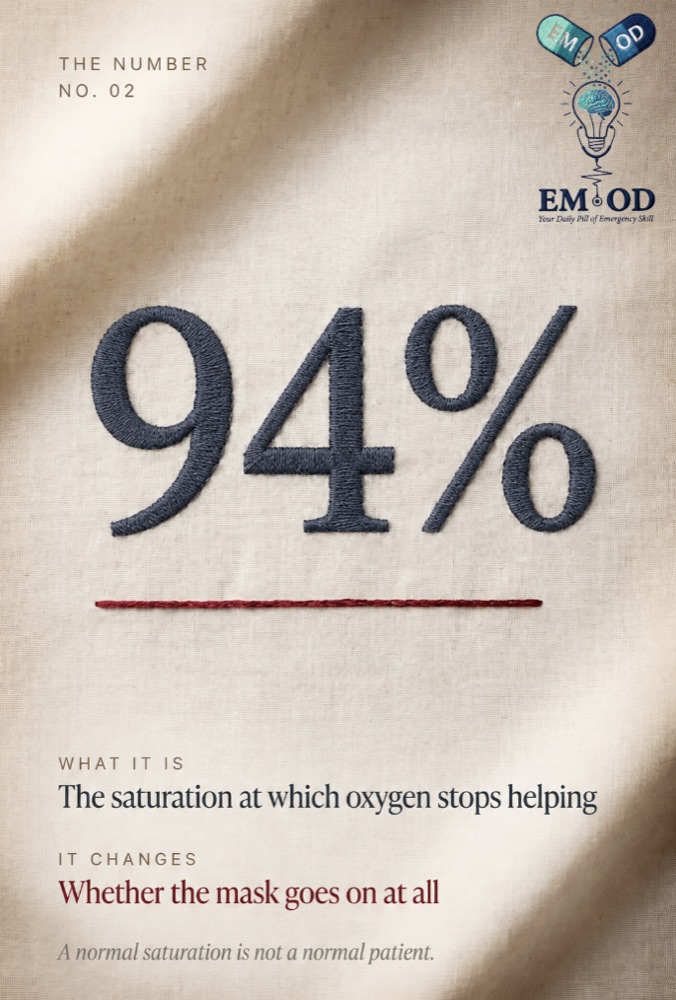
WHAT IT IS: The saturation above which routine oxygen stops helping most acutely unwell adults · IT CHANGES: Whether oxygen is prescribed as a drug, or applied as a reflex A normal saturation is not a normal patient.
The case
A 58-year-old with chest pain arrives by ambulance wearing a non-rebreathe mask at fifteen litres. His saturation underneath it is 100%; when it is lifted for a moment, he sits at 97% on air. Nobody made a decision to give him oxygen — the mask simply happened, the way it has happened to chest pain for fifty years. At the next bed, a 34-year-old with pleuritic pain and a heart rate of 108 is saturating 97% and has been labelled "obs fine". One of these patients is receiving a drug without an indication. The other has a normal number concealing a pulmonary embolism. The threshold sits between them, cutting both ways.
Where the number comes from
The idea that oxygen is a drug — with indications, a target range and harms — was pushed into mainstream practice largely by the British Thoracic Society's guideline for oxygen use in adults in healthcare and emergency settings (O'Driscoll and colleagues, Thorax, most recently updated 2017), which recommends a target saturation range of 94–98% for most acutely unwell adults, and 88–92% for those at risk of hypercapnic respiratory failure. The figure 94% is the floor of that target range: below it, oxygen has an indication; above it, in a patient who is not hypoxaemic, there is nothing left for the drug to do.
The trials that hardened this came from cardiology and stroke. In acute coronary syndrome, the AVOID trial (2015) found that routine high-flow oxygen in normoxic STEMI patients was associated with signals of harm, including larger infarct size on some measures; DETO2X-AMI (Hofmann and colleagues, NEJM 2017), a large registry-based randomised trial, found no mortality benefit from routine oxygen in suspected myocardial infarction without hypoxaemia. In stroke, the Stroke Oxygen Study (Roffe and colleagues, JAMA 2017) found no benefit from prophylactic low-dose oxygen. The IOTA systematic review and meta-analysis (Chu and colleagues, Lancet 2018) pulled the threads together across acutely ill adults: liberal oxygen was associated with increased mortality compared with conservative strategies, and it anchored the now widely quoted advice not to push saturations above 96% with supplemental oxygen.
The precise target range printed on your drug chart, though, is a protocol fact, not a law of nature. British practice follows the BTS ranges; intensive care and resuscitation guidelines phrase their targets slightly differently; and specific conditions — carbon monoxide poisoning above all, covered as NO. 28 in this series — have their own rules. The evidence behind "do not give oxygen to the normoxic" is strong. The exact digits belong to your local oxygen policy.

The edge
The edge of this number cuts in two directions, and the second is the more dangerous one.
The first edge: above the threshold, oxygen is not a treatment, it is a habit. The mask on a normoxic patient treats the team's anxiety, not the patient's tissues. It is not free: it dries and irritates, it interferes with communication and eating, it can mask deterioration by propping up the one number everyone watches while the disease progresses underneath, and in the hypercapnic patient it can be actively dangerous. A patient whose saturation only looks acceptable because of fifteen litres of oxygen is a different patient from one saturating the same number on air — and if the flow rate is not documented next to the reading, that difference is invisible on the chart.
The second edge is the one that kills: a normal saturation is not a normal patient. Pulse oximetry measures one thing — the percentage of haemoglobin that is saturated. A pulmonary embolism can sit at 97%, compensating with tachypnoea. Early sepsis can sit at 97%. A child in compensated shock can sit at 99% until shortly before decompensating. Saturation says nothing about ventilation: a patient at 98% on high-flow oxygen can be retaining carbon dioxide towards narcosis while the monitor stays serene — the oximeter watches oxygenation while ventilation fails silently. And it says nothing about oxygen delivery: a profoundly anaemic or shocked patient can be perfectly saturated and starving at tissue level.
The probe also lies outright in specific circumstances. Carboxyhaemoglobin reads as saturated haemoglobin, so carbon monoxide poisoning presents with a falsely normal reading. Methaemoglobinaemia drags the displayed value towards the mid-80s regardless of reality. Poor perfusion, cold hands, motion, and dark nail varnish degrade the signal. There is also a growing literature on occult hypoxaemia being missed more often in patients with darker skin — reason to treat marginal readings with humility.
The discipline the number teaches is this: the saturation answers exactly one question — does this patient need supplemental oxygen? It never answers the question the reflex mask pretends to answer: is this patient well?
The system it lives in
The parent system is the oxygen prescription itself. The BTS guideline's core move was administrative as much as clinical: oxygen should be prescribed to a target saturation range, not to a flow rate, and titrated up and down against it like any other drug. The two standard adult ranges — 94–98% for most, 88–92% where hypercapnic respiratory failure is a risk (COPD with known retention, obesity hypoventilation, neuromuscular disease, chest wall deformity) — cover most of the department, and the risk group is identified by history and blood gas, not by guesswork at triage.
Applied properly, the system has known limits. The target range assumes the oximeter is telling the truth — so a poisoned, shocked or discoloured patient needs a blood gas with co-oximetry before the number is trusted. It assumes oxygenation is the variable in question — so a tiring asthmatic or a hypercapnic patient needs ventilation assessed on gases, not saturations. And it has explicit exceptions where high-flow oxygen is the treatment regardless of the displayed saturation: carbon monoxide poisoning (NO. 28 — the other side of this argument), cluster headache, pneumothorax management in some pathways, and the peri-arrest patient while things are established.
Your hospital's oxygen policy names its own ranges and its own exceptions. It governs. What does not vary is the two-sided lesson: below the line, oxygen is a drug with an indication; above it, a mask is reassurance — and a normal number reassures hardest exactly when it should not.
References
- O'Driscoll BR, Howard LS, Earis J, Mak V. BTS guideline for oxygen use in adults in healthcare and emergency settings. Thorax 2017.
- Hofmann R, James SK, Jernberg T, et al. Oxygen therapy in suspected acute myocardial infarction (DETO2X-AMI). N Engl J Med 2017.
- Stub D, Smith K, Bernard S, et al. Air versus oxygen in ST-segment-elevation myocardial infarction (AVOID). Circulation 2015.
- Roffe C, Nevatte T, Sim J, et al. Effect of routine low-dose oxygen supplementation on death and disability in adults with acute stroke (SO2S). JAMA 2017.
- Chu DK, Kim LH, Young PJ, et al. Mortality and morbidity in acutely ill adults treated with liberal versus conservative oxygen therapy (IOTA): systematic review and meta-analysis. Lancet 2018.
3 questions to test yourself on this dose are in the app.