Benzodiazepine — Sedated, breathing, protecting the airway
EMOD · The Agent 3 of 30
Open in the appFree, works on your phone and offline, with every tool alongside.
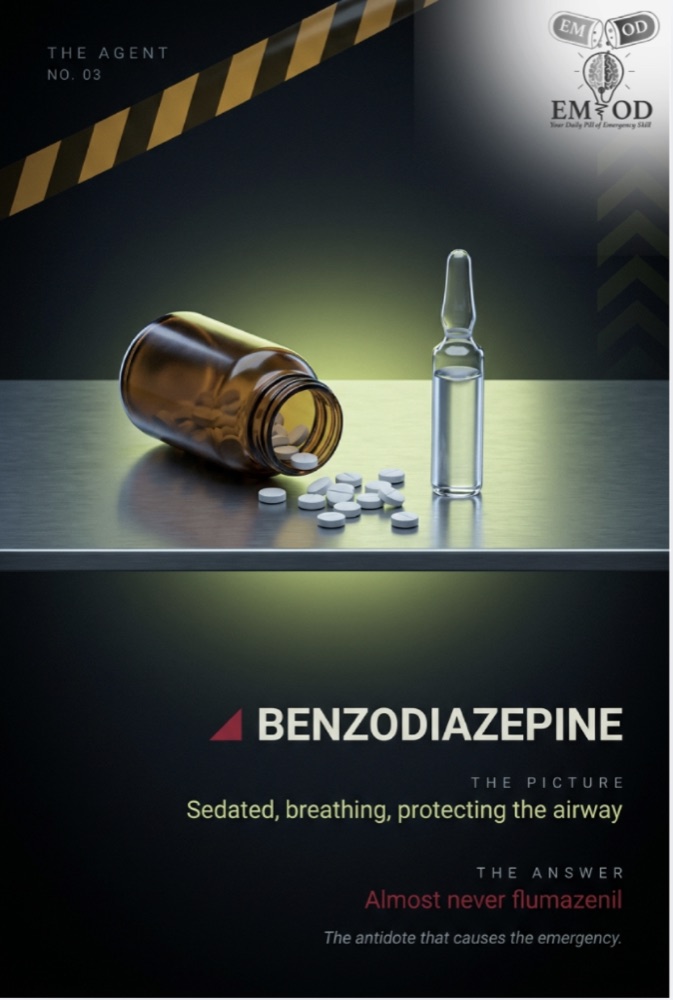
THE PICTURE: Sedated, breathing, protecting the airway · THE ANSWER: Almost never flumazenil The antidote that causes the emergency.
1 · The case
A 52-year-old woman is brought in at three in the morning, drowsy but rousable, saturating well on air, with a respiratory rate of fourteen and an empty diazepam packet in her bag. She has been on diazepam for years. Nobody knows what else she took. A registrar, keen and correct about the pharmacology, draws up flumazenil to "confirm the diagnosis and avoid an admission". The ECG has not yet been printed.
2 · The mechanism
The GABA-A receptor is a pentameric ligand-gated chloride channel and the principal inhibitory receptor in the central nervous system. When GABA binds, the channel opens, chloride enters, the neurone hyperpolarises and becomes harder to excite.
Benzodiazepines are not agonists at that channel. They bind at a separate allosteric site — the interface between the alpha and gamma-2 subunits — and increase the frequency with which the channel opens in response to GABA. That distinction is the whole safety profile of the class. Because the drug only amplifies a signal that endogenous GABA must first provide, there is a ceiling to how much inhibition it can produce. Barbiturates, by contrast, increase channel open duration and at high concentrations open the channel directly, which is why they kill and benzodiazepines usually do not.
This is why an isolated benzodiazepine overdose is rarely fatal. Respiratory drive is preserved because there is a limit to the receptor effect. Deaths in benzodiazepine poisoning are overwhelmingly deaths of co-ingestion — with alcohol or opioids, which depress ventilation through separate mechanisms with no such ceiling — or deaths of an unprotected airway and aspiration.
Flumazenil is a competitive antagonist at that same allosteric site. It does not reverse GABA; it removes the amplification. And in a patient who has taken benzodiazepines chronically, that amplification is no longer a bonus — it is load-bearing. Chronic exposure produces receptor adaptation, and inhibitory tone becomes dependent on the drug being present. Strip it away abruptly and the result is unopposed excitation: seizures, in a patient in whom the first-line anticonvulsant has just been pharmacologically blocked.
The co-ingestion problem is worse and more mechanistic. Tricyclic antidepressants block cardiac sodium channels, antagonise muscarinic receptors, and are themselves proconvulsant. In a mixed overdose, the benzodiazepine on board is actively suppressing that seizure risk. Flumazenil removes the suppression, the patient seizes, the seizure produces acidosis, the acidosis deepens sodium channel blockade, and the QRS widens toward an arrhythmia — with your best anticonvulsant unavailable.
Flumazenil's half-life is shorter than that of most benzodiazepines, so even a "successful" reversal re-sedates.
3 · The picture
The presentation is reassuring, and that is diagnostically useful. Drowsiness or sleep from which the patient can be roused, slurred speech, ataxia, nystagmus, and normal or near-normal observations. Pupils are typically mid-sized and reactive — not pinpoint, which is the fastest bedside discriminator from opioid toxicity. Respiratory rate is broadly preserved.
The most important clinical rule on this page is a negative one. Deep unrousable coma, significant respiratory depression, hypotension, or any focal neurological sign should not be attributed to an isolated benzodiazepine overdose. When the patient is sicker than the drug explains, the diagnosis is incomplete. Look for the co-ingestant — alcohol, an opioid, a tricyclic — and look equally hard for the things that are not toxicological at all: hypoglycaemia, head injury in a patient who fell while sedated, carbon monoxide, sepsis, an intracranial event.
Tempo depends on the agent. Onset after oral ingestion is typically within thirty minutes to two hours. Duration varies enormously: short-acting agents resolve over hours, while diazepam and chlordiazepoxide have long half-lives and active metabolites — desmethyldiazepam prominent among them — that extend sedation well beyond the parent drug and beyond a single nursing shift.
Older patients and those with hepatic impairment behave differently, accumulating active metabolites and remaining sedated far longer than the ingested dose would suggest.

4 · The answer
The treatment is unglamorous, and it is complete.
Airway and position. The overwhelming majority of these patients need nothing more than positioning, oxygen if required, and someone watching. Aspiration is the realistic mode of harm, and it is prevented by nursing position and observation rather than by a drug.
Monitoring and time. Continuous observation until sedation resolves, with attention to the respiratory rate rather than the saturation alone.
Exclude what else is going on. A glucose in every drowsy patient. An ECG, specifically to look for the QRS widening and terminal R wave in aVR of sodium channel blockade — because that finding both changes management and is an absolute reason never to reach for flumazenil. Consider paracetamol, consider alcohol, and reconsider the whole diagnosis if the patient is more obtunded than expected.
Activated charcoal is generally not indicated. The benefit in a poisoning with a low intrinsic mortality does not justify the aspiration risk in a sedated patient with impaired airway reflexes.
Escalate to airway support on the usual grounds — inability to protect the airway, inadequate ventilation, aspiration — and not on the grounds of the number in the drug history.
Where flumazenil genuinely belongs is narrow and mostly outside the emergency department: reversal of procedural sedation, or an isolated iatrogenic single-agent exposure, in a patient who is not dependent, has no seizure history, has no proconvulsant on board, and has a normal ECG. If any of those conditions cannot be confirmed, the conditions are not met. In the undifferentiated overdose at three in the morning, they never are.
If a seizure follows flumazenil, it is difficult by design — the benzodiazepine site is blocked. Escalation is to agents acting at different sites on the GABA-A receptor, such as barbiturates or propofol, with critical care involvement. This is a foreseeable, avoidable emergency.
5 · The drug
This is the only page in the series where the dose block exists to define the boundaries of a drug you will usually decide not to give.
| Agent | Loading / maintenance | Route | Named source of the regimen |
|---|---|---|---|
| Flumazenil — reversal of procedural sedation, or an isolated single-agent iatrogenic exposure | 200 microgram over 15 seconds, then 100 microgram at 60-second intervals as required; usual maximum total 1 mg | IV | Flumazenil product literature (SPC) |
| Supportive care — the actual treatment of benzodiazepine overdose | Airway positioning and support, oxygen, monitoring, and time | — | Standard practice |
Absolute practical contraindications to reaching for it: known or suspected benzodiazepine dependence; co-ingestion of any proconvulsant, tricyclic antidepressants above all; a history of seizures; any QRS widening on the ECG; and — the one that covers most of your department — an undifferentiated overdose in which co-ingestion cannot be excluded.
Confirm against your local poisons service and protocol before use.
6 · The trap
Flumazenil in the mixed overdose. The reasoning that leads there is entirely coherent, which is what makes it dangerous. There is a sedated patient, there is an antidote, the antidote is specific, and giving it promises both a diagnosis and an earlier discharge. Every step of that argument is sound except the premise — that this is a benzodiazepine overdose and only a benzodiazepine overdose.
You almost never know that. The history in an overdose is unreliable by nature; the packet in the bag documents one drug, not the absence of others; and the co-ingestant that matters most — a tricyclic — may be silent on examination and visible only on an ECG that has not been done. Giving flumazenil converts a patient who was going to be fine into a patient having seizures you cannot easily stop, in a poisoning whose baseline mortality was close to zero.
The dependence trap runs alongside it. A long-term prescription is not incidental history here. It is the specific risk factor, and it is written in the notes of a large proportion of the people who take benzodiazepine overdoses.
Knowing when not to use an antidote is a more senior skill than knowing the dose of one. The ampoule stays in the drawer.
8 · References
- UK National Poisons Information Service / TOXBASE — guidance on benzodiazepine poisoning and on the restricted indications for flumazenil.
- Flumazenil product literature (SPC) — dosing for reversal of sedation, and the stated warnings regarding mixed overdose, tricyclic co-ingestion, seizure history and benzodiazepine dependence.
- British National Formulary (BNF) — flumazenil; benzodiazepine poisoning.
- US poison control centres / AAPCC guidance for jurisdictions using US protocols.
- AACT/EAPCCT position paper on single-dose activated charcoal — the basis for not routinely decontaminating a sedated patient with impaired airway reflexes.
- Standard toxicology reference texts on GABA-A receptor pharmacology, the ceiling effect of benzodiazepine site modulation, and the distinct binding sites of barbiturates and propofol.
Regimens and thresholds are jurisdiction-specific. Nothing on this page replaces your national guidance or a conversation with your regional poisons service.
3 questions to test yourself on this dose are in the app.