Opioid — Pinpoint pupils, slow breathing, unrousable
EMOD · The Agent 2 of 30
Open in the appFree, works on your phone and offline, with every tool alongside.
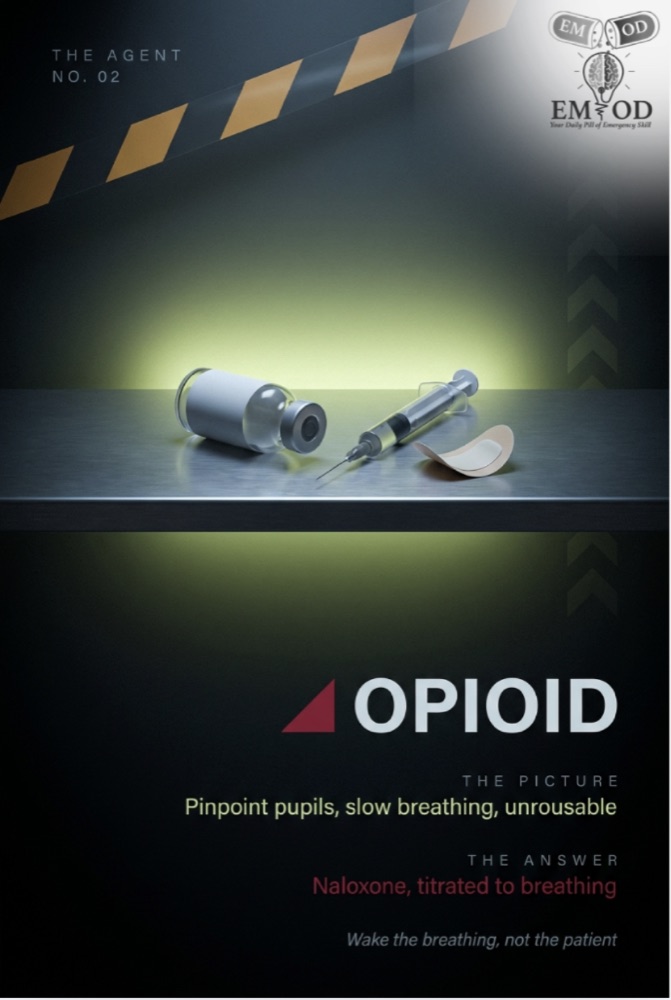
THE PICTURE: Pinpoint pupils, slow breathing, unrousable · THE ANSWER: Naloxone, titrated to breathing Wake the breathing, not the patient.
1 · The case
A 41-year-old man is found slumped in a chair by his brother and arrives unrousable, breathing six times a minute, with pupils you need to look twice to see. He is given 400 microgram of naloxone as a single bolus because that is what the ampoule contains. Within two minutes he is sitting bolt upright, sweating, retching, furious, pulling at the monitoring, and telling everyone he is leaving. Forty minutes later he is found asleep in the waiting room, and nobody has yet asked what he took or looked at his back.
2 · The mechanism
Opioids act at the mu opioid receptor, a G-protein coupled receptor signalling through Gi/o. Activation inhibits adenylyl cyclase, opens G-protein coupled inwardly rectifying potassium channels — hyperpolarising the neurone — and closes presynaptic N-type calcium channels, reducing neurotransmitter release. The net effect is neuronal silencing, and the clinical syndrome depends entirely on which neurones are silenced.
Respiratory depression is a brainstem phenomenon with a specific address. Mu receptors are dense on the pre-Bötzinger complex in the ventral medulla — the rhythm generator for breathing — and on the chemosensitive neurones that sense rising carbon dioxide. Opioids therefore blunt the ventilatory response to hypercapnia and slow the respiratory rhythm itself. This is why the abnormality is predominantly rate rather than depth, and why the patient is bradypnoeic rather than shallow. The hypoxic drive is more preserved than the hypercapnic one, which is precisely why a patient can look adequate on a saturation probe while their carbon dioxide climbs.
Miosis comes from mu-mediated stimulation of the Edinger–Westphal nucleus, increasing parasympathetic outflow to the pupillary sphincter.
Naloxone is a competitive antagonist at mu, kappa and delta receptors, with high mu affinity. It displaces the agonist rather than metabolising it, and that single fact generates every practical problem on this page. Given intravenously it acts within one to two minutes. Its clinical duration is short — commonly in the region of twenty to ninety minutes — and its plasma half-life is shorter than that of almost every opioid it is used against. Methadone's half-life is measured in tens of hours. Modified-release preparations release for hours after ingestion. The antidote is a window; the poison is not.
Precipitated withdrawal has its own mechanism. Abrupt displacement of the agonist in a dependent patient disinhibits the locus coeruleus, producing a noradrenergic surge: agitation, hypertension, tachycardia, sweating, vomiting. That vomiting occurs in a patient whose airway reflexes are still partly obtunded, which is the harm.
3 · The picture
The classical triad is reduced consciousness, respiratory depression and miosis, and its value is in knowing when each element fails.
Respiratory rate is the vital sign that matters and the one least reliably recorded. A rate of six is frequently charted as "regular". In a patient with an intact saturation on supplemental oxygen, the rate is the only bedside number tracking the poisoning.
Miosis is helpful when present and does not exclude when absent. Pupils may be normal or dilated with pethidine and tramadol, with co-ingested stimulants or anticholinergics, and — importantly — with severe hypoxia, which dilates the pupil. A dilated pupil in a peri-arrest opioid overdose is a marker of how sick the patient is, not evidence against the diagnosis.
Agent-specific features change the emergency. Tramadol causes seizures and can contribute to serotonin syndrome, often with little miosis. Methadone prolongs the QT interval and is associated with torsades de pointes. Pethidine accumulates normpethidine, which is proconvulsant. Buprenorphine is a partial agonist with very high receptor affinity — it is comparatively resistant to displacement and may require substantially more naloxone, and an infusion, to reverse.
The complications are the reason these patients are admitted rather than watched for an hour. Aspiration pneumonitis, non-cardiogenic pulmonary oedema, and rhabdomyolysis with compartment syndrome from prolonged immobility on a hard surface — the last of these declares itself late, in a limb nobody examined because the patient was unconscious when they arrived.
Examine the skin, including the back. Transdermal patches are missed constantly. A patch that has been removed has already delivered a subcutaneous depot which continues to absorb for many hours, so removal is the start of the observation period, not the end of it.
4 · The answer
Ventilate first. Bag-mask ventilation with airway positioning corrects the immediate physiology and buys the time in which everything else is done. A patient who is being ventilated is not dying while you titrate.
Then titrate naloxone to breathing. The endpoint is a respiratory rate and tidal volume adequate to protect the patient — not eye opening, not conversation, not a Glasgow Coma Scale of 15. A patient who is breathing well and remains sedated has been treated correctly. Small increments, reassess after each, stop when ventilation is adequate. Where the patient is apnoeic or peri-arrest, larger increments and rapid escalation are appropriate — the calculus changes when there is no ventilation at all.
Then keep them. The observation period is the treatment. A patient who responded well to naloxone has a demonstrated opioid poisoning and a demonstrably shorter-acting antidote on board. Re-sedation is expected, not surprising, and it is commonest with methadone, modified-release preparations, and transdermal patches. Where re-sedation occurs or is anticipated, an infusion is used rather than repeated rescue boluses, because bolus-only management produces a sawtooth of over- and under-treatment.
Look for what else is on board. Mixed overdose is the norm rather than the exception. Check a glucose, obtain an ECG — methadone and the QT interval, and any co-ingested sodium channel blocker — and consider paracetamol, because compound analgesic preparations combine an opioid with paracetamol and the opioid is what brings the patient in.
Discharge is a decision about the drug's duration, not the patient's current alertness. A patient who is awake at the point of maximum naloxone effect tells you very little about the next four hours.
5 · The drug
| Agent | Loading / maintenance | Route | Named source of the regimen |
|---|---|---|---|
| Naloxone — spontaneously breathing, inadequate ventilation | 40–100 microgram increments, repeated every 2–3 minutes, titrated to respiratory rate and adequacy of ventilation, not to consciousness | IV | UK NPIS/TOXBASE and BNF titration approach in opioid poisoning |
| Naloxone — apnoeic or peri-arrest | Larger initial increments (commonly 400 microgram), escalated rapidly until ventilation is restored | IV | BNF; product literature |
| Naloxone — no intravenous access | 400 microgram, or one dose of your intranasal device | IM / intranasal | Product literature; national take-home naloxone programmes |
| Naloxone infusion — re-sedation on a long-acting opioid | Hourly rate commonly set at approximately two-thirds of the total bolus dose that restored adequate ventilation, then retitrated | IV infusion | Approach described in NPIS/TOXBASE and standard toxicology references |
The endpoint is ventilation. A patient who is breathing adequately and remains sedated has been treated correctly. A patient who has been made to sit up has been over-treated, and the cost of that is precipitated withdrawal, agitation, vomiting into an unprotected airway, and self-discharge into the community with a naloxone half-life shorter than the opioid's.
Confirm against your local poisons service and protocol before use.
6 · The trap
Titrating to consciousness instead of to breathing. The whole ampoule is given because that is the unit it comes in, and it works — spectacularly. The patient wakes, and the clinician has an immediate, visible, gratifying result. What has actually happened is that a competitive antagonist has been pushed well past the point of restoring ventilation into the range that strips a dependent patient of every receptor occupancy at once. The patient vomits, becomes combative, refuses the observation they now need more than ever, and leaves — with a short-acting antidote and a long-acting opioid.
And that is the second half of the trap: the good response used as a discharge criterion. A patient who woke is a patient in whom the diagnosis is confirmed, not a patient who is fixed. The naloxone will wear off first. Almost every clinician who has worked a few years has had a patient re-sedate after a textbook response, and the ones that are remembered are the ones who had already gone home.
A removed patch is not a treated patch. The depot in the skin continues to absorb.
8 · References
- UK National Poisons Information Service / TOXBASE — national guidance on the assessment and management of opioid poisoning, including naloxone titration and infusion.
- British National Formulary (BNF) — naloxone in opioid overdose; incremental dosing and routes.
- Naloxone product literature (SPC) — onset, duration of action, routes of administration, and the explicit warning regarding a duration of action shorter than that of many opioids.
- World Health Organization guidance on the community management of opioid overdose — basis for take-home naloxone and intranasal/intramuscular administration by non-clinicians.
- US poison control centres / AAPCC guidance for jurisdictions using US protocols.
- Product literature for buprenorphine, regarding partial agonism, high receptor affinity and the implications for reversal.
- Product literature for methadone, regarding prolonged elimination half-life and QT interval prolongation.
Regimens and thresholds are jurisdiction-specific. Nothing on this page replaces your national guidance or a conversation with your regional poisons service.
3 questions to test yourself on this dose are in the app.