Paracetamol — Well for hours, then silent liver failure
EMOD · The Agent 1 of 30
Open in the appFree, works on your phone and offline, with every tool alongside.
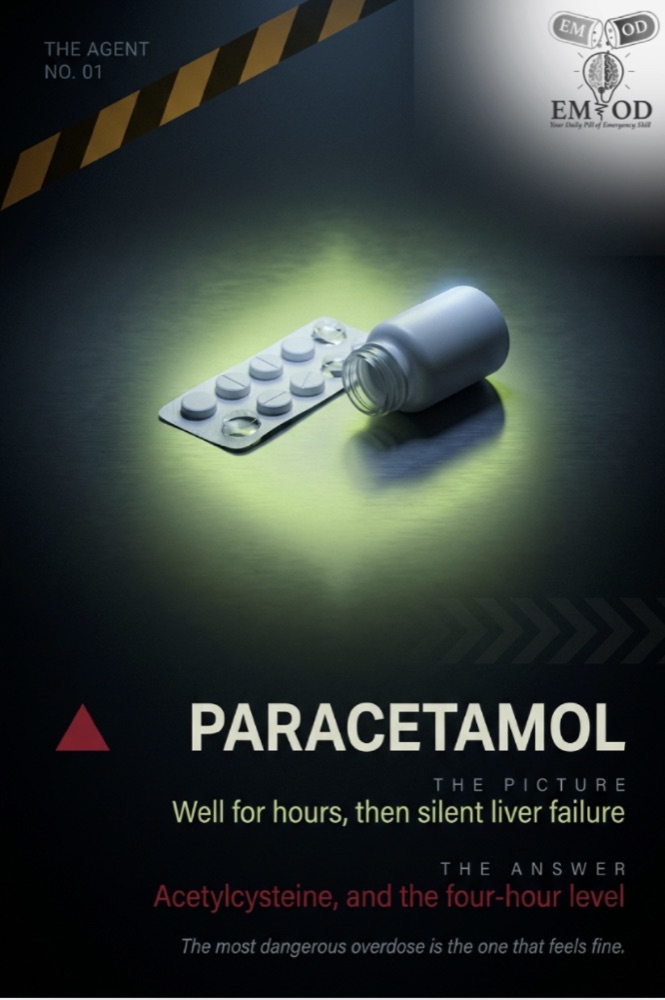
THE PICTURE: Well for hours, then silent liver failure · THE ANSWER: Acetylcysteine, and the four-hour level The most dangerous overdose is the one that feels fine.
1 · The case
A 19-year-old is brought in by a friend after an argument. She took "some paracetamol" at home, is apologetic, wants to go, and has entirely normal observations — not nauseated, not tender, her only complaint that she is embarrassed. A level is sent forty minutes after arrival because that is when the phlebotomist came round, and it comes back low. Nobody has yet established that the tablets were taken over about six hours rather than all at once.
2 · The mechanism
At therapeutic doses roughly ninety per cent of paracetamol is conjugated — glucuronidated and sulfated — into inert metabolites cleared in the urine. A small remaining fraction is oxidised by cytochrome P450, principally CYP2E1, into N-acetyl-p-benzoquinone imine (NAPQI). NAPQI is a highly reactive electrophile, and at normal doses it is neutralised almost as fast as it is made by conjugation with glutathione.
Overdose breaks that arrangement in two steps. First the sulfation pathway saturates, so a progressively larger proportion of the dose is shunted down CYP2E1 and NAPQI production rises. Second, glutathione is consumed faster than the hepatocyte can resynthesise it. Once hepatic glutathione falls below roughly thirty per cent of baseline, unbuffered NAPQI begins binding covalently to cysteine residues on hepatocyte proteins — including mitochondrial proteins — producing oxidative injury, mitochondrial failure and cell death.
The distribution of injury follows the enzymology. Centrilobular hepatocytes (zone 3) carry the highest CYP2E1 activity and the lowest glutathione reserve, which is why the lesion is centrilobular necrosis and why the biochemical signature is a transaminase rise that can reach extraordinary values.
Acetylcysteine works because it is a cysteine donor. It replenishes the substrate for glutathione synthesis and supplies sulfate, favouring the safe conjugation pathway. Given early it restores the buffer before NAPQI ever accumulates — hence its near-complete protection when started within eight hours of an acute ingestion, and its progressively declining efficacy after that. Given late, in established hepatotoxicity, it retains benefit through mechanisms that are not purely glutathione-related, including free radical scavenging and improved microcirculatory oxygen delivery. That is the reason a late presenter is still treated.
The kinetics explain the four-hour rule. Paracetamol has an elimination half-life of about two hours therapeutically, and absorption after an acute overdose is essentially complete by around four hours. Before that point a plasma concentration is still climbing and does not represent the peak, so plotting it underestimates risk. After hepatotoxicity is established the half-life lengthens, and a prolonged half-life is itself a marker of injury.
3 · The picture
Paracetamol poisoning is described in phases because the phases are real and because the first one is the dangerous one.
Phase 1, roughly the first 24 hours. Nothing, or almost nothing. Nausea, vomiting, malaise, pallor. Many patients are entirely asymptomatic. Observations are normal. There is no examination finding that discriminates the patient who will develop hepatic failure from the patient who will not, and this is the single most important clinical fact on the page. The silent interval is not a grace period; it is the treatment window.
Phase 2, roughly 24 to 72 hours. Right upper quadrant pain and hepatic tenderness. Transaminases climbing, often steeply. The INR begins to rise, and it rises before bilirubin, because factor VII has the shortest half-life of the vitamin K-dependent factors — making INR the more useful early marker of synthetic failure.
Phase 3, roughly 72 to 96 hours. Peak hepatic necrosis. Jaundice, coagulopathy, hepatic encephalopathy, lactic acidosis, acute kidney injury, and hypoglycaemia — late, ominous, and easily attributed to something else in a drowsy patient. Deaths occur here.
Phase 4, four days to two weeks. Either resolution with complete hepatic regeneration, or progression to transplantation or death.
What discriminates at the bedside is the history, not the examination. The questions that change management are: when, over what period, what preparation, and what else. A patient who took tablets over six hours is a staggered ingestion, and the tempo of the story is what moves them out of the nomogram.

4 · The answer
Establish the timing before anything else. The entire risk assessment depends on whether this is a single acute ingestion at a known time. If it is, a plasma paracetamol concentration taken at four hours or later is plotted against the treatment line your national guidance uses, and treatment follows. If it is not, the nomogram does not apply and cannot be made to apply.
The nomogram's boundaries, which are where most errors live. It was constructed for a single acute ingestion, at a known time, sampled at four hours or later. It does not apply to staggered ingestion, to ingestion at an unknown time, to modified-release preparations, or to presentation beyond the interval your guidance covers. In each of those situations the decision moves to formal risk assessment and local toxicology guidance, and in most protocols the default is to start acetylcysteine while the assessment is completed rather than to wait.
Activated charcoal has a role in the patient presenting early after a significant ingestion with a protected airway. Its benefit falls sharply with time from ingestion.
Acetylcysteine is the treatment and it is time-critical. Do not delay the first dose while waiting for a level in a patient who plainly needs treatment — the late presenter, the staggered ingestion, the unknown time, the patient who is already unwell.
Anaphylactoid reactions are a nuisance, not an allergy. Flushing, urticaria, wheeze and occasionally hypotension are rate-related and histamine-mediated rather than IgE-mediated, and cluster during the initial high-rate infusion. Pause or slow the infusion, treat symptomatically, restart — do not abandon the antidote. The two-bag regimens were developed substantially to reduce this problem.
Do not stop at the end of the protocol reflexively. Continuation criteria differ between guidelines but the principle is universal: if the INR or transaminases are rising, or paracetamol is still detectable, or the patient is unwell, treatment continues and toxicology is involved.
Know the transplant referral criteria. The King's College criteria for paracetamol-induced acute liver failure (O'Grady et al., 1989) identify the patients who should be discussed with a liver unit: arterial pH below 7.3 after adequate fluid resuscitation, or the combination of INR above 6.5, creatinine above 300 µmol/L and grade III–IV encephalopathy. Persistent or worsening acidosis and a rising lactate are the practical triggers to pick up the phone. Referral is a conversation to have early, not a decision to make at the point of failure.
5 · The drug
| Agent | Loading / maintenance | Route | Named source of the regimen |
|---|---|---|---|
| Acetylcysteine — two-bag ("SNAP-style") regimen | 100 mg/kg over 2 hours, then 200 mg/kg over 10 hours | IV infusion | Bateman DN et al., SNAP randomised controlled trial, Lancet 2014; adopted in UK practice per MHRA 2012 guidance and NPIS/TOXBASE |
| Acetylcysteine — classic three-bag (Prescott) regimen | 150 mg/kg over 60 minutes, then 50 mg/kg over 4 hours, then 100 mg/kg over 16 hours | IV infusion | Prescott LF et al., original intravenous protocol; retained in several national guidelines and in US 21-hour IV practice |
| Activated charcoal | 50 g adult; 1 g/kg in children — early presentation, protected airway only | Oral / NG | Standard decontamination practice; AACT/EAPCCT position papers on single-dose activated charcoal |
Weight is capped in most protocols (commonly at 110 kg) and dilution volumes are specified by the local protocol — follow the infusion chart your department uses rather than calculating from first principles at the bedside.
Thresholds are deliberately not given here. The plasma concentration at which treatment starts, the mg/kg ingested dose that triggers investigation, and the time limit beyond which the nomogram is abandoned differ between countries — the UK, US, Australasian and several European guidelines do not use the same treatment line, and applying another country's threshold to your patient will either over-treat or, far worse, under-treat. Use your own national guidance and your regional poisons service. This is precisely the situation the phone call exists for.
Confirm against your local poisons service and protocol before use.
6 · The trap
The level taken too soon. A concentration drawn before four hours from ingestion is uninterpretable on the nomogram, and the harm is not that it is useless — it is that it is reassuring. A low number at ninety minutes gets read as a low number, the patient is stood down, and the four-hour sample is never taken. If a patient presents before four hours, the correct action is to wait and sample at four hours, not to sample now and act on it.
The staggered ingestion plotted anyway. The second trap is the nomogram used on a patient it was never built for. Tablets taken over an evening have no single "time of ingestion", so there is no valid x-axis value, so any point plotted is fiction — and it will usually plot below the line. This is the mechanism by which a genuinely high-risk patient is discharged with a documented, plausible, entirely invalid risk assessment.
And the third, quieter one: nobody rechecked the time. The patient felt well, was pleasant, was not sick, and the history was taken once at triage and never revisited. Ask when, not just how much.
8 · References
- Rumack BH, Matthew H. Acetaminophen poisoning and toxicity. Pediatrics, 1975 — the origin of the Rumack–Matthew nomogram, and the reason its stated inclusion criteria matter.
- Prescott LF et al. Intravenous N-acetylcysteine: the treatment of choice for paracetamol poisoning — the original intravenous regimen underlying the classic three-bag protocol.
- Bateman DN et al. Reduction of adverse effects from intravenous acetylcysteine treatment for paracetamol poisoning: a randomised controlled trial (SNAP). Lancet, 2014.
- O'Grady JG et al. Early indicators of prognosis in fulminant hepatic failure. Gastroenterology, 1989 — the King's College criteria.
- UK National Poisons Information Service / TOXBASE — national guidance on paracetamol risk assessment, treatment lines and continuation criteria.
- MHRA guidance on intravenous acetylcysteine (2012, UK) — treatment line and infusion changes.
- US poison control centres / AAPCC and US-based guidance for the 21-hour intravenous and oral protocols where those apply.
- AACT/EAPCCT position paper on single-dose activated charcoal.
Regimens and treatment thresholds are jurisdiction-specific. Nothing on this page replaces your national guidance or a conversation with your regional poisons service.
3 questions to test yourself on this dose are in the app.