The Back X-Ray —
EMOD · Safe to Stop 5 of 30
Open in the appFree, works on your phone and offline, with every tool alongside.
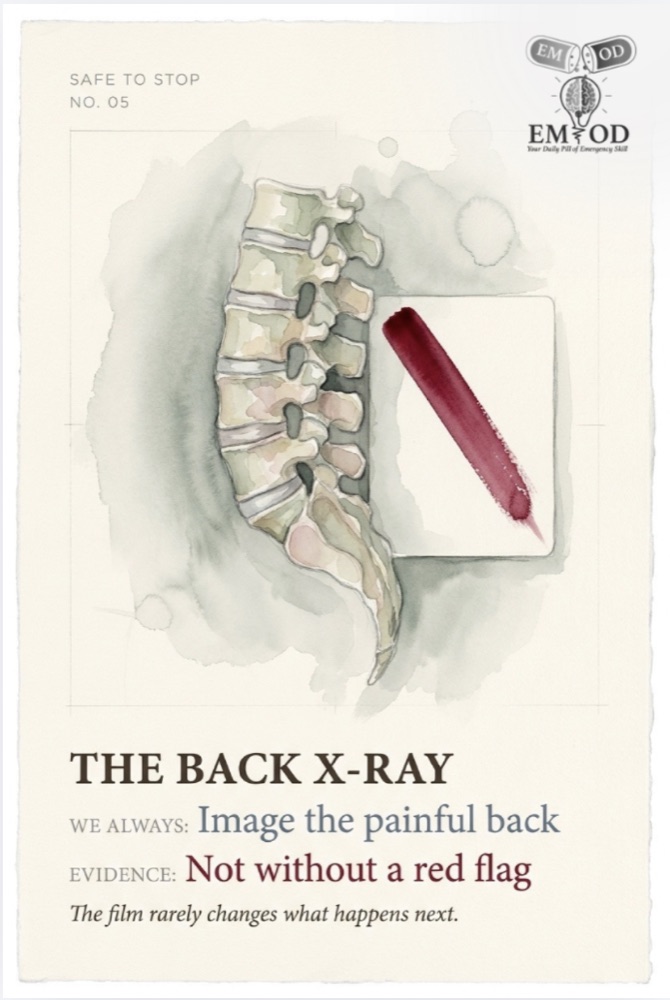
WE ALWAYS: Image the painful back EVIDENCE: Not without a red flag The film rarely changes what happens next.
1 · The case
A 42-year-old warehouse worker presents with three days of low back pain after a weekend of lifting. No trauma, no fever, no weight loss, no neurological symptoms; he walked in, and he winces getting on the trolley. He would like "a scan to see what's wrong". The lumbar spine series is requested, partly because he asked, partly because it is quicker than the conversation about why it will not help.
2 · The argument
The lumbar film survives on two illusions: that pain of that severity must have a visible cause, and that ordering the image is the cautious option. Neither survives contact with the evidence.
Imaging without red flags does not improve outcomes. The meta-analysis by Chou and colleagues in the Lancet pooled the randomised trials of routine imaging for low back pain without features of serious disease: no benefit in pain, function or wellbeing over usual care without imaging. Not a marginal benefit — none. The film does not change what happens next, because what happens next is analgesia, movement and time, whatever the film shows.
The film almost always shows something, and that is the problem. Degenerative change is close to universal from middle age onwards. Brinjikji's systematic review of imaging in asymptomatic people documented disc degeneration, bulges and facet arthropathy at high and rising prevalence in every decade — findings sitting quietly in people with no pain at all. Handing a patient a report that says "degeneration" tells him he has a spine, not why it hurts this week. What it often does achieve is harm of a specific kind: the labelling effect. A patient who believes his spine is "crumbling" moves less, fears more, and recovers more slowly — the opposite of everything the consultation should have delivered.
The X-ray is also simply the wrong test for the things worth finding. The serious causes of back pain — cauda equina compression, epidural abscess, malignant deposit, occult fracture — are found by history and examination directing an urgent MRI, not by a plain film ordered without a question. A "normal lumbar series" in a patient with saddle anaesthesia is a catastrophe wearing the costume of reassurance.
The real cost is the conversation not had. The five minutes spent arranging and explaining imaging is precisely the five minutes that should have asked about bladder function, night pain, fever, immunosuppression, cancer history and injecting drug use — the questions that actually sort the dangerous five per cent from the benign ninety-five.
Counterweight — Deadly Mimics Days 18 and 19: cauda equina and spinal epidural abscess are the patients the red flags exist to find; the rule frees your attention for exactly them.
3 · The evidence
ACEP Choosing Wisely, verbatim:
"Avoid lumbar spine imaging in the emergency department for adults with non-traumatic back pain unless the patient has severe or progressive neurologic deficits or is suspected of having a serious underlying condition."
Chou R, et al., Lancet 2009. Systematic review and meta-analysis of randomised trials of imaging strategies for low back pain without indication of serious pathology: routine imaging did not improve clinical outcomes compared with usual care without imaging.
Brinjikji W, et al., American Journal of Neuroradiology 2015. Systematic review of imaging findings in over three thousand asymptomatic individuals: degenerative findings are common at every age and increase steadily with each decade — the reason a "positive" film is so rarely an answer.
American College of Radiology Appropriateness Criteria — low back pain. Uncomplicated acute low back pain without red flags: imaging usually not appropriate; MRI reserved for suspected serious pathology or progressive deficit.
4 · Still justified when
The exception clause carries all the weight here, because the serious causes are exactly what the other series spends two whole days on. Image — and almost always with the right modality, which is MRI rather than a plain film — when there is:
- Severe or progressive neurological deficit: objective weakness, a evolving sensory level, gait disturbance.
- Any feature of cauda equina syndrome: saddle anaesthesia, new bladder or bowel dysfunction, bilateral leg symptoms. This is an emergency MRI, not a lumbar series and not a morning-list referral.
- Suspicion of infection: fever, injecting drug use, recent spinal procedure or instrumentation, immunosuppression, unrelenting night pain. Epidural abscess is missed precisely because the first visit looked like mechanical pain.
- Suspicion of malignancy: known cancer, unexplained weight loss, age with a first-ever significant episode, pain unrelieved by rest.
- Significant trauma — or minor trauma in patients with osteoporosis or long-term steroid use, where fragility fracture is real and a plain film or CT genuinely answers a question.
- Pain that fails to follow the expected course, where re-examination and a lower threshold for imaging replace the reflex at the first visit.
The recommendation was never "don't image back pain". It is: ask the questions that decide, and image the patients the answers point to — with the modality that can actually find what you fear.
6 · References
- American College of Emergency Physicians. Choosing Wisely — recommendation on lumbar spine imaging.
- Chou R, et al. Imaging strategies for low-back pain: systematic review and meta-analysis. Lancet 2009.
- Brinjikji W, et al. Systematic literature review of imaging features of spinal degeneration in asymptomatic populations. American Journal of Neuroradiology 2015.
- American College of Radiology. ACR Appropriateness Criteria — Low Back Pain.
3 questions to test yourself on this dose are in the app.