The Collar And The Scan —
EMOD · Safe to Stop 3 of 30
Open in the appFree, works on your phone and offline, with every tool alongside.
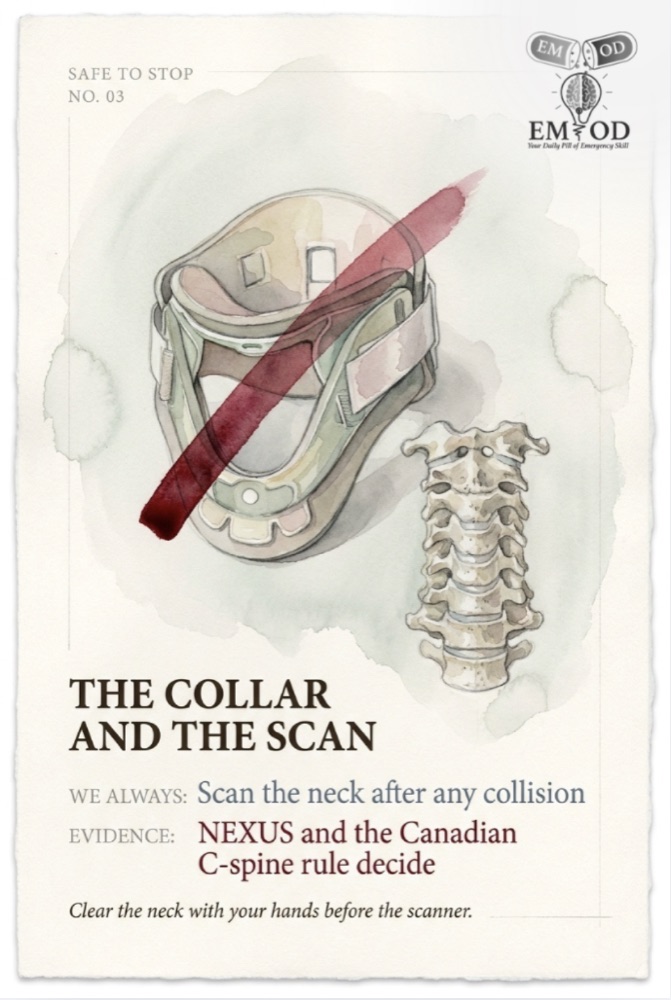
WE ALWAYS: Scan the neck after any collision EVIDENCE: NEXUS and the Canadian C-spine rule decide Clear the neck with your hands before the scanner.
1 · The case
A 28-year-old is brought in after a low-speed rear-end collision. He walked around the car at the scene, sat waiting in the ambulance, and is now lying flat in a rigid collar that went on at triage. He is alert, sober, has no midline tenderness, and turns his head to look at you when you say his name — as far as the collar allows. The CT cervical spine request is in the system. The collar will come off when the report does.
2 · The argument
The habit persists because the stakes feel infinite. A missed cervical spine injury is the catastrophe every emergency clinician carries around, and against that image the scan feels like the only responsible act. The collar goes on "just in case", the scan follows the collar, and the examination — the thing that was actually designed to make this decision — never happens.
The rules were built for exactly this moment, and built well. NEXUS was validated on over 34,000 patients; the Canadian C-Spine Rule was derived and validated on many thousands more. Both are highly sensitive for clinically important injury. This is not an area where clinicians are being asked to trust a hunch — it is one of the best-validated decision territories in emergency medicine, and the rules consistently outperform the unstructured instinct to image everyone.
The scan and the collar both have costs that are never entered in the ledger. The scan is radiation to the thyroid of a young patient, time on a trauma trolley, and incidental findings in the lung apices and thyroid that generate their own cascades. The collar is worse than neutral: pressure injury, raised intracranial pressure, harder airway access, aspiration risk, agitation in the elderly and the intoxicated — and pain, which by the time someone examines the neck can itself read as midline tenderness and buy a scan the patient never needed. A collar left on "for safety" for six hours is not a precaution. It is an intervention with a side-effect profile and no indication.
The precondition is where the whole thing is misused. Both rules demand an alert, assessable, stable patient. Applied to someone intoxicated, distracted by a femoral fracture, or unable to cooperate, the output is meaningless — and this misapplication runs in both directions. Using a rule to clear an unassessable patient is dangerous; refusing to use it on a fully assessable one is merely wasteful. Most departments manage both errors in the same shift.
The examination is not a shortcut around the scan. It is the instrument that tells you whether the scan is the right question.
3 · The evidence
NEXUS (Hoffman et al., New England Journal of Medicine 2000). A prospective validation in 34,069 blunt trauma patients across 21 US centres. The five low-risk criteria identified clinically significant injury with sensitivity above 99%. Its virtue is simplicity; its weakness is that several criteria — "intoxication", "distracting injury" — require judgement and are inconsistently applied.
Canadian C-Spine Rule (Stiell et al., JAMA 2001). Derived in 8,924 alert, stable adult trauma patients. Structured as three sequential questions — high-risk factors, low-risk factors permitting assessment, then active rotation. In derivation and validation it was highly sensitive for clinically important injury while allowing substantially more patients to be cleared without imaging.
Head-to-head comparison (Stiell et al., New England Journal of Medicine 2003). In a direct comparison in Canadian EDs, the Canadian C-Spine Rule outperformed NEXUS on both sensitivity and specificity. Either rule, applied properly, is defensible; the comparison is an argument for adopting one deliberately rather than mixing fragments of both.
4 · The tool
Canadian C-Spine Rule
Derived on: alert (GCS 15), haemodynamically stable adults with blunt trauma and concern for cervical spine injury, assessed within 48 hours.
Explicitly outside the rule — where it is most often misapplied:
- Age under 16
- GCS below 15, or unstable vital signs
- Penetrating trauma
- Acute paralysis or known vertebral disease
- Previous cervical spine surgery
- Pregnancy
Step 1 — any high-risk factor mandates imaging: age 65 or over; a dangerous mechanism (fall from elevation, axial load to the head, high-speed collision, rollover or ejection, motorised recreational vehicle, bicycle collision); paraesthesiae in the extremities.
Step 2 — a low-risk factor must be present to allow examination: simple rear-end collision, sitting position in the ED, ambulatory at any time, delayed onset of neck pain, or absence of midline tenderness. No low-risk factor — image.
Step 3 — active rotation: the patient must actively rotate the neck 45 degrees left and right. Able — no imaging. Unable — image.
NEXUS
Five criteria, all of which must be met to forgo imaging: no posterior midline tenderness; no evidence of intoxication; normal level of alertness; no focal neurological deficit; no painful distracting injury.
What neither rule can do. Neither diagnoses injury — they identify patients in whom imaging is not required. Neither applies to the unassessable patient, and neither tells you a patient with a deficit is fine. And a rule-based clearance is a clearance: the collar comes off then, not after a confirmatory scan the rule just told you not to order. Use one rule, adopted departmentally, and apply it whole. Mixing criteria from both produces the sensitivity of neither.
5 · Still justified when
- The patient fails whichever rule your department has adopted — that is the rule working, not the rule failing.
- The patient cannot be assessed: intoxication, reduced GCS, dementia, language barrier without an interpreter, distracting injury. An unassessable neck is an unclearable neck, and imaging (or maintained precautions and reassessment when assessable) is the correct path.
- The mechanism is high-risk as defined by the rule — the mechanism criteria are part of the instrument, not an optional extra.
- There is any neurological deficit, at any point, regardless of what the rules say about the rest of the presentation.
- The patient is outside the rule's population — children, penetrating trauma, known vertebral disease, previous cervical surgery. The rules have nothing to say about these patients, and silence is not clearance.
And when a patient is cleared, finish the job: take the collar off, document the rule used and the findings, and say out loud that the neck is clear. A cleared patient still in a collar two hours later has been given the harms of immobilisation with none of the indication.
7 · References
- Hoffman JR, et al. Validity of a set of clinical criteria to rule out injury to the cervical spine in patients with blunt trauma (NEXUS). New England Journal of Medicine 2000.
- Stiell IG, et al. The Canadian C-Spine Rule for radiography in alert and stable trauma patients. JAMA 2001.
- Stiell IG, et al. The Canadian C-Spine Rule versus the NEXUS low-risk criteria in patients with trauma. New England Journal of Medicine 2003.
3 questions to test yourself on this dose are in the app.