The reflex CT head —
EMOD · Safe to Stop 1 of 30
Open in the appFree, works on your phone and offline, with every tool alongside.
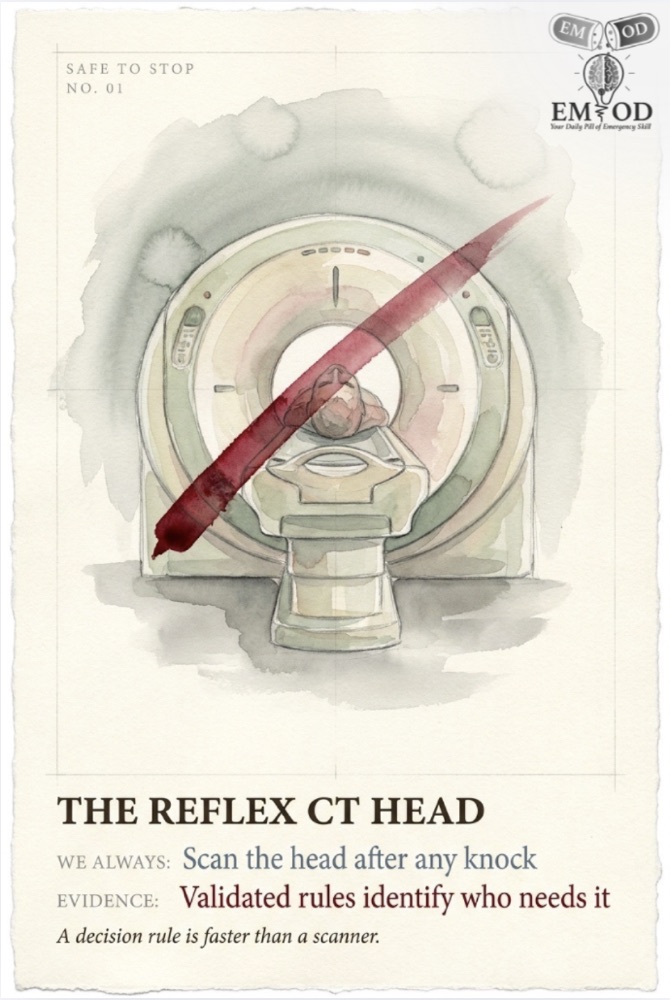
WE ALWAYS: Scan the head after any knock EVIDENCE: Validated rules identify who needs it A decision rule is faster than a scanner.
1 · The case
A 34-year-old walks in an hour after hitting their head on a cupboard door. They did not lose consciousness. They are alert, orientated, and mildly embarrassed. The CT request is already half typed before anyone has examined them.
2 · The argument
The reflex is understandable. A head injury feels like something you image, the scan takes four minutes, and nobody has ever been criticised for ordering one.
But the decision to scan is not neutral, and the reasons are not only radiation.
It is a decision that can be made better by a rule than by instinct. The validated head injury rules were derived on tens of thousands of patients and prospectively validated. They outperform unstructured clinical judgement at identifying the patients who need imaging, which is an uncomfortable thing to accept and the entire reason they exist.
Ionising radiation is real but it is the weakest argument. In an adult a head CT carries a small absolute increase in lifetime malignancy risk. It matters, it is not zero, and it should never be the only thing you say to a patient — because said alone it sounds like an excuse for not scanning.
The stronger arguments are the ones nobody makes. A scan takes the patient out of the department and away from observation, which is the intervention that actually detects deterioration. It generates incidental findings that produce anxiety, follow-up imaging and occasionally harm. It consumes a scanner that another patient is waiting for. And, most importantly, a normal CT is frequently used to end a clinical encounter that should have continued — the patient with a normal scan who is discharged without observation, without a repeat examination, and without return advice.
The rule does not tell you the patient is fine. It tells you that imaging is unlikely to change what happens next. Those are different statements, and conflating them is the commonest error made in the name of "following the rule".
3 · The evidence
ACEP Choosing Wisely, first list (2013), verbatim:
"Avoid computed tomography (CT) scans of the head in emergency department patients with minor head injury who are at low risk based on validated decision rules."
ACEP's stated rationale: CT scans expose patients to ionising radiation, increasing lifetime risk of cancer, and should only be performed on patients at risk for significant injuries.
Canadian CT Head Rule (Stiell et al., Lancet 2001). Derived and validated to identify patients with minor head injury who require CT. Highly sensitive for neurosurgically important lesions.
NEXUS II (Mower et al.). An alternative validated instrument with a different set of criteria, derived on a broader population including children.
Head CT for minor head injury in the era of Choosing Wisely (2017) — examined real-world uptake and found imaging rates remain high despite the recommendation, which is the reason this item is in this series at all. The evidence is not the bottleneck. The habit is.

4 · The tool
Canadian CT Head Rule
What it was derived on. Adults with minor head injury — witnessed loss of consciousness, amnesia, or disorientation — with a GCS of 13 to 15 on arrival.
Who it explicitly excludes, and this is where it is most often misused:
- Age under 16
- Anticoagulation or a known bleeding disorder
- An obvious open skull fracture
- Seizure after the injury
- No history of loss of consciousness, amnesia or disorientation
A patient on a direct oral anticoagulant is outside the rule. Applying it to them and concluding they are low risk is not using the rule; it is misapplying it.
High-risk criteria — for neurological intervention:
- GCS below 15 at two hours after injury
- Suspected open or depressed skull fracture
- Any sign of basal skull fracture
- Two or more episodes of vomiting
- Age 65 or over
Medium-risk criteria — for brain injury on CT:
- Amnesia before impact of 30 minutes or more
- Dangerous mechanism — pedestrian struck, ejection, fall from height
What it is and is not. It is highly sensitive and deliberately not specific. It was built to reduce imaging safely, not to diagnose. A negative rule means imaging is unlikely to change management — it does not mean no injury exists, and it does not replace observation, a documented examination, or return advice.
NEXUS II — the alternative
Used by some departments instead. Its criteria include evidence of significant skull fracture, altered alertness, neurological deficit, persistent vomiting, scalp haematoma, abnormal behaviour, coagulopathy, and age over 65.
Use one rule and know it properly. Departments that mix criteria from two instruments get the sensitivity of neither. Find out which one yours has adopted — most clinicians cannot say.
5 · Still scan when
- The patient fails whichever rule your department uses
- They fall outside the rule's inclusion criteria — anticoagulated, under 16, seizure after injury, no loss of consciousness or amnesia
- They cannot be assessed reliably: intoxication, dementia, language barrier without an interpreter, intellectual disability
- Anticoagulation or antiplatelet therapy, which carries its own pathway
- Deterioration at any point, regardless of an earlier normal examination or an earlier normal scan
- Social circumstances make observation and return impossible
And the counterweight from the other series. Deadly Mimics Day 10 — "just drunk" — is the same patient from the opposite direction. The smell of alcohol explains the smell of alcohol and nothing else, and intoxication is exactly the state in which these rules cannot be applied. Not scanning an assessable low-risk patient and not scanning an unassessable one are entirely different decisions.
7 · References
- American College of Emergency Physicians. Choosing Wisely — first list, 2013.
- Stiell IG et al. The Canadian CT Head Rule for patients with minor head injury. Lancet 2001.
- Mower WR et al. Developing a decision instrument to guide computed tomographic imaging of blunt head injury patients (NEXUS II). J Trauma.
- Head CT for minor head injury presenting to the emergency department in the era of Choosing Wisely, 2017.
3 questions to test yourself on this dose are in the app.