Ask The Three Questions — Aortic dissection
EMOD · Deadly Mimics 6 of 30
Open in the appFree, works on your phone and offline, with every tool alongside.
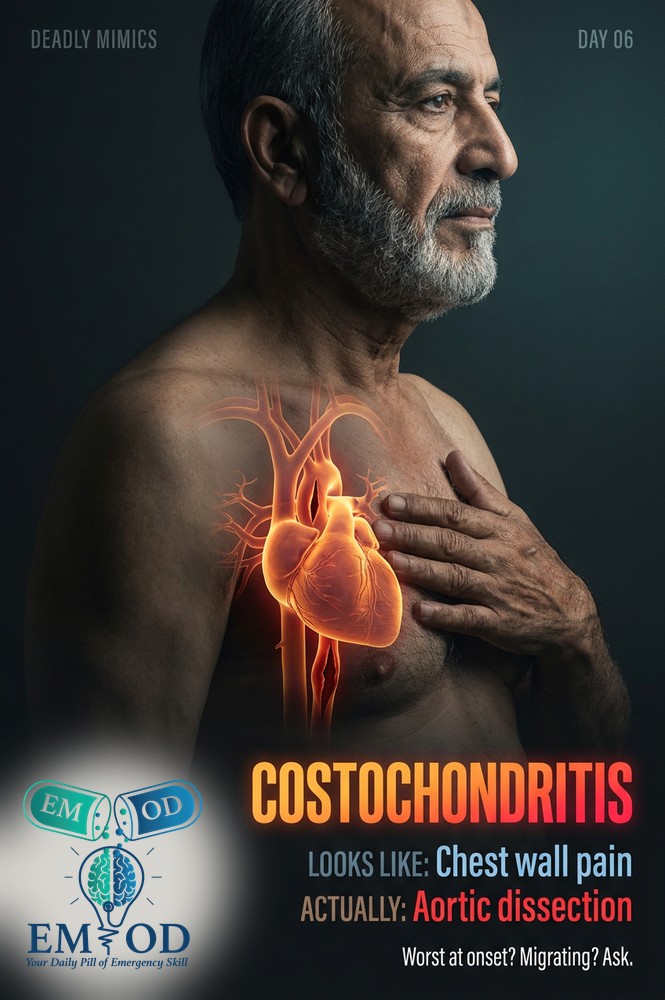
LOOKS LIKE: Costochondritis · ACTUALLY: Aortic dissection Worst at onset? Migrating? Different between the arms? Absent findings do not exclude it.
The case
A 63-year-old man presents with sharp chest and upper back pain that started abruptly while he was carrying shopping. By the time he is seen, the pain has eased to a dull ache. He is hypertensive but comfortable, his ECG shows only left ventricular hypertrophy, and there is some tenderness over the thoracic spine when pressed. The working label is musculoskeletal pain. Nobody has asked him whether the pain was at its absolute worst in the very first second — it was — or whether it has moved — it has, from chest to between the shoulder blades.
The argument
Aortic dissection occupies an awkward statistical position: not rare enough to ignore, not common enough to stay on the differential without deliberate effort. Registry data — the International Registry of Acute Aortic Dissection (IRAD, Hagan et al., JAMA 2000) — and the missed-diagnosis literature suggest that a substantial proportion of dissections, figures approaching a third in some series, are initially diagnosed as something else. The commonest reason is not that the signs were checked and absent. It is that the story was never asked for.
The mimic works because dissection pain, once past its first minutes, behaves badly on purpose. It eases — spontaneously, or with simple analgesia — and easing pain reads as benign pain. It localises to the back, where "musculoskeletal" is the default label for almost everything. And it occurs in patients who often have a mechanical alibi available: the shopping bags, the gardening, the awkward lift. Add a little incidental spinal tenderness — near-universal in men over 60 if you press hard enough — and the costochondritis script completes itself.
The counter-move costs three questions and perhaps twenty seconds. Was the pain worst at the very first second? Dissection is a tearing event; its pain is classically abrupt and maximal at onset, unlike ischaemic pain, which typically crescendos. Did it move anywhere? Migration — chest to back, back to abdomen — tracks the dissection flap's propagation and belongs to very few other diagnoses. Is anything different between the two arms? A pulse deficit or a marked blood pressure differential, where present, is a hard physical sign. The honesty that must accompany the third question: pulse deficits and pressure differentials are specific but insensitive. Their presence should set off alarms; their absence rules out almost nothing, and the same is true of the chest X-ray — a normal mediastinum does not exclude dissection. The Rational Clinical Examination on this exact question (Klompas, JAMA 2002) found no examination finding with the sensitivity to exclude the diagnosis.
That is why the value of the three questions is not that they diagnose. It is that they stop the case being closed by the first plausible label. A "yes" to any of them does not make the diagnosis — it buys the patient a real consideration of it: a proper pulse examination, bilateral pressures, a look at the mediastinum, and where the answers keep pointing the same way, definitive imaging. The lethal version of this case is not the one where dissection was considered and reasonably excluded. It is the one where it was never on the list.
The evidence
Hagan PG et al., the International Registry of Acute Aortic Dissection (IRAD) (JAMA 2000). The registry that defined the modern clinical picture: abrupt severe pain is the dominant symptom, classic examination findings are present only in a minority, and initial misdiagnosis is common. It is the empirical rebuttal to every version of "he didn't look like a dissection."
Klompas M. Does this patient have an acute thoracic aortic dissection? (JAMA Rational Clinical Examination, 2002). The systematic synthesis: pain of sudden onset, tearing or ripping character, migration, pulse deficits and focal neurology each raise probability where present, but no finding or combination of absent findings achieves rule-out sensitivity. A normal chest X-ray reduces probability modestly and excludes nothing.
2022 ACC/AHA Guideline for the Diagnosis and Management of Aortic Disease (Isselbacher et al., Circulation). The current framework, including structured pre-test assessment of high-risk conditions, pain features and examination findings, and the explicit expectation that clinicians actively consider the diagnosis in acute chest, back and abdominal pain.
ADvISED trial (Nazerian et al., Circulation 2018). Prospective multicentre validation of the strategy pairing the Aortic Dissection Detection Risk Score with D-dimer — the first serious attempt at a safe rule-out pathway for a diagnosis that historically had none.

The tool
Aortic Dissection Detection Risk Score (ADD-RS), with D-dimer
What it was derived on. The score organises the high-risk features from the AHA aortic guidelines into three columns — predisposing conditions (Marfan and connective tissue disease, family history, known aortic disease, prior aortic intervention), pain features (abrupt, severe, tearing/ripping), and examination findings (pulse deficit, pressure differential, focal neurology, new murmur, shock) — scoring 0 to 3 by how many columns contain at least one feature. The ADvISED trial prospectively tested ADD-RS ≤1 plus a negative D-dimer as a rule-out strategy and found a very low failure rate.
Who it does not cover. Patients in whom dissection is already clinically evident or who are unstable — they need imaging, not arithmetic. And the score cannot be applied retrospectively to a history that was never taken: its pain-feature column is the three questions.
What it is sensitive for. As a combined strategy with D-dimer, missing very few dissections in the validation cohort — but the D-dimer arm matters; the score alone does not rule out.
What it cannot do. A low score without the D-dimer is not an exclusion. D-dimer is nonspecific, so the strategy generates false positives in exactly the patients (elderly, comorbid) most likely to be tested. And no score compensates for the diagnosis never being considered — the instrument's inputs are the answers to questions that anchoring prevents being asked. Where a local pathway exists, use the local pathway.
When it really is benign
Musculoskeletal chest and back pain vastly outnumbers dissection, and most of it deserves its label. The features that genuinely support the benign diagnosis: a clear mechanical trigger with pain onset during or after the strain rather than an instantaneous tear; pain that crescendoed rather than arriving maximal; pain reproduced by specific movements of the spine or chest wall, not just by pressure; no migration; symmetrical pulses and pressures; and no high-risk substrate — no known aortopathy, connective tissue disease or family history. A patient with all of that, and answers of "no" to the three questions, can be treated as musculoskeletal with confidence.
Safety-net in named terms: return immediately if the pain returns abruptly and severely, moves to a new region, or arrives with collapse, weakness, or one limb feeling different from the other. Document the three questions and their answers — "sudden-onset queried: pain built over minutes; no migration; pulses symmetrical" is a record that shows the diagnosis was considered, which is the entire game.
References
- Hagan PG et al. The International Registry of Acute Aortic Dissection (IRAD): new insights into an old disease. JAMA 2000.
- Klompas M. Does this patient have an acute thoracic aortic dissection? JAMA 2002.
- Isselbacher EM et al. 2022 ACC/AHA Guideline for the Diagnosis and Management of Aortic Disease. Circulation 2022.
- Nazerian P et al. Diagnostic accuracy of the Aortic Dissection Detection Risk Score plus D-dimer for acute aortic syndromes: the ADvISED prospective multicenter study. Circulation 2018.
3 questions to test yourself on this dose are in the app.