Not All Wheeze Is Asthma — Acute heart failure
EMOD · Deadly Mimics 4 of 30
Open in the appFree, works on your phone and offline, with every tool alongside.
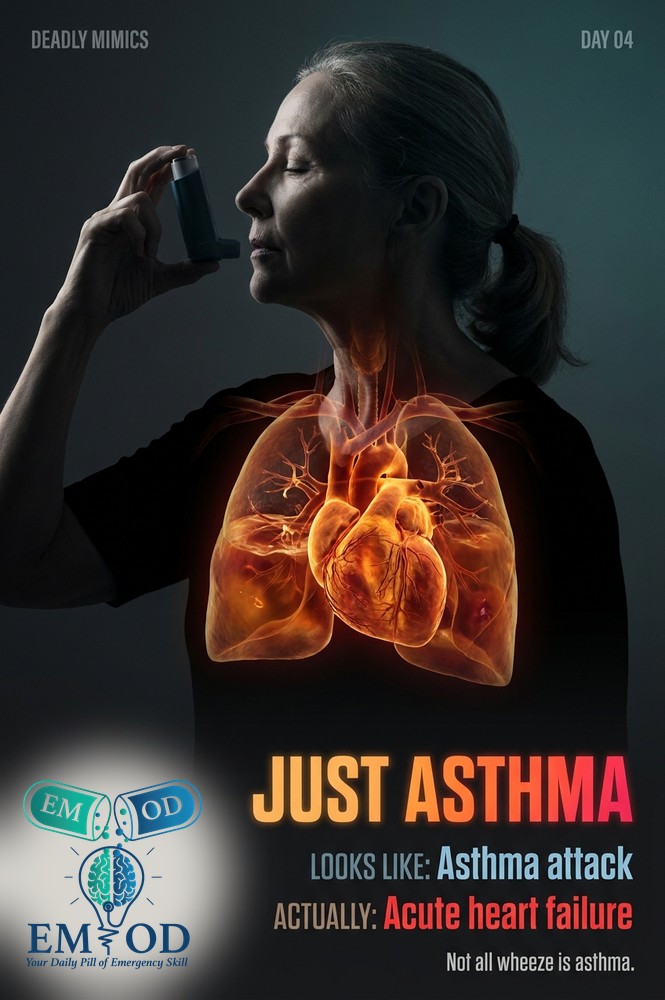
LOOKS LIKE: Asthma exacerbation · ACTUALLY: Acute heart failure First-ever wheeze after 50 = cardiac until proven otherwise.
The case
A 68-year-old woman is brought in at 3 a.m. breathless and wheezing. She has never smoked and has no respiratory history, but the wheeze is loud and audible from the end of the bed, and a salbutamol nebuliser is already running when the clerking doctor arrives. Her heart rate is 122. She mentions, when asked directly, that she has spent the last three nights sleeping in the armchair because lying flat "sets her chest off". Her ankles have been swelling for a week.
The argument
Wheeze does not mean asthma. Wheeze means narrowed small airways, and hearts narrow them too. Pulmonary venous congestion causes bronchial wall oedema and reflex bronchoconstriction, and the resulting expiratory wheeze — the old name is cardiac asthma — can occur with no crackles at all. The textbook picture of acute heart failure, the drowning patient with widespread fine crepitations, is only one of its faces. The wheezing face is the one that gets misfiled, because wheeze has a pre-assigned meaning in every clinician's head, and the meaning is bronchospasm.
The mechanism of the error is representativeness: the finding matches the prototype of asthma, so the patient is slotted into the asthma script, and the script comes with a treatment attached. That treatment is where the mimic turns from a diagnostic error into an iatrogenic one. Repeated high-dose beta-agonists given to a failing heart add tachycardia, increase myocardial oxygen demand, and can worsen the very physiology producing the wheeze. Meanwhile the treatments the patient actually needs are delayed, and each nebuliser cycle buys the wrong diagnosis another twenty minutes of apparent legitimacy — because the patient is "on treatment", the case feels handled.
What separates the two conditions is rarely the chest sounds, and the JAMA Rational Clinical Examination on the dyspnoeic patient (Wang et al., 2005) is blunt about how weak individual examination findings are. The discriminators live in the history. Has this person ever had asthma before? A first presentation of "asthma" past 50, in a lifelong non-wheezer, is a cardiac question until proven otherwise — asthma declares itself early in life far more often than it debuts in the seventh decade. What has changed over the last 48 hours — weight, ankle swelling, exercise tolerance? Asthma does not put fluid in the ankles. And the single highest-yield question: how many pillows last night, and how many normally? Orthopnoea and paroxysmal nocturnal dyspnoea point hard toward the heart; a patient who has migrated from bed to armchair is telling you the diagnosis if anyone converts the detail into a question.
The other pattern that should break the script is the "exacerbation" that fails to behave. A known asthmatic whose attack does not respond the way their attacks usually respond deserves the same scepticism as a first-time wheezer — patients with asthma are allowed to develop heart failure, and the known label is exactly what will hide it.

The evidence
Wang CS et al. Does this dyspneic patient in the emergency department have congestive heart failure? (JAMA Rational Clinical Examination, 2005). The systematic synthesis: no single symptom or sign rules heart failure in or out, but a history of heart failure, paroxysmal nocturnal dyspnoea, and a third heart sound are among the strongest positive features, while the absence of any single finding — crackles included — excludes little. The paper is the formal statement of why "no crackles" must not be read as "not the heart".
ESC 2021 Guidelines for the diagnosis and treatment of acute and chronic heart failure (McDonagh et al., European Heart Journal). The diagnostic framework for acute dyspnoea: clinical probability, ECG, natriuretic peptides where diagnosis is uncertain, and early imaging. The guidelines describe bronchial oedema and wheeze as a recognised presentation of pulmonary congestion.
Natriuretic peptide literature (the Breathing Not Properly study, Maisel et al., NEJM 2002). Demonstrated that BNP measurably improves discrimination between cardiac and pulmonary dyspnoea in the emergency department precisely because clinical assessment alone misclassifies a meaningful fraction of patients — which is this page in trial form.
Point-of-care ultrasound literature on B-lines (Lichtenstein's BLUE protocol and subsequent studies). Sonographic interstitial syndrome distinguishes cardiogenic pulmonary oedema from obstructive airways disease at the bedside faster than any blood test; a wheezing chest full of diffuse B-lines is a heart failure chest until proven otherwise.
When it really is benign
Most wheeze in a known asthmatic is asthma. The features that genuinely support the benign diagnosis: an established asthma or COPD history with an attack that matches that patient's usual pattern and usual triggers; age and story consistent with airways disease; no orthopnoea, no nocturnal migration to the armchair, no new oedema or weight gain; and a response to bronchodilators that follows the expected trajectory. In a young patient with known asthma, a typical trigger and a typical attack, treating asthma as asthma is correct and requires no cardiac workup.
The discharge conversation still earns its keep: return if the breathlessness comes back at rest, if waking at night breathless becomes a pattern, or if the ankles begin to swell — named symptoms, written down. And for the older first-time wheezer being discharged with an airways label, the safety-net should include early follow-up specifically to revisit the diagnosis, because a label given at 3 a.m. has a long half-life.
References
- Wang CS et al. Does this dyspneic patient in the emergency department have congestive heart failure? JAMA 2005.
- McDonagh TA et al. 2021 ESC Guidelines for the diagnosis and treatment of acute and chronic heart failure. European Heart Journal 2021.
- Maisel AS et al. Rapid measurement of B-type natriuretic peptide in the emergency diagnosis of heart failure (Breathing Not Properly study). New England Journal of Medicine 2002.
- Lichtenstein DA, Mezière GA. Relevance of lung ultrasound in the diagnosis of acute respiratory failure: the BLUE protocol. Chest 2008.
3 questions to test yourself on this dose are in the app.