The Antacid Test Doesn'T Exist — Cardiac ischaemia
EMOD · Deadly Mimics 3 of 30
Open in the appFree, works on your phone and offline, with every tool alongside.
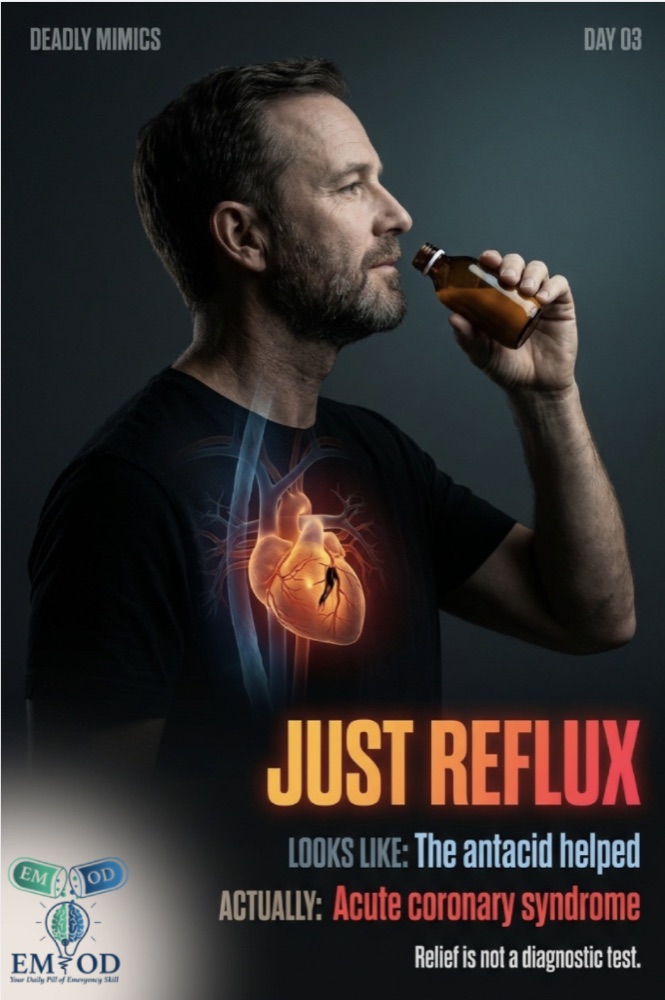
LOOKS LIKE: Reflux — "the antacid helped" · ACTUALLY: Cardiac ischaemia Response to treatment is not a diagnostic test.
The case
A 54-year-old man presents with two hours of burning retrosternal discomfort after a late meal. He looks well. The nurse gives him an antacid-and-lidocaine mixture — the "GI cocktail" — and twenty minutes later he reports that the pain has eased considerably. The clerking note reads: "pain settled with GI cocktail — reflux." The troponin request is cancelled as unnecessary.
The argument
The logic feels airtight: reflux responds to antacids, this pain responded to an antacid, therefore this pain is reflux. It fails at the first premise's hidden twin — only reflux responds to antacids — which is false, and demonstrably so. Response to a GI cocktail has actually been studied as a diagnostic test for distinguishing cardiac from oesophageal chest pain, and it does not discriminate. Patients with proven myocardial ischaemia report relief after antacids at rates that make the "test" useless. The observation is real; the inference is unlicensed.
Why do ischaemic patients improve after a white medicine? Several reasons, all mundane. Ischaemic pain waxes and wanes on its own, and unstable angina is by definition intermittent — relief that follows a treatment in time was often coming anyway, and the treatment steals the credit. Placebo response to a fast-acting, strong-tasting liquid delivered by a professional is substantial for any visceral pain. Viscous lidocaine has genuine local effect on the oesophagus, and oesophageal irritation can coexist with coronary disease in the same patient on the same evening. None of these mechanisms cares what the underlying diagnosis is.
The deeper problem is a whole family of errors that share one skeleton: therapeutic response mistaken for diagnostic information. The nitrate that "worked, so it's cardiac" — except nitrates relax oesophageal smooth muscle and relieve oesophageal spasm beautifully, a point made explicitly in the Rational Clinical Examination literature. The triptan that "worked, so it's migraine" — except symptomatic response has been reported in subarachnoid haemorrhage, and headache from serious causes can respond to simple analgesia. The salbutamol that "worked, so it's asthma" — except bronchospasm has many causes, cardiac wheeze among them. One rule covers every version: treat the symptom, and do not let the symptom's response answer the diagnostic question. Analgesia relieves almost everything; that is the point of analgesia.
There is also a timing trap worth naming. Relief arrives at exactly the moment the clinician is looking for a reason to be reassured — mid-shift, cubicles full, a well-looking patient who would love to go home. The cocktail's answer is the answer everybody in the room wants. That is precisely the condition under which weak evidence gets promoted to proof, and it is why the discipline has to be procedural rather than motivational: the pathway (probability, ECG, troponin) runs to completion regardless of what the pain did after treatment.
The stakes are not theoretical. The missed-MI literature — Pope et al. in the New England Journal of Medicine — found that a small but real percentage of patients with acute ischaemia are inadvertently discharged from emergency departments, and that discharged patients do worse. Atypical presentations, normal or non-diagnostic ECGs, and premature reassurance are recurring threads in that literature. "The antacid helped" is premature reassurance in a medicine cup.

The evidence
Wrenn K et al., and the GI cocktail literature (Annals of Emergency Medicine and related emergency medicine journals). The studies that examined antacid/lidocaine response as a discriminator between cardiac and gastrointestinal chest pain found it could not reliably separate them — patients with ischaemia improved too.
Swap CJ, Nagurney JT (JAMA Rational Clinical Examination, 2005). Alongside its findings on palpation and pain character, notes that response to nitroglycerin does not reliably distinguish cardiac from non-cardiac chest pain — the same fallacy, different drug.
Pope JH et al. Missed diagnoses of acute cardiac ischemia in the emergency department (NEJM 2000). The landmark study of inadvertent discharge in acute ischaemia: around 2% of patients with acute myocardial infarction were sent home, with higher mortality than admitted counterparts. The paper is the standing answer to "but he looked fine and the pain settled."
ESC 2023 Guidelines for the management of acute coronary syndromes (Byrne et al.). The diagnostic pathway is symptom-onset-timed high-sensitivity troponin plus ECG plus structured risk assessment. Nowhere in any guideline pathway does "response to antacid" appear as a decision node — an absence that is itself the teaching point.
When it really is benign
Reflux is common and most burning post-prandial chest pain is exactly what it appears to be. The features that genuinely support the benign diagnosis: a long history of identical symptoms with meals, recumbency or alcohol; acid regurgitation or water-brash; pain that is burning rather than heavy, without radiation to arm or jaw, without exertional pattern, and without autonomic accompaniment; a low pre-test probability decided on age and risk factors; and — where the presentation warranted testing at all — a normal ECG and a negative troponin pathway. In a genuinely low-risk patient with a classic reflux story, it is entirely proper to treat, reassure and discharge without a troponin; the error is not "failing to test everyone," it is letting the treatment response substitute for the risk assessment.
Give the antacid. Give it early — the patient is in pain and the treatment works. Just write the diagnosis from the story and the risk profile, not from the medicine cup. Safety-net specifically: return if the pain becomes heavy or exertional, radiates, or arrives with sweating, breathlessness or collapse.
References
- Wrenn K et al. The use of the "GI cocktail" in the emergency department — studies of antacid response in undifferentiated chest pain. Annals of Emergency Medicine and related literature.
- Swap CJ, Nagurney JT. Value and limitations of chest pain history in the evaluation of patients with suspected acute coronary syndromes. JAMA 2005.
- Pope JH et al. Missed diagnoses of acute cardiac ischemia in the emergency department. New England Journal of Medicine 2000.
- Byrne RA et al. 2023 ESC Guidelines for the management of acute coronary syndromes. European Heart Journal 2023.
3 questions to test yourself on this dose are in the app.