Just Anxiety — Pulmonary embolism
EMOD · Deadly Mimics 1 of 30
Open in the appFree, works on your phone and offline, with every tool alongside.
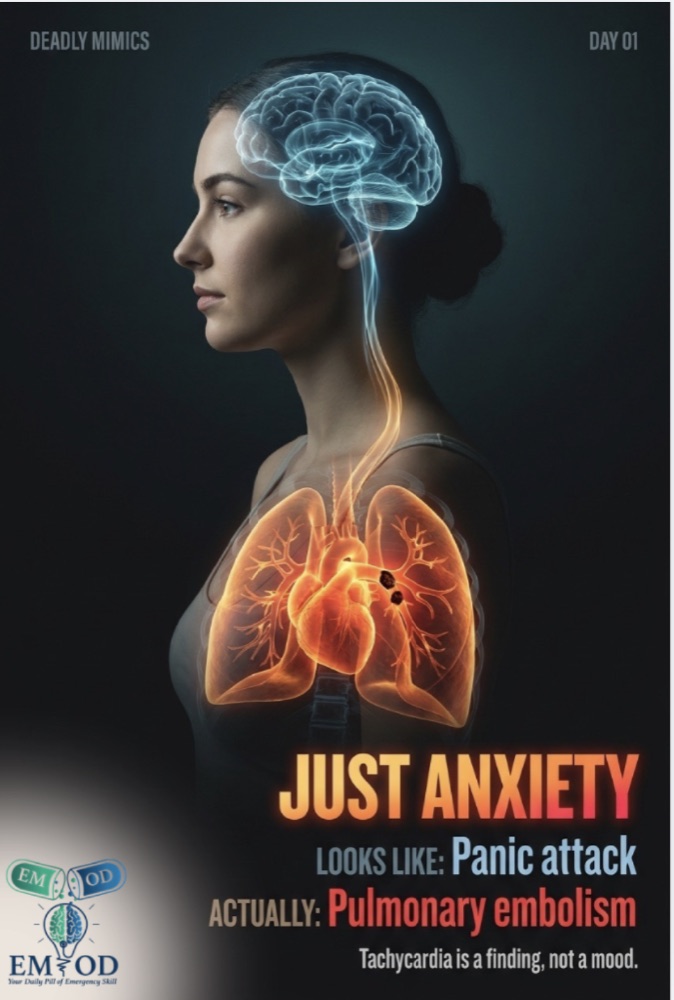
LOOKS LIKE: Panic attack · ACTUALLY: Pulmonary embolism Tachycardia is a finding, not a mood.
The case
A 28-year-old woman presents at midnight with chest tightness, breathlessness and a feeling that something terrible is about to happen. She is tearful and hyperventilating. Heart rate 118, respiratory rate 24, saturations 96% on air. Her chest is clear and the ECG shows sinus tachycardia. She started the combined oral contraceptive pill three months ago. She tells the triage nurse she has been under stress at work, and by the time she reaches a cubicle the word "anxiety" is already on the board.
The argument
Pulmonary embolism and panic share almost their entire symptom list: dyspnoea, chest pain, palpitations, tremor, presyncope, and — the detail examiners love and clinicians forget — a sense of impending doom. The overlap is not a coincidence of description. Both conditions activate the same sympathetic response; a patient with a clot in their pulmonary circulation is genuinely frightened, and fear looks like fear whatever is driving it. The crying does not distinguish. The stress at work does not distinguish. A patient can be anxious and embolising, and the anxious presentation of PE is precisely the one that gets discharged.
The cognitive mechanism is anchoring plus premature closure. Anxiety is common, PE is uncommon, and the base rates seduce. Once "she seems panicky" is spoken aloud, every subsequent finding gets read through that lens: the tachycardia becomes part of the panic, the tachypnoea becomes hyperventilation, the normal chest examination becomes reassurance. But a clear chest is the expected finding in PE, and sinus tachycardia is its commonest ECG abnormality — far more common than the S1Q3T3 pattern that trainees are taught to hunt for. Everything about this presentation is behaving exactly as PE behaves.
Two specific errors deserve naming. The first is treating young age as protective. It is not; risk factors matter more than the year of birth. Oestrogen-containing contraception, pregnancy and the postpartum period, recent surgery or immobilisation, long-haul travel, malignancy and previous venous thromboembolism each move the pre-test probability, and a 28-year-old on the pill is not a low-risk patient by virtue of being 28. The second is using the diagnosis of anxiety as a diagnosis of first impression. In a tachycardic patient, anxiety is a diagnosis of exclusion. That does not mean every anxious patient needs a CT pulmonary angiogram — it means the tachycardia must be explained, or the patient must genuinely satisfy a validated rule-out strategy, before the benign label is allowed to end the encounter.
The discriminator, then, is not how the patient looks. It is whether anyone asked why the heart rate is 118 and stayed unsatisfied with "anxiety" as the answer. Unexplained tachycardia is a finding, not a mood — and a heart rate that fails to settle as the patient calms is the single feature that should reopen the case.
The evidence
ESC 2019 Guidelines on the diagnosis and management of acute pulmonary embolism (Konstantinides et al., European Heart Journal). The current diagnostic framework: establish pre-test probability first, with a validated score or structured gestalt, and let the probability determine the pathway — D-dimer for the non-high-probability patient, imaging for the high. Testing out of sequence is what generates both missed PEs and unnecessary scans.
PERC — Pulmonary Embolism Rule-out Criteria (Kline et al., Journal of Thrombosis and Haemostasis, derivation 2004; multicentre validation 2008). Derived and validated to identify patients in whom the risk of PE is so low that testing causes more harm than it prevents. The PROPER randomised trial (Freund et al., JAMA 2018) subsequently supported a PERC-based strategy in low-risk European emergency department patients.
ACEP Choosing Wisely, on the same theme:
"Avoid CT pulmonary angiography in emergency department patients with a low-pretest probability of pulmonary embolism and either a negative Pulmonary Embolism Rule-Out Criteria (PERC) or a negative highly sensitive D-dimer."
The rule-out pathway is the answer to the obvious objection — "if we chase every tachycardia we will scan everyone." We will not. The tools exist so that the anxious patient can be worked up proportionately rather than either scanned reflexively or dismissed reflexively.

The tool
Wells score and PERC — in that order
What Wells was derived on. Ambulatory and emergency patients with clinically suspected PE, producing a pre-test probability that dichotomises into "PE unlikely" and "PE likely" (the Christopher study approach, JAMA 2006, paired the unlikely group with D-dimer testing). Its most criticised component — "PE is the most likely diagnosis" — is subjective, which is exactly why it must be applied before the anxiety label has anchored.
What PERC was derived on. Emergency department patients whom the clinician had already judged low risk. The eight criteria include age under 50, heart rate under 100, and oxygen saturations of 95% or above.
Who PERC explicitly excludes. Anyone not already low risk by gestalt or score. PERC is not a screening test to be run on every breathless patient; applied to a moderate- or high-probability patient it will miss PEs, because it was never designed for them. Note also what the criteria do to today's patient: a heart rate of 118 and oestrogen use each fail PERC on their own.
What it is sensitive for. In the low-risk population it was validated on, a negative PERC brings the probability of PE below the threshold at which testing helps.
What it cannot do. It cannot rescue a wrong gestalt. If the clinician's low-risk judgement was itself the product of anchoring on anxiety, PERC inherits the error. The rule follows the probability estimate; it does not replace it.
When it really is benign
Panic attacks exist, they are common, and most breathless frightened young patients in an emergency department are not embolising. The features that genuinely support the benign diagnosis: a previous history of identical panic episodes with a documented pattern; symptoms that resolve fully, including normalisation of the heart rate and respiratory rate, as the patient settles; no VTE risk factors; and a PERC-negative assessment made after a genuinely low-risk gestalt. A patient whose observations are normal at discharge, whose episode matches her known pattern, and who fails no rule-out criterion can go home safely.
Safety-netting is still owed, and it should be specific: return immediately if the breathlessness comes back at rest, if there is chest pain on breathing, haemoptysis, leg swelling, or fainting — named symptoms, not "come back if worse". Document the resolved observations. A normal set of discharge vitals is the strongest sentence in the whole record.
References
- Konstantinides SV et al. 2019 ESC Guidelines for the diagnosis and management of acute pulmonary embolism. European Heart Journal 2020.
- Kline JA et al. Clinical criteria to prevent unnecessary diagnostic testing in emergency department patients with suspected pulmonary embolism. Journal of Thrombosis and Haemostasis 2004.
- Kline JA et al. Prospective multicenter evaluation of the pulmonary embolism rule-out criteria. Journal of Thrombosis and Haemostasis 2008.
- Freund Y et al. Effect of the Pulmonary Embolism Rule-Out Criteria on subsequent thromboembolic events among low-risk emergency department patients: the PROPER randomized clinical trial. JAMA 2018.
- Wells PS et al. Derivation of a simple clinical model to categorize patients' probability of pulmonary embolism. Thrombosis and Haemostasis 2000.
- van Belle A et al (Christopher Study Investigators). Effectiveness of managing suspected pulmonary embolism using an algorithm combining clinical probability, D-dimer testing, and computed tomography. JAMA 2006.
- American College of Emergency Physicians. Choosing Wisely recommendation on CT pulmonary angiography in low-pretest-probability patients.
3 questions to test yourself on this dose are in the app.